Showing posts with label 1899. Show all posts

Sunday, May 17, 2009

Mae West: Slick Wiley

Raise your hand if you remember MAE WEST's Slick Wiley.
• • Born in Pittsburgh, Pennsylvania in the month of May — — on 17 May 1899 — — Ralf H. Wigger wiggled his name to Ralf Harolde and headed for the Hollywood Hills. Often cast in bit parts, Ralf Harolde racked up nearly 100 motion picture credits between 1920 and 1963.
• • In "I'm No Angel," the slinky five-foot-eleven Easterner played Tira's jealous boyfriend, Slick, who tails her to the hotel where she is romancing a big spender from Dallas. When Slick knocks him unconscious and robs him, he puts Tira in a compromising position.
• • Hal Erickson describes the screen veteran briefly in his excellent All Movie Guide: The best way to physically describe actor Ralf Harolde is to note his striking resemblance to Zeppo Marx. However, Harolde projected a far more sinister image than Marx, beginning with his film debut as the "gentlemanly" villain in Bebe Daniels' "Dixiana" (1930). Often cast as a low-life crook, he played an escaped convict who hid behind his wife and children in "Picture Snatcher" (1933) and the erstwhile kidnapper of little Shirley Temple in "Baby Take a Bow" (1934). He also showed up in such minor roles as a Tribunal prosecutor in "Tale of Two Cities" (1935) and a tuxedoed society gangster in Laurel and Hardy's "Our Relations" (1936).
• • Hal Erickson adds: Ralf Harolde's film career came to a screeching halt when, in 1937, he was involved in a traffic accident that resulted in the death of fellow actor Monroe Owsley. When Ralf re-emerged on screen in 1941, it was clear that the tragedy had taken its toll: Harolde's facial features had taken on a gaunt, haunted look, and his hair had turned completely white. Remaining active until the mid-1950s, Ralf Harolde still had a few good screen characterizations left in him — — most notably the sleazy sanitarium doctor in "Murder My Sweet" (1944).
• • Born in 1901, Monroe Owsley was featured in the Mae West vehicle "Goin' to Town" [1935]; often cast as a debauched young playboy, he played Cleo Borden's "husband-by-convenience" Fletcher Colton. Monroe died on 7 June 1937 from a heart attack suffered during a car accident. He was 36 years old.
• • On 1 November 1974, Ralf Harolde died of pneumonia in Santa Monica, California at age 75.

• • Come up and see Mae every day online: http://MaeWest.blogspot.com/
________
Source:http://maewest.blogspot.com/atom.xml

Add to Google
• • Photo: • • Mae West • • none • •
• • Feed — — http://feeds2.feedburner.com/MaeWest
Mae West.

Wednesday, December 10, 2008

Mae West: Graham Avenue

By the late 1890s, MAE WEST's family had moved to the Williamsburg section of Brooklyn.
• • Since John West often found work as a "special policeman" and a bouncer — — jobs that kept him on his feet until very late at night and early in the morning — — he gravitated towards neighborhoods where an efficient mass transit system was already in place. And the long expected operation of trolley cars across the Brooklyn Bridge began in January 1898 with the Graham Avenue line of the Brooklyn Heights Railroad. [The Graham Avenue Line was selected because it carried the largest number of passengers to the bridge in 1898.]
• • Supporting his growing family [which included little Mary Jane/ "Mae" born in August 1893 and baby Mildred born in December 1898] forced John West into odd employment situations — — for instance, as a watchman who was hired in 1899 to patrol Grand Avenue. One of the burglars he apprehended was stealing from the Belvidere Bicycle Company on Grand Avenue; John West ran to the corner of Grand and Graham Avenue where he got assistance from Officer Golden at the Stagg Street Precinct to help arrest the brazen 24-year-old thief.
• • But one of her father's jobs gave flight to Mae's career aspirations.
• • In November 1901 the superb Folly Theatre opened on Debevoise Street and Graham Avenue within walking distance of the West household. John West was hired as a bouncer and he soon got on speaking terms with the vaudevillians who performed there. And his loved ones enjoyed a free pass to many features. Matilda took young Mae to shows at this flagship of Hyde and Behman's Brooklyn houses. Measuring 36' by 80', the stage could accommodate the most elaborate scenery. The main floor of the auditorium had 850 seats and the balcony held an additional 600 chairs. Three ceiling paintings, floral artwork, and other decorations added to the splendor and luxuriousness of this playhouse. When the crowd applauded an actress, Matilda told Mae that she could be important like that. A star was born on Graham Avenue.
• • Graham Avenue was named for John and James Lorimer Graham who were land-jobbers in Williamsburg during the first part of the nineteenth century. Jobbers sought to purchase lots for the sole purpose of making a profit. Look who we New Yorkers have named our streets after: profiteers who drive up our real estate prices. Just once though I'd like to see a local street named for Mae West, wouldn't you?
• • Come up and see Mae every day online: http://MaeWest.blogspot.com/

________
Source:http://maewest.blogspot.com/atom.xml

• • Photo:
• • Mae West • • in Mae's footsteps • •
Mae West.

Friday, November 21, 2008

Mae West: Who's Who

Who's Who, that venerable volume established in 1899 and updated once a year, celebrated its 110th birthday with a toast to MAE WEST.
• • Their boring press release is far too tedious and self-congratulatory to be reprinted here in its entirety — — but the gist is that their editors "compiled a collection of facts, letters, and other interesting documents providing a fascinating view of the history and cultural impact of Who's Who in America(R)" — — to give added value to the 2009 edition.
• • Looking back on its own historical quip-cream and snippets for the past century, their commemorative edition documents the flattery they received from noteworthy individuals.
• • According to the publisher, "This historical retrospective, appearing as a 16-page color section in the front of the new edition, includes: advertisements and published cartoons featuring Who's Who in America(R), such as a Cuban cigar advertisement from 1955, Beetle Bailey, and Doonesbury; quotes about the book from such famous Americans as Mae West; a letter to the editor from former President Harry Truman, as well as one from magician Harry Houdini; and editorial reviews of the first edition from 1899. Also included are biographies of interesting, one-time listees William "Buffalo Bill" Cody, explorer Hiram Bingham, and the author of The King and I, Anna Leonowens. ...

• • Come up and see Mae every day online: http://MaeWest.blogspot.com/
________
Source:http://maewest.blogspot.com/atom.xml

• • Photo:
• • Mae West • • none
• •

Mae West.

Friday, May 23, 2008

Mae West: Brooklyn Bridge

It opened in May 1883 and by New Year's Eve 1899 MAE WEST was selling it — — that is, her character Peaches O'Day was doing the dirty deed as a plot point in "Every Day's a Holiday." As the venerable Brooklyn Bridge celebrates its 125th anniversary, a firestorm of articles will be appearing. This feature by Richard Haw mentions Mae West.
• • . . . The famous, as well as the anonymous, also have made their way to the bridge. Before he became Mr. New York, Frank Sinatra was Mr. Brooklyn (Bridge), singing and dancing his way over the span in a couple of movies. Elsewhere on the silver screen, Mae West and Bugs Bunny sold the bridge to gullible tourists, Tarzan clambered up its cables, George Raft jumped off it, and Dorothy, the Scarecrow, the Cowardly Lion and the Tin Man quick-stepped their way across in "The Wiz."
• • We look at the beautiful span across the water, and perhaps it gazes back. Ever since it opened in 1883, the Brooklyn Bridge has stood stoically as an ever-present witness to 125 years of New York City history, in all its strange and bizarre glory.
• • The bridge's real value is its ability to tell both sides of our story: the rise and development of a great city, yet also our quirky folkways. . . .
— — Excerpt: — —
• • Article: "Built to connect two boroughs, it's a bridge to our past"
• • Written by: Richard Haw, author of "Art of the Brooklyn Bridge: A Visual History"
• • Published in: The New York Daily News — — www.nydailynews.com
• • Published on: 22 May 2008
• • Come up and see Mae every day online: http://MaeWest.blogspot.com/
________
Source:http://maewest.blogspot.com/atom.xml

• • Photo:
• • Mae West • •
1938 • •

Mae West.

Friday, October 19, 2007

Mae West: St. Louis

Actor John Huston, enthralled by Diamond Lil's rendition of "Frankie and Johnny" on Broadway in 1928, gave MAE WEST a copy of this fascinatin' news clipping that had appeared in the St. Louis-Post Dispatch on the 19th of October in 1899.
• • Note: Frankie Baker's weapon was a knife — — not a noisy gun [in the newspaper account].
• • The unnamed third party in this fatal love triangle was Alice Pryar, an 18-year-old prostitute [nine years younger than Frankie Baker]. In the song, the "other woman" is called Nellie Bly.


• • Amid the Suffering . . .
• •
• • .Allen Britt's brief experience in the art of love cost him his life. He died at the City Hospital Wednesday night from knife wounds inflicted by Frankie Baker, an ebony hued cake-walker. Britt was also colored. He was seventeen years old. He met Frankie at the Orange Blossom's ball — — and was smitten with her. Thereafter they were lovers.
• • In the rear of 212 Targee Street lived Britt. There his sweetheart wended her way a few night's ago and lectured Allen for his alleged duplicity. Allen's reply was not intended to cheer the dusky damsel and a glint of steel gleamed in the darkness. An instant later the boy fell to the floor mortally wounded.
• • Frankie Baker is locked up at the Four Courts.
• • The City Hospital's account was quite different.
• • According to a doctor, Allen Britt died at 2:15 AM on the 19th of October 1899 with a bullet wound of the liver. He lived seventeen years in the city [St. Louis, Missouri] before his death. He was born in Kentucky.
• • Allen Britt's occupation at the time of entering the emergency room was given as "job worker."
• • George and Nancy Britt, Allen's parents, buried their son in St. Peter's Cemetery on 22 October 1899.
• • Why was the ballad called "Frankie and Johnny" and not "Frankie and Allen"?
• • When John Huston interviewed her in 1929, Nancy Britt was still living at 32 Johnson [formerly Targee] Street in St. Louis. Mrs. Britt had asked the composer, she claimed, not to use her son's name. Perhaps because a "john" is a customer of a prostitute, Johnny was substituted.
• • These details were provided to the Mae West blog exclusively by NYC historian LindaAnn Loschiavo, author of the play "Courting Mae West." If you copy this info, please affix this CREDIT LINE in full.
• • Tring to escape notoriety, Frankie Baker moved around. She wound up at the Eastern Oregon State Hospital. According to news accounts, she was eventually committed to this facility, where she died shortly thereafter on 10 January 1952.
• • Come up and see Mae every day online: http://MaeWest.blogspot.com/
________
Source:http://maewest.blogspot.com/atom.xml

• • Cartoon: • • Mae West as Diamond Lil/ Lady Lou • • 1933 • •

Mae West.

Monday, July 02, 2007

Mae West: Hammerstein's

In June 1914 Willie Hammerstein died and, oh, what an angel he had been to MAE WEST. In 1912 and 1913, Hammerstein booked the teenager for eleven week-long engagements at his vaudeville attraction situated in Longacre [later Times] Square. The location was popularly known by New Yorkers as "the corner."
• • In 1899, Oscar Hammerstein built his fifth showplace the Victoria Theatre at the corner of West 42nd Street and Seventh Avenue. Stars like MAE WEST, Will Rogers, W.C. Fields, Charlie Chaplin, Al Jolson, Eddie Cantor, Buster Keaton, Harry Houdini, Evelyn Nesbit, and Eva Tanguay were among the thousands of performers who made Hammerstein's Victoria the vaudeville "nut house" of Times Square.
• • Mainly, it was Oscar's son Willie Hammerstein who deserves credit for the playhouse's 17-year successful run. Willie had the knack for booking crowd-pleasing stagebills along with a peacock's genius for public relations.
• • In 1900, Oscar Hammerstein built his sixth theatre the Republic Theatre next door to his Victoria Theatre on West 42nd Street and leased it to the immensely successful producer, David Belasco. Retaining roof rights of both buildings, Oscar opened Hammerstein's Roof Garden above both theatres. Mae West often played at "the Roof" as well.
• • Come up and see Mae every day online: http://MaeWest.blogspot.com/
________
Source:http://maewest.blogspot.com/atom.xml
Add to Google
• • Photo: • • Mae West venue • • Hammerstein's Victoria • •
Mae West.

Sunday, June 17, 2007

Mae West: Harvey Brooks

MAE WEST 's composer Harvey Brooks died in June, so let's take a moment to meditate on his angel music.
• • Born in 1899 in Philadelphia, Pennsylvania, Harvey Brooks wrote all the numbers that Mae fans associate with her successful film "I'm No Angel."
• • His song compositions included "I'm No Angel," "They Call Me Sister Honky Tonk," "That Dallas Man," and "I Found a New Way to Go to Town."
• • The songwriter a member of ASCAP died in Los Angeles at age 69 on 17 June 1968.
• • Come up and see Mae every day online: http://MaeWest.blogspot.com/
________
Source:http://maewest.blogspot.com/atom.xml
Add to Google
• • Photo: • • Mae West • • none • •
Mae West.

Sunday, April 29, 2007

Mae West: Duke Ellington

On the birthday of Edward Kennedy "Duke" Ellington - - born 29 April 1899 in Washington, D.C. - - it's interesting to recall how hard MAE WEST had to fight with Paramount Pictures to get the musician into her film "Belle of the Nineties."
• • Always the champion of the African-American talents she met, Mae insisted that the studio hire him to play and also appear in the movie. The studio didn't want to hire Ellington, at first, because they said the famed Cotton Club headliner would be "too expensive." When Paramount finally gave in to Mae, they agreed to let Ellington and his orchestra play - - however, they insisting on having all white musicians on the set.
• • Mae West marched into the head office at Paramount and said, "White men can't play black music in my picture!" And it was done. Ellington and his band were used and shown onscreen, thanks to Mae (who refused to budge on this).
• • Hollywood's censors did have the final say, though; they refused to let Mae appear next to the musicians in the same scene.
• • "Belle of the Nineties" was in production from 19 March 1934 until June 1934.
• • During the 1920s, Mae West met Duke Ellington at Owney Madden's speakeasy. An autographed photo of Mae given to the "Duke" was among his most cherished possessions.
• • Come up and see Mae every day online: http://MaeWest.blogspot.com/
________
Source:http://maewest.blogspot.com/atom.xml

Add to Google

• • Photo: • • Mae West • • none • •

Mae West.

Wednesday, November 01, 2006

Mae West: Champ Segal

Mae West knew some shady characters — — and Champ Segal had a special place in his heart for Mae.
• • Sunset Boulevard during the 1940s was where all the guys and dolls nightclubbed, gambled, brawled, and minted gossip. Harry "Champ" Segal, a former boxer and bookie, ran a little joint on the Strip that was disguised as a barbershop (not unlike the bookmaking and loan-sharking operation he ran in a midtown Manhattan barbershop). Nearby in Los Angeles, Champ's bosom buddy Benjamin Siegel had an office at the corner of Sunset and Vine, although Bugsy did not take walk-ins.
• • Although Champ Segal never won a title in the ring, the dapper hoodlum managed many prizefighters — — Charley "Phil" Rosenberg, Ace Hudson, Phil Kaplan, Freddy Beshore, Sal Belloise — — and had 118 fights himself, 78 of which he won by knock-outs.
• • Mae West enjoyed going to boxing matches and she got a kick out of the nattily dressed wheel-dealer. Champ Segal admired Mae and included anecdotes about their friendship in his book.
• • Born in Harlem in 1899, by 1917 Harry had an arrest record for possessing narcotics.
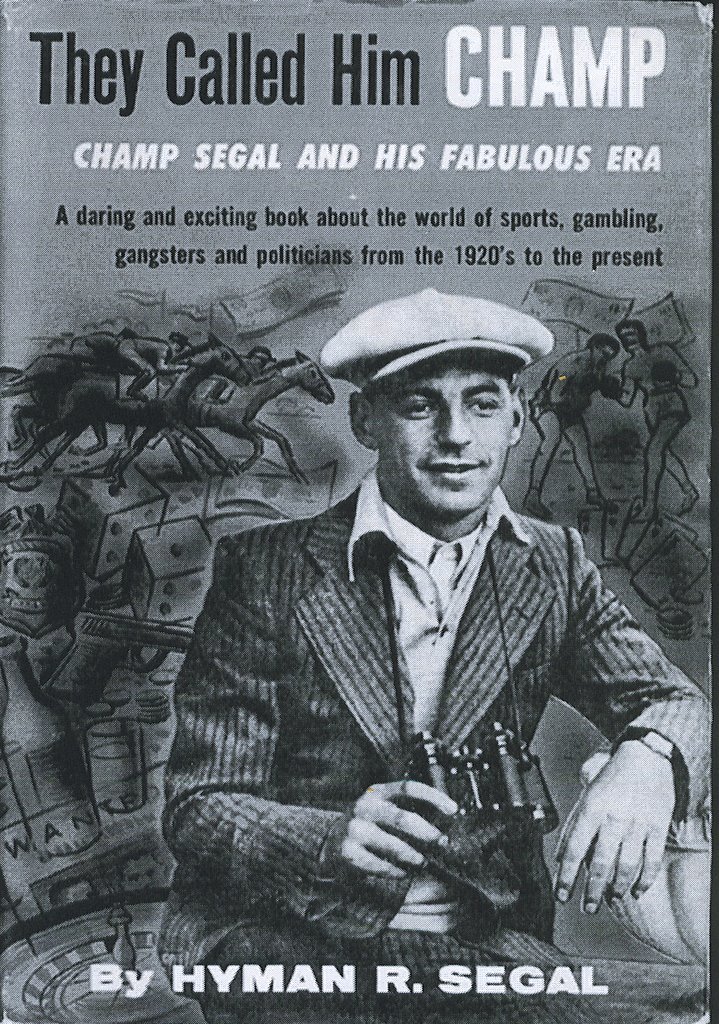
• • In 1927 he was locked up in connection with a homicide at his restaurant on St. Nicholas Avenue and West 112th Street. Throughout his hair-raising past he must have been taking notes for this biography that his brother published in November 1959, which was called "a daring and exciting book about the world of sports, gambling, gangsters, and politicians from the 1920s to the present day." Though Champ was as solitary a figure as Charlie Chaplin, astonishingly he did have a brother; Hyman's name appeared on the dustjacket: They Called Him Champ: the Story of Champ Segal and His Fabulous Era by Hyman R. Segal [NY: Citadel Press, 1959; 480 pages with b/w photographs].
• •
Mae West, Texas Guinan, Al Capone, Legs Diamond, Bugsy Siegel, Primo Carnera, Mayor Jimmy Walker — — they're all inside.
• • November 1959 there was a book launch at Lindy's Restaurant with his buddies from Stillman's Gym.
• • That was a better November than nine years earlier for Champ Segal. On 1 November 1950 the 51-year-old bookie was arrested outside of the Park-Sheraton Hotel, where he'd been living. This was part of a Times Square round-up of gangsters by the police. Champ Segal slipped through the grasp of the city's legal eagles, however. The colorful con man was still being indicted in 1974 when he was age 77.
• • Come up and see Mae every day online: http://MaeWest.blogspot.com/
________
Source:http://maewest.blogspot.com/atom.xml

• • Photo:
• • Mae West's pal • •
1967 • •

Mae West.