skip to main |
skip to sidebar
MAE WEST had some unpleasant encounters with A. Toxen Worm. One headline dated for Wednesday, 4 May 1921, read "Mae West Foiled by Toxen."
• • Yes, there really was a gentleman named A. Toxen Worm. Perhaps Mae was thinking of him when she wrote this line for "Belle of the Nineties" — — "Remember, I'm a lady, you worm." Though his Christian name was Conrad, he delighted in the odd pairing of his Danish surname "Worm" with his two middle names Aage and Toxen. No one could forget a sinister moniker like that.
• • Conrad Henrik Aage Toxen Worm [1866 — 12 January 1922] • •
• • Born in Denmark in 1866, at the turn of the century he was a press agent whose clients included the actor James O'Neill (father of Eugene). Worm emigrated to the USA. In 1910, the ambitious 44-year-old began working for the Shubert Brothers as a manager and a highly resourceful press agent. His command of English was fluent enough to enable Worm to write for the Shubert publication, New York Review.
• • In 1921, the officious 55-year-old bachelor was lying in wait for Mae West in Boston at the Shubert Theatre and there was a showdown. The Worm turned victorious.
• • In 1922, The New York Times announced the death of this unmarried man.
• • "A. Toxen Worm Dead; Well-Known Theatrical Agent Dies of Apoplexy in Paris" • •
• • The Times wrote: A. Toxen Worm, associated for twenty years with the Shubert theatrical enterprises, died Friday in Paris of apoplexy, according to word received yesterday by his counsel, Phelan Beale, in this city. He had gone abroad on a vacation, following a term in charge of the Shubert interests in Boston. Surviving are several brothers and a niece, Miss Ella Scheel of Copenhagen.
• • Source: The NY Times; published on 00day, 15 January 1922.
• • Come along as we revisit the scintillating scene of the shimmy that never was.
• • Boston Nearly Sees "Shimmy Dance" • •
• • "Mae West Foiled by Toxen Worm— Lights Turned Off" • •
• • Boston, May 4 — — Bostonians almost saw the "shimmy" for the first time at the Shubert Saturday night. The censors long ago put the ban on this dance and have kept it on, so that while it has often been promised, it has never been seen.
• • When the news got around among the members of the "Whirl of the Town" that the show was to close, Mae West, the dancer, passed the word around she was going to give those in the house one fine demonstration of the "shimmy" dance at the final performance.
• • A. Toxen Worm heard the report and, when the time drew near for this little piece of business, he took up a position near the light switches backstage.
• • When Mae was all set for the finale, Mr. Worm passed the word to the electrician and the stage was suddenly thrown into darkness. Mae may have "shimmied," but if she did she was the only one that knew about it. However, she was much Incensed and was on her way to complain to Worm — — when she discovered that he was the one who had foiled her.
• • Source: Item in Variety; published on Wednesday, 4 May 1921.
• • On Tuesday, 4 May 1886 • •
• • On Tuesday, 4 May 1886 the black composer Shelton Brooks was born. Mae and Beverly performed his dance novelty "Walking the Dog" when they toured with their act "Mae West and Sister." In her 1928 Bowery melodrama "Diamond Lil," Mae performed his jaunty song "Where Has My Easy Rider Gone?" and the number would be reprised in "She Done Him Wrong" [filmed in 1932].
• • On Saturday, 4 May 1935 • •
• • A Los Angeles Times columnist noted on Saturday, 4 May 1935, that the news about Mae West's secret marriage to Frank Wallace had "chased Hitler, the NRA, and the quintuplets off the front page of every newspaper in America for two weeks."
• • On Sunday, 4 May 1969 • •
• • Reporter Whitney Bolton wrote an article, a first person remembrance: "Critic Impressed by Mae West Role of Siren at Seance." Bolton had attended one of Mae's backstage seances and his piece was published in the Philadelphia Inquirer in its weekend edition on Sunday, 4 May 1969.
• • Overheard in Hollywood • •
• • They figured that, because of those ultra-sexy things she did on the stage. Will Hays would frown upon Mae West on the screen.
• • In Her Own Words • •
• • Mae West said: "It takes two to get one in trouble."
• • Quote, Unquote • •
• • The May Mann papers mentioned Mae West.
• • During her summer at college, May Mann began to pursue an interview with Mae West. According to May, this stunning star evaded the press in fine Garbo fashion. It was May's dream to actually go "up and see [her] some time," and write an exclusive on it. According to the editor of the Standard-Examiner, May got the interview "after two years of repeated effort . . . after considerable maneuvering, near appointments and finally by pulling all the 'strings of power and pull' in Hollywood" (Mae West article, box 9, fd. 5, editor's note). Through her contact with Miss West's personal representative, May became one of the five women to have a personal interview with Mae West . . . .
• • Source: Item in the May Mann Papers, 1930 —1982
• • The Mae West Blog celebrates its 10th anniversary • •
• • Thank
you for reading, sending questions, and posting comments during this
past decade. The other day we entertained 3,497 visitors. And we reached a
milestone recently when we completed 3,100 blog posts. Wow!
• • By the Numbers • •
• • The Mae West Blog was started ten years ago in July 2004. You are reading the 3170th blog post.
Unlike many blogs, which draw
upon
reprinted
content
from
a
newspaper
or
a
magazine
and/
or
summaries,
links,
or
photos,
the
mainstay
of
this
blog
is
its
fresh
material
focused
on
the
life
and
career
of
Mae
West,
herself
an
American
original.
•
•
Come
up
and
see
Mae
every
day
online:
http://MaeWest.blogspot.com/
________
Source:http://maewest.blogspot.com/atom.xml
Mae West
• • Photo: • • Mae West • • "Whirl of the Town," 1921 • •
• • Feed — — http://feeds2.feedburner.com/MaeWest
NYC Mae West
Matilda West urged MAE WEST to put together a sister act with Beverly in 1916.
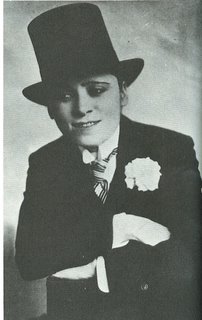 • • In July of that year "Mae West and Sister" appeared at Keith and Proctor's Fifth Avenue Theatre [27-31 West 28th Street, between Fifth Avenue and Broadway]. On the same bill was a Fatty Arbuckle film, a Keystone comedy.
• • Mae and Beverly's vaudeville turn included popular ragtime songs by black composers such as Shelton Brooks, numbers that Mae had previously found success with such as "They Call It Dixieland" and "Walkin' the Dog," their finale, for which Mae appeared in a man's tuxedo and top hat and Beverly wore feminine frills.
• • But the New York City critics remained dismissive, underwhelmed, and even contemptuous.
• • Variety, 7 July 1916 • •
• • Sime Silverman sniffed and snorted behind his keyboard like an overheated carriage horse. "Unless Miss West can tone down her stage presence in every way," he sneered, "she just might as well hop right out of vaudeville and into burlesque." And if the unabashed Brooklynite was going to continue to be so disarmingly aggressive, Sime scolded Mae by suggesting that she should get up onstage next time in "men's dress altogether."• • Come up and see Mae every day online: http://MaeWest.blogspot.com/
________
Source:http://maewest.blogspot.com/atom.xml
Mae West
• • Photo: • • Mae West • • 1916 • •
• • Feed — — http://feeds2.feedburner.com/MaeWestNYC
Mae West.

MAE WEST always said, "The best way to behave is to misbehave." And she meant it. 
• • One of the many playhouses Mae West appeared in, with her seductive showmanship of comedy mixed with the blues and ragtime music by trendy black composers, was the American Music Hall (located at 260 West 42nd Street, New York, NY). Built to seat over 2,000 ticket-holders, this was one of the first theatres to open in the "new" theatre district on 42nd Street. Various managers, including William Morris (founder of the talent agency, an outfit that represented Mae during the 1940s and 1950s), tried to make a success of an auditorium handicapped by its "remote" Eighth Avenue location.
• • When this hopeful haven for the perfoming arts opened in the month of May — — on 22 May 1893 — — it was known as the American Theatre. Eventually, it added a popular top floor feature, an additional room known as the American Roof.
• • March 1912 was Mae's first performance at the American Roof.
• • When the 21-year-old trouper returned to the American Roof Theatre in January 1915, she was the headliner even though Guido Deiro was in the line-up. In Mae West, An Icon in Black and White, biographer Jill Watts writes: For this appearance, in addition to her trademark "I've Got a Style All My Own," she performed several characterizations and Shelton Brooks's [sic] "Balling the Jack." The New York Clipper rated it Mae's best number, noting it "won her the desired applause." Sime remained unconverted. He felt that Deiro, also on the bill, should have occupied the featured spot, noting that Mae had "repressed her exuberance somewhat, but could stand a trifle more repression" [Variety, 9 January 1915].
• • • • Note: The term "balling the jack" was originally a conductor's way of saying a train was moving at top speed; in black slang, the locomotive carrying the load was the jack[ass]. However, due to the popularity of the song "Balling the Jack," one of the hits from the Ziegfeld Follies in 1913, by the 1920s, this expression had come to mean any wild, rapid, or all-out effort. And though Jill Watts is a very careful researcher, it was actually the African-American team of composer Chris Brown [1879 — 1949] and lyricist James Burris who deserve credit for the song "Balling the Jack," which cleverly offers step-by-step dance instructions in the lyrics.
• • A few years before Mae performed here, Sophie Tucker was engaged as the headliner by the management of 260 West 42nd Street. And her exuberance and magnetism was not appreciated by the critics who reviewed her January 1910 show. Was Sophie misbehaving or simply putting on a good show?
• • REVIEW: Sophie Tucker at the American Music Hall, New York, January 1910
• • 'Sophie Tucker made her usual pronounced hit and sang seven songs in all. These included, "If You Want a Little Bit of Love Just Send for Me," "Don't Waltz So Fast, Honey," "That Yiddisha Rag," "Cubanola Glide" and "Wild Cherry Rag." Miss Tucker at one time had a big chance of becoming a musical comedy artiste of real note, but she missed it. Her present method — — though it wins great outbursts of applause from a certain class of vaudeville goers — — is too rough and "loud" to be classed as artistic. The magnetism is there and the ability to sing "coon" numbers exuberantly. But the method is too broad and at times is almost offensively vulgar in its apparent double entendre of rendition of certain phrases and songs.'
• • Review published in The New York Dramatic Mirror, New York [on Saturday, 18 January 1910, p. 18d]• • • • • • • • • • • • • • • • • • • • • • • • • • • • • • • • • • • • • • • •
• • You are invited to the Annual Mae West Birthday Tribute to hear the songs of Shelton Brooks (and others) performed live.
• • WHEN: 10:00 PM on Saturday, 14 August 2010 — — one night only
• • WHERE: ACTORS TEMPLE, 339 West 47th Street, New York, NY 10036 [where SOPHIE TUCKER became one of their first vaudeville members in 1923]
• • WHO: MAE WEST [Anne Marie Finnie] and SOPHIE TUCKER [Maggie Worsdale], presented and introduced by playwright LindaAnn Loschiavo
• • WHAT ELSE: Shimmy lessons, raffle prizes, goodies, and a chance to win deluxe European scarves featuring MAE WEST’s quotes.
• • SUBWAYS: IND: C, E to West 50th Street station; BMT: N, R, W to West 49th Street station — — exit on the West 47th Street side
• • VIP service available. Please inquire.• • CONTACT: Miss Sophie — Email: worsdale (at) aol.com — URL: www.thegaudygirls.com• • • • • • • • • • • • • • • • • • • • • • • • • • • • • • • • • • • • • • • •• •
Come up and see Mae every day online: http://MaeWest.blogspot.com/________
Source:http://maewest.blogspot.com/atom.xml
Mae West
• • Photo: • • Mae West appeared in this theatre in 1912 and 1915 • •
• • Feed — — http://feeds2.feedburner.com/MaeWestNYC
Mae West.
MAE WEST adored ragtime. She performed a rag that she especially loved onstage in "Diamond Lil" and its Hollywood counterpart "She Done Him Wrong."  The lyricist and composer of this song — — "I Wonder Where My Easy Rider's Gone" — — was Shelton Brooks [4 May 1886 — 6 September 1975], who published it in 1913.
• • Born in Canada, Shelton Brooks moved to Detroit in 1901 with his family; his parents were Native American and Black. His father was a preacher and Shelton and his brother would play the organ during services.
• • Surrounded by music, Shelton was 24 years old when he wrote his first big hit in 1910 — — "Some of These Days" — — using his own lyrics. He had already debuted the song in his own variety act when Sophie Tucker's maid introduced both him and the tune to Sophie, then touring through The Windy City. The vaudevillian, who would eventually style herself as "the Last of the Red Hot Mamas," made this 1910 composition her very own theme song.
• • Let's move three years forward to 1913.• • "I Wonder Where My Easy Rider's Gone" — — lyrics • •
• • Published by Will Rossiter in Chicago in 1913, the song combined horse racing and romance with a blues touch.  Though Mae West's rendition [which can be seen on YouTube and endlessly replayed] has given people the idea that she was the first to sexualize the lyrics, that is simply untrue. In fact it was Sophie Tucker, who first introduced this number in vaudeville, who performed it with well-timed sly winks and a veneer of naughty innuendo — — especially when she would sing a suggestive line such as "To be on any horse that jockey's on ...." Here's an excerpt.
• • The lyrics tell of a Susie Johnson who bets on a horse race using a tip from Jockey Lee, who subsequently runs off with her money.
• • First verse:
• • • Miss Susie Johnson is a crazy as can be
• • • About that easy riding kid they call Jockey Lee.
• • • Now don't you think it's funny, only bets her money
• • • In the race friend jockey's goin' to be.
• • • There was a race down at the track the other day,
• • • And Susie got an inside tip right away
• • • She bet a "hundred to one" that her little "Hon"
• • • Would bring home all the "mon"!
• • • When she found out "Jockey" was not there,
• • • Miss Susie cried out in despair
• • Chorus:
• • • I wonder where my easy rider's gone today
• • • He never told me he was goin' away.
• • • If he was here he'd win the race
• • • If not first he'd get a "place"
• • • Cash in our winnings, on a "joy-ride" we'd go, right away
• • • I'm losing my money that's why I am blue.
• • • To win a race, Lee knows just what to do.
• • • I'd put all my junk in pawn,
• • • To be on any horse that jockey's on.
• • • Oh, I wonder where my easy rider's gone ....• • From 1910 onward, Shelton Brooks watched his fortunes rise along with Sophie's. His 1916 instrumental tune "Walkin' The Dog" [which inspired a dance that first swept dancehall-crazed New York City, and then the rest of the country] was performed by Mae West in male drag during the shows she did with her sister Beverly in 1916.
• • In 1917, Brooks had another hit with "The Darktown Strutter's Ball," for which he wrote both the words and music.
• • • • • • • • • • • • • • • • • • • • • • • • • • • • • • • • • • • • • • • •
• • You are invited to the Annual Mae West Birthday Tribute to hear the songs of Shelton Brooks (and others) performed live.
• • WHEN: 10:00 PM on Saturday, 14 August 2010 — — one night only
• • WHERE: ACTORS TEMPLE, 339 West 47th Street, New York, NY 10036 [where SOPHIE TUCKER became one of their first vaudeville members in 1923]
• • WHO: MAE WEST [Anne Marie Finnie] and SOPHIE TUCKER [Maggie Worsdale], presented and introduced by playwright LindaAnn Loschiavo
• • WHAT ELSE: Shimmy lessons, raffle prizes, goodies, and a chance to win deluxe European scarves featuring MAE WEST’s quotes.
• • SUBWAYS: IND: C, E to West 50th Street station; BMT: N, R, W to West 49th Street station — — exit on the West 47th Street side
• • VIP service available. Please inquire.• • CONTACT: Miss Sophie — Email: worsdale (at) aol.com — URL: www.thegaudygirls.com• • • • • • • • • • • • • • • • • • • • • • • • • • • • • • • • • • • • • • • •• •
Come up and see Mae every day online: http://MaeWest.blogspot.com/________
Source:http://maewest.blogspot.com/atom.xml
Mae West
• • Photo: • • Mae West's songwriter Shelton Brooks; Sophie Tucker in 1913 • •
• • Feed — — http://feeds2.feedburner.com/MaeWestNYC
Mae West.
MAE WEST adored ragtime. She once told an interviewer about grooving very early to "the black man's sound." Whether she was imitating the sultry Shimmy she watched in a Chicago club or swinging to the latest jam she heard in Harlem, Mae's musical taste was in formation: "we copied it because it was the greatest. [Black people] had been developing it for years."
• • In 1928, she performed a rag that she especially loved onstage in "Diamond Lil" and its Hollywood counterpart "She Done Him Wrong" [1933]. The lyricist and composer of this song — — "I Wonder Where My Easy Rider's Gone" — — was Shelton Brooks [4 May 1886 — 6 September 1975], who published it around 1913. He was good friends with Mae's maid Bea Jackson; his nickname for her was "Hot Story Telling."
• • Born in Amesburg, Ontario, Canada, Shelton Brooks moved to Detroit in 1901 with his family; his parents were Native American and Black. His father was a preacher and Shelton and his brother would play the organ during services.
• • Surrounded by music, Shelton wrote his first big hit in 1910 — — "Some of These Days" — — using his own lyrics. He had already introduced the song in his own vaudeville act when Sophie Tucker's maid introduced both him and the tune to Sophie. The vaudevillian, who would eventually style herself as "the Last of the Red Hot Mamas," made this number her very own theme song.
• • "Walkin' the Dog" • •
• • His 1916 instrumental tune "Walkin' the Dog" inspired a dance that first swept dancehall-crazed New York City, and then the rest of the country. That year, the variety act "Mae West and Sister" performed "Walkin' the Dog" as their grand finale.
• • A lifelong lover of black culture, Mae's ears were drawn to the relaxed, finger-snappy Shelton Brooks sound.
• • "I Wonder Where My Easy Rider's Gone" — — Shelton Brooks's playful song, which Mae performed in 1933 in her first blockbuster hit film, was also been recorded by a diverse group of song stylists such as Tampa Red & His Hokum Jug Band, Sophie Tucker, Liza Minnelli, Frankie "Half-Pint" Jaxon, Peter Bocage, Kid Thomas Valentine, Le Petit Jazzband de Mr. Morel, and others.
• • On September 6th, Shelton Brooks died in Los Angeles in 1975 when he was 89 years old. He is buried at Rose Hills Memorial Park.• • • • • • • • • • • • • • • • • • • • • • • • • • • • • • • •
• • "I Wonder Where My Easy Rider's Gone" [lyrics] • •
• • • • Miss Susie Johnson is a crazy as can be
• • • • About that easy riding kid they call Jockey Lee
• • • • Now, don't you think it's funny, only bets her money
• • • • In the race friend Jockey's goin' to be
• • • • There was a race down at the track the other day
• • • • And Susie got an inside tip right away
• • • • She bet a hundred to one that her little Hon
• • • • Would bring home all the mon
• • • • When she found out Jockey was not there
• • • • Miss Susie cried out in despair....
• • • • I wonder where my easy rider's gone today
• • • • He never told me he was goin' away
• • • • If he was here he'd win the race
• • • • If not first, he'd get a place
• • • • I never saw that Jockey trailing anyone before
• • • • I'm losing my money, that's why I am blue
• • • • To win a race, Lee knows just what to do
• • • • I'd put all my junk in pawn
• • • • To bet on any horse that Jockey's on
• • • • Oh! I wonder where my easy rider's gone
• • • • Oh! I wonder where my easy rider's gone
• • • • He went to put my brand new watch in pawn
• • • • I see him comin' round that turn
• • • • What a trail that man can burn
• • • • He's gonna win because my dough is on the nose
• • • • Just watch my Jockey's easy rider stance
• • • • He'll hit that home stretch, win it by a mile
• • • • I want him to win this spree
• • • • And keep a-goin' till he comes to me
• • • • Oh! I wonder where my easy rider's gone
• • • • Oh! I wonder where my easy rider's gone
• • • • • • • • • • • • • • • • • • • • • • • • • • • • • • • •
• • Come up and see Mae every day online: http://MaeWest.blogspot.com/
________
Source:http://maewest.blogspot.com/atom.xml
Mae West
• • Photo: • • Mae West • • none • •
• • Feed — — http://feeds2.feedburner.com/MaeWestNYC
Mae West.
MAE WEST adored ragtime. She once told an interviewer about grooving very early to "the black man's sound." Whether she was imitating the sultry Shimmy she watched in a Chicago club or swinging to the latest jam she heard in Harlem, Mae's musical taste was in formation: "we copied it because it was the greatest. [Black people] had been developing it for years."
• • In 1928, she performed a rag that she especially loved onstage in "Diamond Lil" and its Hollywood counterpart "She Done Him Wrong" [1933]. The lyricist and composer of this song — — "I Wonder Where My Easy Rider's Gone" — — was Shelton Brooks [4 May 1886 — 6 September 1975], who published it around 1913. He was good friends with Mae's maid Bea Jackson; his nickname for her was "Hot Story Telling."
• • Born in Canada in the month of May, Shelton Brooks moved to Detroit in 1901 with his family; his parents were Native American and Black. His father was a preacher and Shelton and his brother would play the organ during services.
• • Surrounded by music, Shelton wrote his first big hit in 1910 — — "Some of These Days" — — using his own lyrics. He had already introduced the song in his own vaudeville act when Sophie Tucker's maid introduced both him and the tune to Sophie. The vaudevillian, who would eventually style herself as "the Last of the Red Hot Mamas," made this number her very own theme song.
• • "Walkin' the Dog" • • • • His 1916 instrumental tune "Walkin' the Dog" inspired a dance that first swept dancehall-crazed New York City, and then the rest of the country. That year, the variety act "Mae West and Sister" performed "Walkin' the Dog" as their grand finale.
• • Shelton Brooks died in Los Angeles in 1975 when he was 89 years old. He is buried at Rose Hills Memorial Park.• • Come up and see Mae every day online: http://MaeWest.blogspot.com/
________
Source:http://maewest.blogspot.com/atom.xml
Mae West
• • Photo: • • Mae West • • none • •
• • Feed — — http://feeds2.feedburner.com/MaeWestNYC
Mae West.
 MAE WEST slipped the censor's noose in 1932 when she selected a number about an "easy rider" for her first major motion picture "She Done Him Wrong" — — because the "song police" did not understand Harlem slang. If they had, they might have realized Mae was singing about a pimp.
• • Today, on September 6th, it's a good time to toast the lyricist and composer of this song — — "I Wonder Where My Easy Rider's Gone" — — Shelton Brooks [4 May 1886 — 6 September 1975], who published it around 1913.
• • While we're on the subject, let's pass the baton to Victoria Large, who writes for Brattle Theatre Film Notes, and who discussed the strong-willed star in this article (printed awhile back): • • • • • • • • • • • • • • • • • • • • • • • •• • Tough As Diamonds: Taboos, Censorship, and Mae West • • • • By Victoria Large
• • • • Even today Mae West would be breaking all the rules. There she is in all her glory in 1933’s She Done Him Wrong: defiant, smart, curvy, and past forty, declaring herself “the finest woman ever to walk the streets” and suggestively yowling her appreciation for “A Guy What Takes His Time” (“I’m a fast moving girl that likes ‘em slow,” she sings with cheerful vulgarity).
• • I came to Mae West already knowing the persona — — having already gleaned the distinctive voice and the mannerisms, the outrageous diamond jewelry, and the immortal “Come up and see me sometime” from clips and impersonations — — but I still found her brassy presence galvanizing the first time I saw one of her films.
• • In her own time West made a splash with her risqué humor, but even now her brazen onscreen persona and off-screen chutzpah carry more weight than simply that. She’s the anti-ingénue, tough and worldly and unapologetic. She made a career of playing women who took care of themselves, and was one of very few classic era actresses to wield a great deal of control over her own image.
• • West had a part in writing the majority of films she appeared in and based the screenplay for She Done Him Wrong on her own stage play, Diamond Lil. She also selected She Done Him Wrong’s leading man herself — — a young and fairly inexperienced fellow named Cary Grant.
• • It’s a kick to see Cary Grant [18 January 1904 — 29 November 1986] opposite West before his own movie star image had solidified. The promise may be there, but Grant is not yet the polished and adroit comic leading man that he would be at the end of the thirties: here he’s baby-faced and no real match for West’s dominating presence.
• • Cary Grant wasn’t yet thirty the first time he starred opposite West, and his age adds another provocative element to West’s gleefully taboo-busting, sexually frank presence. “To be sexual with younger men has been, according to Hollywood, a female sin punishable by death or dishonor,” feminist film critic Kathi Maio writes in her book Popcorn and Sexual Politics. “There have only been rare exceptions. When Mae West encouraged Cary Grant, a much younger man, to come up and see her sometime, she wasn’t interested in baking him a batch of brownies. Mae was sexy, but her blatant bawdiness was never threatening because her come hither looks were played for comedy. And besides, Mae West got to break the rules governing female comportment because Mae West was a law unto herself.”
• • Maio is mostly right here — — West really does seem to be a law unto herself as she shimmies across the screen and swaps lascivious double entendres, but what Maio neglects to acknowledge is that there were a great number of people who did find West extremely threatening, and that her persona only emerged as the result of cleverness and persistence in the face of censorship.
• • Even before she hit the big screen Mae West was ruffling feathers. She and the rest of the cast of her play Sex were arrested in 1927 for corrupting the morals of youth, and, later that year, her play The Drag, “a homosexual comedy in three acts,” created such a public outcry that no theater in New York would book it [sic].
• • West made her Hollywood debut with a supporting role in the film Night After Night and put her own distinctive stamp on the role, responding to a hatcheck girl’s cry of “Goodness, what beautiful diamonds,” with a saucy, “Goodness has nothing to do with it.”
• • She made waves again with her first starring role in She Done Him Wrong. The Hays Office, responsible for the industry’s newly-instituted Production Code, used to regulate objectionable content in motion pictures in order to avoid government censorship, had already determined that Diamond Lil was unsuitable for filming when Paramount Studios and their new leading lady Mae West began conspiring to bring the ribald play to the screen. They made their way around the censors by cleaning up much of the script, still implying much but avoiding actually saying or showing it forthright. They also set about altering the names of several characters — — Lil became Lou — — and coming up with something new for the title.
• • Even with the changes, the film was severely edited in a number of states when the film was released (West’s performance of “A Guy What Takes His Time” received the brunt of the censorship, but many of her sexually charged jokes were also jettisoned in various parts of the country).
• • Similarly, West’s next film I’m No Angel sent the Hays Office to work nipping and tucking scenes, lyrics, and dialogue. Nevertheless, there was really no diluting West. She had to do little more than swagger across the screen for one to get a sense of who she was. She became a subversive success and eventually, an icon.
• • Humor isn’t a means of diffusing the potency of West’s persona so much as one of the sharpest weapons in her arsenal. She remains an intrinsically subversive figure for many of the reasons already mentioned — — her sexuality, to be sure, but more importantly her unmistakable independence, and the satiric edge of her indelicate wit. She isn’t only playing herself and her “blatant bawdiness” for laughs, but also highlighting the ridiculousness of lustful male admirers, most notably in I’m No Angel, where she plays a lion tamer who is equally adept at wrangling men. It’s telling that when searching for a title for her thinly-veiled adaptation of Diamond Lil, West rejected the suggestion He Done Her Wrong and chose to reverse the gender of the wronged party. She wanted the woman of the title to be the one performing the action, and that, ultimately, was only fitting. West was a woman who acted — — not one who was acted upon.
• • Hollywood films displayed a marked tendency to punish and vilify independent, sexualized women for years before West’s emergence and in years hence — — from the gold diggers of the 1920s to countless noir femme fatales — — but West’s Lady Lou not only escapes any form of punishment, she gets a diamond ring, and Cary Grant. More importantly, we know that she may want Grant and his diamond, but she doesn’t need either of them. She’s older, wiser, and stronger too — — Lady Lou can make it all on her own, and so could Mae West.
• • She Done Him Wrong USA, 1933. 66 minutes. Paramount
• • Source: Brattle Theatre Film Notes — — http://brattleblog.brattlefilm.org/
• • Byline: Victoria Large
• • Come up and see Mae every day online: http://MaeWest.blogspot.com/
________
Source:http://maewest.blogspot.com/atom.xml
Mae West
• • Photo: • • Mae West with co-stars • • 1933 • •
NYC
Mae West.


