skip to main |
skip to sidebar
 In early July 1916 MAE WEST and Beverly were busy with their dress rehearsals. Matilda West had urged her daughters to put together a sister act.
• • Variety announced: "New Acts This Week — — July 7th. Mae West and Sister — Songs. 18 Minutes."
• • "Mae West and Sister" appeared at Keith and Proctor's Fifth Avenue Theatre [27-31 West 28th Street, between Fifth Avenue and Broadway]. On the same bill was a Fatty Arbuckle film, a Keystone comedy.
• • Mae and Beverly's vaudeville turn included two popular Black songs that Mae had previously found success with: "They Call It Dixieland" and "Walkin' the Dog," their finale, for which Mae appeared in a man's tuxedo and top hat and Beverly wore feminine frills.
• • Reviewing the act, Variety's publisher Sime (who was often critical of Mae) wrote this: "This working out new acts, buying new wardrobe, and worrying will get to Miss West's nerve in time (but it will probably be a long time). Miss West, in the first number, "I Want to Be Loved in the Old Fashioned Way," follows her sister (who sings the first verse straight) with a second verse telling how Miss West would prefer to be loved, in the modern way, auto ride, plenty of wine, and so on . . . ."
• • Quote, Unquote • •
• • This lively excerpt was written by the versatile variety artist, monologist, and comedian Joe Laurie, Jr. [1892 — 1954], a native New Yorker well acquainted with "hometown girl" Mae West. Writing in 1953, Mr. Laurie presents his recollections on the remarkable vaudevillians of his generation.
• • • • Chapter: Mimics 103 • • • •
• • Most imitated males — — I believe that the most imitated men in the world were Harry Lauder, Charlie Chaplin, Gallagher & Shean, and Jimmy Durante. Just try and find me a guy who hasn't tried to sing "She Is My Daisy" with a burr; they ran Charlie Chaplin contests all over the world; and there were so many imitations of Gallagher & Shean that the Keith office had to issue a rule that there would be only one on a bill! And, of course, as for the great Schnozzola, Jimmy Durante, there's millions of 'em. (Eddie Garr was the first mimic to do Durante and was great.)
• • Most imitated females — — The most imitated women were Eva Tanguay and Mae West. Just think back and try to remember any kid just learning to talk who didn't say, "Why don't you come up and see me sometime?" and their doting mothers would say, "Another Mae West!"
• • From 1897 to 1910 there was an epidemic of mimics in vaude, It died down for about five years and then broke out again and lasted until about 1925, when the mimics took a powder for awhile. Creators, not imitators, became the order of things. Then radio came in and with it a plague of mimics got aboard the gravy train many very good ones who have since given up mimicry but, as I said before, I'm only telling you about the guy and dolls in vaude up through the Palace days. ...
• • Source: Excerpt from the book "Vaudeville: From the Honky-tonks to the Palace" written by Joe Laurie, Jr. [NY: Henry Holt & Co., 1953]; Chapter "Mimics 103"
• • By the Numbers • •
• • The Mae West Blog was started seven years ago in July 2004. You are reading the 1980th blog post. Unlike many blogs, which draw upon reprinted content from a newspaper or a magazine and/ or summaries, links, or photos, the mainstay of this blog is its fresh material focused on the life and career of Mae West, herself an American original.
• • Come up and see Mae every day online: http://MaeWest.blogspot.com/
________
Source:http://maewest.blogspot.com/atom.xml

Mae West
• • Photo: • • Mae West • • "Mae West & Sister," 1916 • •
• • Feed — — http://feeds2.feedburner.com/MaeWest
NYC
Mae West.

Matilda West urged MAE WEST to put together a sister act with Beverly in 1916.
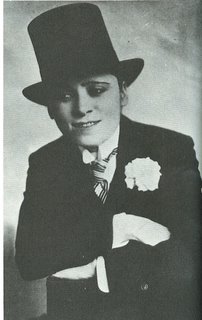 • • In July of that year "Mae West and Sister" appeared at Keith and Proctor's Fifth Avenue Theatre [27-31 West 28th Street, between Fifth Avenue and Broadway]. On the same bill was a Fatty Arbuckle film, a Keystone comedy.
• • Mae and Beverly's vaudeville turn included popular ragtime songs by black composers such as Shelton Brooks, numbers that Mae had previously found success with such as "They Call It Dixieland" and "Walkin' the Dog," their finale, for which Mae appeared in a man's tuxedo and top hat and Beverly wore feminine frills.
• • But the New York City critics remained dismissive, underwhelmed, and even contemptuous.
• • Variety, 7 July 1916 • •
• • Sime Silverman sniffed and snorted behind his keyboard like an overheated carriage horse. "Unless Miss West can tone down her stage presence in every way," he sneered, "she just might as well hop right out of vaudeville and into burlesque." And if the unabashed Brooklynite was going to continue to be so disarmingly aggressive, Sime scolded Mae by suggesting that she should get up onstage next time in "men's dress altogether."• • Come up and see Mae every day online: http://MaeWest.blogspot.com/
________
Source:http://maewest.blogspot.com/atom.xml
Mae West
• • Photo: • • Mae West • • 1916 • •
• • Feed — — http://feeds2.feedburner.com/MaeWestNYC
Mae West.
When newspapers penned an obituary for James A. Timony, they attributed MAE WEST's stardom to his devoted stewardship. 
• • In 1916, the hard-working Brooklyn-bred attorney Matilda West introduced to her daughter was loyal and clever — — if no oil painting. When they met, Mae was 23 and Jim was 30, a solidly built balding Irish American whose injured leg required assistance from an expensive cane adorned with an elk's tooth.
• • Though they both hailed from Massachusetts, Jim's parents Thomas and Mary Timony each had Irish-English ancestry. A builder and contractor, Thomas K. Timony [1847 — 1912] provided well for his brood. Before marriage, Mary [1854 — 1935] had been a teacher in a public school. Of their seven children, five survived and were raised in a substantial dwelling that still exists in pristine condition on Rutland Road [in the Lefferts Park section of Flatbush]. James, born in 1886, attended the best schools and a respected law school, and set up his pratice in Times Square, advertising heavily for new clients.
• • A devout Roman Catholic, Jim Timony carried rosary beads and began each morning by going to Mass. Mae accompanied him during this daily ritual. For decades they went everywhere together — — on cross-country trains, on the Queen Mary, in Mae's "house car," and in limousines (first his and, eventually, hers).
• • The New York Times obituary, alas, reported his age incorrectly when they announced his death on 5 April 1954 from a heart attack at his Hollywood home. According to his obit, Timony had been in retirement for five years due to poor health. (At the time, Mae was 60 years old and performing with her hunky bodybuilders on the nightclub circuit. Timony was then in discussion with developers for a Mae West theme park.)
• • Calling James A. Timony the manager of Mae West for 25 years, and the person who "guided her to success," The Times also noted that he "received major credit for her development from a relatively obscure singer and dancer into an internationally known prototype of the American siren."
• • The Mae West Blog is saluting James A. Timony — — celebrating his life and successful partnership with the Empress of Sex, an intimate relationship that only ended with his death on 5 April 1954 at age 68.• • Come up and see Mae every day online: http://MaeWest.blogspot.com/
________
Source:http://maewest.blogspot.com/atom.xml
Mae West
• • Photo: • • Mae West • • Jim Timony • •
• • Feed — — http://feeds2.feedburner.com/MaeWestNYC
Mae West.
When Ann Jillian portrayed Mae West for ABC-TV's viewers in the spring of 1982, she was far luckier than the Brooklyn bombshell. Co-starring as Mae's burly lawyer-manager James A. Timony was the handsome actor James Brolin mouthing sentences in E. Arthur Kean's fairy-dusted confection. 
• • In reality, the Brooklyn-bred attorney Matilda West introduced to her daughter in 1916 was loyal and clever — — but certainly no oil painting. When they met, Mae was 23 and Jim was 30, a solidly built balding fellow who limped and leaned on a cane adorned with an elk's tooth.
• • Though they were both born in Massachusetts, Jim's parents Thomas and Mary Timony each had Irish-English ancestry. A builder and contractor, Thomas K. Timony [1847 — 1912] provided well for his brood. Before marriage Mary [1854 — 1935] had been a teacher in a public school. Of their seven children, five survived and were raised in a substantial dwelling that still exists in pristine condition on Rutland Road [in the Lefferts Park section of Flatbush].
• • A devout Roman Catholic, Jim Timony carried rosary beads and began each morning by going to Mass. Mae accompanied him during this daily ritual. For decades they went everywhere together — — on cross-country trains, on the Queen Mary, in Mae's "house car," and in limousines.
• • The New York Times obituary, alas, reported his age incorrectly when they announced his death on 5 April 1954 from a heart attack at his Hollywood home. According to his obit, Timony had been in retirement for five years due to poor health.
• • Calling James A. Timony the manager of Mae West for 25 years, and the person who "guided her to success," The Times also noted that he "received major credit for her development from a relatively obscure singer and dancer into an internationally known prototype of the American siren."
• • The Mae West Blog is saluting James A. Timony — — celebrating his life and successful partnership with the Empress of Sex, an intimate relationship that only ended with his death in early April 1954 at age 68.
• • Come up and see Mae every day online: http://MaeWest.blogspot.com/
________
Source:http://maewest.blogspot.com/atom.xml
Mae West
• • Art: Michael Di Motta • • Mae West • • Jim Timony • • 9 February 1927 • •
NYC
Mae West.
From 1912 — 1916, MAE WEST had an ally in vaudeville: her well-connected booking agent Frank Bohm. 
• • When the Brooklyn-born tough chick was 19 years old, she described herself as "a hard-boiled, wise-cracking kid, doing anything to get a laugh."
• • Born in Hungary in 1883/4, the 29-year-old booking agent at first struck Mae as brash and rude; when first introduced, he didn't even bother to remove his hat. But he was soon exerting his influence, cautioning her against being a sidewalk cut-up and giving away her good stuff for free.
• • And not long after, Mae was influencing Bohm; she confided that the married man (with a pregnant wife) was "in trouble" over her. Soon they were sitting in a Times Square restaurant having dinner when Frank Bohm presented Mae with a diamond ring as he implored her not to encourage a rival agent: Joseph M. Schenck, the Loew circuit booking manager.
• • Mae's career took flight under Frank Bohm. In 1912, he arranged for her to appear on sheet music for "Cuddle Up and Cling to Me" with the "Girard Boys." Shortly after, he encouraged her to go out as a single in variety, promising her $350 — $500 week. And knowing she was special in his eyes, Mae took full advantage of this stepping stone.
• • Mae West claimed that her father went into real estate when she signed with Frank Bohm.
• • When Guido Deiro and Mae were hot and heavy over each other, it was Bohm who was booking them both — — "engaged jointly as headline features" for 40 weeks on the prestigious Loew circuit.
• • Under Bohm's careful grooming, Mae transformed herself into a headliner for Manhattan's American Roof Theatre in January 1915 where she performed Sheldon Brooks's "Balling the Jack" and her trademark number "I've Got a Style All My Own."
• • Unfortunately, the agent who was so "generous, vital, and adoring" to Mae was cut down by tuberculosis of the spine when he was only 33. Frank Bohm died on 9 March 1916.
• • By March 1916, however, Mae West had fallen mightily off the wagon to the stars. From applauded headliner at a good theatre steps from Broadway in January 1915, by March 1916 Mae was slaving away at Pittsburgh's Victoria Theatre, performing in cheap, third-rate burlesque.
• • Come up and see Mae every day online: http://MaeWest.blogspot.com/
________
Source:http://maewest.blogspot.com/atom.xml
Mae West
• • Photo: • • Mae West • • 1912 • •
NYC
Mae West.
MAE WEST adored ragtime.  She performed a rag that she especially loved onstage in "Diamond Lil" and its Hollywood counterpart "She Done Him Wrong." The lyricist and composer of this song — — "I Wonder Where My Easy Rider's Gone" — — was Shelton Brooks [4 May 1886 — 6 September 1975], who published it about 1913.
• • Born in Canada, Shelton Brooks moved to Detroit in 1901 with his family; his parents were Native American and Black. His father was a preacher and Shelton and his brother would play the organ during services.
• • Surrounded by music, Shelton wrote his first big hit in 1910 — — "Some of These Days" — — using his own lyrics. He had already introduced the song in his own vaudeville act when Sophie Tucker's maid introduced both him and the tune to Sophie. The vaudevillian, who would eventually style herself as "the Last of the Red Hot Mamas," made this number her very own theme song.
• • His 1916 instrumental tune "Walkin' The Dog" inspired a dance that first swept dancehall-crazed New York City, and then the rest of the country. In 1917, Brooks had another hit with "The Darktown Strutter's Ball," for which he wrote both the words and music.
• • It was in August [on 21 August 1971] — — on a TV program called "The Anthony Newley Show" — — that "I Wonder Where My Easy Rider's Gone" was performed by Liza Minnelli. Was Mae West watching Liza on television that evening?
• • Four years later, Shelton Brooks died in Los Angeles in 1975 when he was 89 years old. He is buried at Rose Hills Memorial Park.
• • Come up and see Mae every day online: http://MaeWest.blogspot.com/
________
Source:http://maewest.blogspot.com/atom.xml
Mae West
• • Photo: • • Mae West's songwriter • • Shelton Brooks • •
NYC
Mae West.
 In early July 1916 MAE WEST and Beverly were busy with their dress rehearsals. Matilda West had urged her daughters to put together a sister act.


