skip to main |
skip to sidebar
In the summer of 1922, MAE WEST was starring in "The Ginger Box Revue" and it was a musical designed to showcase her special talents.
• • Since Larry Ceballos had collaborated before with the Austrian composer Arthur H. Gutman [1891 — 1945], the shifty Paul Dupont managed to drag both of these worthy gentlemen onboard for his ill-starred maiden voyage. 
• • The libretto credit for "The Ginger Box Review" [1922] went to Paul Dupont, and the music credit went to Arthur H. Gutman. Promotional material printed by Jerome H. Remick & Co. indicated the first number was to be Mae's introductory song "Come Over" followed by "Canoodle-Ooodle-Oo," then "Eugene O'Neill, You've Put a Curse on Broadway" — — also meant for Mae. Four more songs were prepared for either a soloist or the ensemble; these were: "California Poppy," "Sister Teams," "Big Chief Hooch," and "Cottage for Two."
• • Born in Vienna in the month of August — — on 27 August 1891 — — Gutman worked his way to the West Coast and was hired in Tinseltown for the MGM Studios, serving as musical director and composer for a few dozen films during the 1930s and 1940s, often with a German theme. How popular were those during the WW2 era?
• • Gutman was only 54 when he died in Los Angeles on 3 September 1945 and was laid to rest in the Hollywood Forever Cemetery.
• • Mae West on the Bookshelf • •
• • Published in June 1997 (in hardcover) by Farrar, Straus & Giroux is the wonderful biography Becoming Mae West by Emily Wortis Leider. Masterfully written by this California poet.
• • Library Journal's reviewer said: Exhaustive research, fine writing, and a keen appreciation of Mae West's own bawdy wit inform this energetic and erudite biography of the flamboyant vaudeville, theater and film star. Brooklyn-born West (1893 — 1980) made her own way in show business at a very early age, taking charge of her career, taking whomever she wanted into her bed (she never spent the night in someone else's if she could avoid it) and, through sheer willpower, working her way up to become a film star and sex symbol in her 40s. ...
• • In Her Own Words • •
• • Mae West wrote this: "There are no good girls gone wrong — — just bad girls found out."
• • Quote, Unquote • •
• • Veteran designer Vicky Tiel, now 67, knows how to make women look good and she studied the style of iconic actresses like Mae West.
• • Vicky Tiel told a N.Y. Post reporter: Use white to create the goddess look. “The leading lady wears white,” Tiel says. “It’s a power dress to catch the eye. Raquel Welch knew that secret. And Mae West knew the power of white. If you’re going to a party, and you wear a white drape dress, not only will the guy like you, but you’ll be the star of the room." . . .
• • Source: Article: "Iconic Iconic style arbiter Vicky Tiel tells you what to put on before you take it all off" written by Mandy Stadtmiller for The N.Y. Post; posted on 21 August 2011
• • By the Numbers • •
• • The Mae West Blog was started seven years ago in July 2004. You are reading the 2035th blog post. Unlike many blogs, which draw upon reprinted content from a newspaper or a magazine and/ or summaries, links, or photos, the mainstay of this blog is its fresh material focused on the life and career of Mae West, herself an American original.
• • Come up and see Mae every day online: http://MaeWest.blogspot.com/
________
Source:http://maewest.blogspot.com/atom.xml

Mae West
• • Photo: • • Mae West • • Mae's opening number in 1922 • •
• • Feed — — http://feeds2.feedburner.com/MaeWest
NYC
Mae West.

"The electric sign for the Ginger Box Revue, starring MAE WEST, is still up on the facade of the Greenwich Village Theatre, but current will never light it," tsk-tsked The New York Daily News in August 1922. But during July the firefly of Broadway did not know this musical would end on a sour note. And on 29 July 1922, as she busied herself in that Connecticut dressing room, listening to the Clef Club play the introduction to her opening number "Come On Over," each beat of the drums thrilled with possibilities.
• • Mae West on the Newsstand • •
• • The August 1974 issue of Jet Magazine printed two readers' letters that commented on the profile Jet had run on Mae West in their issue dated 25 July 1974.
• • "I had no idea that [Mae West] broke so many barriers, putting her career in jeopardy for the sake of Blacks," remarked Evelyn Boddie of Brooklyn, NY [excerpt from "Readers Rap," Jet, 8 August 1974].
• • • • • • • • • • • • • • • • • • • •
• • Annual Mae West Tribute 2011 • • 
• • "Mae West in Bohemia — — Gin, Sin, Censorship, and Eugene O'Neill"
• • Mae West's birthday is August 17th. An upcoming Mae West event that is open to the public will be held on Sunday afternoon, 14 August 2011. The title of this illustrated historical theme walk is "Mae West in Bohemia — — Gin, Sin, Censorship, and Eugene O'Neill." Rare vintage illustrations will show you how the buildings and blocks looked as these two theatre people saw them.
• • Sites will include the Village speakeasies where Eugene drank himself into oblivion and met the characters he would put in his plays, and where Mae socialized and bent elbows with Texas Guinan, Walter Winchell, Jack Dempsey, and Barney Gallant; significant theatres; the court where Eugene and Mae battled against censorship; and off-beat addresses that made an impact. Get ready to walk on the wild side. 
• • Raffle prizes! Each Mae West walking tour ends with a raffle of Mae-themed prizes. Here is a detail from one of the O'Neill-themed goodies; the original was created in 1928.
• • When: Sunday, 14 August 2011 — — rain or shine
• • Where: Illustrated Walking Tour begins at 3:00 PM at 62 West Ninth Street, where a gay cabaret once stood that inspired Mae West to write "The Drag" (and to hire their drag queens for the cast). This tour focuses on 18 sites around Washington Square and ends at the Eugene O'Neill and Al Hirschfeld exhibition on West Third. Time: 90 — 120 minutes.
• • Cost: $10 per person
• • • • • • • • • • • • • • • • • • • •
• • In Her Own Words • •
• • Mae West said: "Between two evils, I always pick the one I never tried before."
• • Quote, Unquote • •
• • With all the information about Mae West available online, it's astonishing that some news people do not proofread nor bother to fact check. For instance, one Midwest journalist located squarely in the heartland remarks that Mae made her Hollywood screen debut in 1893. [For the record, Mae was born on 17 August 1893 and made her cinema debut in 1932.]
• • Hutchinson, Kansas-based columnist Sheila Lisman writes: Celebrating someone's birthday can take your mind off the heat for a time. How about remembering Mae West on her birthday August 17? She made her Hollywood debut in 1893 and acted in vaudeville before she was in movies. She was quite a lusty old gal. As she once said, "When I am good, I am very, very good, but when I bad, I am better." ...
• • Source: Column "Some hot dates" written by Sheila Lisman, Community columnist for Hutch News; posted on 27 July 2011
• • 17 July 2004 — 17 July 2011 • •
• • In mid-July the Mae West Blog celebrates its seventh anniversary. Thank you to all those Mae-mavens who come up and see Mae every day.
• • By the Numbers • •
• • The Mae West Blog was started seven years ago in July 2004. You are reading the 2006th blog post. Unlike many blogs, which draw upon reprinted content from a newspaper or a magazine and/ or summaries, links, or photos, the mainstay of this blog is its fresh material focused on the life and career of Mae West, herself an American original.
• • Come up and see Mae every day online: http://MaeWest.blogspot.com/
________
Source:http://maewest.blogspot.com/atom.xml
Mae West
• • Photo: • • Mae West • • 1928 • •
• • Feed — — http://feeds2.feedburner.com/MaeWest
NYC
Mae West.
MAE WEST sang "I'm in the Mood for Love" — — and it was featured on the LP Fabulous Mae West [released in September 1955]. The song had been published twenty years earlier in 1935.
• • Born in Boston in the month of July — — on 10 July 1894 — — James Francis McHugh was a prolific songwriter who was doing his best work from the 1920s through the 1950s. McHugh composed over 270 songs and his hits were recorded by Mae West as well as Frank Sinatra, Bing Crosby, Judy Garland, Billie Holiday, Chet Baker, Dinah Washington, June Christy, Peggy Lee, Deanna Durbin, and Ella Fitzgerald.
• • Composer Jimmy McHugh collaborated with lyricist Dorothy Fields on "I'm in the Mood for Love," which enjoyed great popularity and is still being sung today.
• • Jimmy McHugh died on 23 May 1969 in Beverly Hills, California at age 74.
• • In July 1922 • • 
• • During July 1922, Mae was preparing for her spotlight as she rehearsed the "Ginger Box Review" with a wonderful cast that included Jimmy Hussey and Harry Richman. After a two performance try-out in Hartford, Connecticut, this musical was supposed to be opening at the Greenwich Village Theatre in Sheridan Square. If only . . . .
• • "Ginger Revue Now a Pepless Stew as Promoter Disappears" announced the New York Daily News [13 August 1922]. Thirteen Equity actors sued Perkins to recover their salaries — — but not Mae, who was to have received a percentage of the box office.• • Well, this situation was forcing the ambitious Brooklynite into the one role she feared the most: unemployed actress. On 23 August 1922, however, the New York Clipper noted: Mae West, who was with 'The Ginger Box,' which opened and closed rather suddenly, has returned to vaudeville, and opened at Proctor's Fifth Avenue on Monday. . . .
• • In Her Own Words • •
• • Mae West: During her number "Eugene O'Neill, You've Put a Curse on Broadway," Mae's character was bellowing, Yank-style, "She don me doit! Lemme up! I'll show her who's an ape!"
• • Quote, Unquote • •
• • "Mae West was better suited to writing gritty realism than Eugene O'Neill," explains Frank Cullen in the book "Vaudeville, Old and New" [2007].
• • Mae West spoofed Eugene O'Neill in 1922 and others followed with a parody.
• • Felicia Hardison Londré writes: During the 1920s Eugene O’Neill’s plays elicited an exceptionally large number of playful rewrites. . . . Why did Eugene O’Neill’s plays of the 1920s become such a magnet for la critique créatrice as well as source material for burlesque? First, he met the basic criterion of a subject for parody: universal recognition by the target audience. . . . The Hairy Ape opened on 9 March 1922 and moved uptown in April for a 127-performance run. It quickly spawned travesties, beginning in June with a three-scene burlesque titled “The Shaving of the Hairy Ape” in Raymond Hitchcock’s Pinwheel Revel. Although Frank Fay played “Bull Burke, the Ape Man,” the piece attracted little critical attention apart from a general call for scissors to be taken to the whole show (NYT 16 June 1922). O’Neill’s strong language was targeted in the next two stage lampoons of The Hairy Ape. First came The Ginger Box on July 28-29 in Stamford, Connecticut. The program in the Billy Rose Theatre Collection proclaims “prior to opening at the Greenwich Village Theatre, New York,” but an unscrupulous producer left the show in the lurch and it never got to New York (Watts 61). In the second slot of Act 2, Mae West impersonated Yank Smith and, backed up by the twelve Stoker Girls, sang “Eugene O’Neill, You’ve Put a Curse on Broadway.”
• • Two months later, The Passing Show of 1922 at the Winter Garden featured a similar number performed by the popular blonde singing comedienne Ethel Shutta. According to an undated clipping in the file on that show in the Billy Rose Theatre Collection, the song “condemned O’Neill for teaching Broadway to curse,” while “a supporting chorus yelled ‘Go to hell!’ with an aptitude which might have shamed the ‘Hairy Ape’.” ...
• • Source: Article: "Twitting O’Neill: His Plays of the 1920s Subjected to La Critique Créatrice" written by Felicia Hardison Londré for The Eugene O'Neill Review; posted in Volume 26 — — 2004
• • 17 July 2004 — 17 July 2011 • •
• • In mid-July the Mae West Blog will celebrate its seventh anniversary. Thank you to all those Mae-mavens who come up and see Mae every day.
• • By the Numbers • •
• • The Mae West Blog was started seven years ago in July 2004. You are reading the 1987th blog post. Unlike many blogs, which draw upon reprinted content from a newspaper or a magazine and/ or summaries, links, or photos, the mainstay of this blog is its fresh material focused on the life and career of Mae West, herself an American original.
• • Come up and see Mae every day online: http://MaeWest.blogspot.com/
________
Source:http://maewest.blogspot.com/atom.xml
Mae West
• • Photo: • • Mae West • • Greenwich Village Theatre, 1922 • •
• • Feed — — http://feeds2.feedburner.com/MaeWest
NYC
Mae West.
Leo McCarey, who helmed "Belle of the Nineties," was one of the directors MAE WEST never liked.
• • In September 1934, a review of "Belle of the Nineties" appeared in The New York Times: "Of course, Miss West is her own plot, but there are a fixed prize-fight, some stolen jools, an envious siren, a fire, and a pair of rival claimants for her affections to add the necessary business. While Ruby Carter's personal philosophy is, in her own words, to keep cool and collect, she has a healthy admiration for a good man, and the Tiger Kid fills the bill. ..."
• • Born in Los Angeles, in the month of July, Leo McCarey [3 October 1898 — 5 July 1969] was an Academy Award-winning film director, screenwriter, and producer.
• • Where It Happened • • 
• • When Mae West was rehearsing in the month of July for "Ginger Box Review" — — in which she would be singing "Eugene O'Neill, You Put a Curse on Broadway" — — she was returning to a familiar playhouse on Sheridan Square. In 1920, Mae had enjoyed seeing her idol Bert Savoy [1888 — 1923] in the musical comedy "The Greenwich Village Follies of 1920," which opened at the Greenwich Village Theatre on 30 August 1920.
• • En route to Seventh Avenue South to production meetings at this 400-seat theatre in the summer of 1922, it is likely that Mae would have passed a place where she could have purchased a copy of "The Hairy Ape," the recently staged drama that was being lampooned in "Ginger Box Review."
• • "The Hairy Ape," an expressionist play by Eugene O'Neill, had opened in Greenwich Village on Thursday, 9 March 1922. Drama critic Alexander Woollcott wrote: The little theatre of Provincetownsmen in MacDougal Street was packed to the doors with astonishment last evening as scene after scene unfolded in the new play by Eugene O'Neill. This was "The Hairy Ape," a bitter, brutal, wildly fantastic play of nightmare hue and nightmare distortion. It is a monstrously uneven piece, now flamingly eloquent, now choked and thwarted and inarticulate . . . ["Eugene O'Neill at Full Tilt" by Alexander Woollcott, published in The N.Y. Times on 10 March 1922].
• • If O'Neill was fortunate in the enthusiastic media coverage he received, he was also blessed by having an intelligent promoter of the manuscripts of his plays, the imaginative and erudite literary publisher Frank Shay, famously located at 4 Christopher Street. Come along with us to Chez Shay on August 14th.
• • Annual Mae West Tribute 2011 • •
• • "Mae West in Bohemia — — Gin, Sin, Censorship, and Eugene O'Neill" 
• • Mae West's birthday is August 17th. An upcoming Mae West event that is open to the public will be held on Sunday afternoon, 14 August 2011. The title of this illustrated historical theme walk is "Mae West in Bohemia — — Gin, Sin, Censorship, and Eugene O'Neill." Rare vintage illustrations will show you how the buildings and blocks looked as these two theatre people saw them.
• • Sites will include the Village speakeasies where Eugene drank himself into oblivion, and where Mae socialized and bent elbows with Texas Guinan, Walter Winchell, and Barney Gallant. Get ready to walk on the wild side.
• • Each Mae West walking tour ends with a raffle of Mae-themed prizes. Sponsors may inquire about suitable product placements for August 14th.
• • In Her Own Words • •
• • Mae West said: “Love thy neighbor. And if he happens to be tall, debonair, and good looking, it will be that much easier.”
• • Quote, Unquote • •
• • Mae West enjoyed shopping at Bullocks. You can spend the day there, too, in July.
• • An occasional blogger, The Chic Bargainista has just written this post: Some Los Angeles residents may remember the art deco splendor of the old Bullocks Wilshire store. It was one of the first shopping stores to open in the suburbs and features a parking lots for its patrons cars. Wealthy Los Angeles residents shopped there as well as movie stars. Stars like Mae West, Marlene Dietrich, Judy Garland, and Doris Day all shopped at the renowned department store. Sadly, the store shuttered its doors in 1993 after the Los Angeles riots and the recession of the 1980s. . . . However, every summer the [current law] school reopens Bullocks Wilshire for a wonderful tour, which also offers attendees the chance to chose to have lunch or high-tea in the legendary Tea Room where stars like John Wayne stopped in, and models in the latest fashions floated between the tables of ladies who lunched. This year, the tour will take place on 30 July 2011. General reservations for the tour will open on July 6th. ...”
• • Source: Article: "Save the Date: A Summer's Day at Bullocks Wilshire Tour is on July 30th " written by The Chic Bargainista; posted on 4 July 2011
• • 17 July 2004 — 17 July 2011 • •
• • In mid-July the Mae West Blog will celebrate its seventh anniversary. Thank you to all those Mae-mavens who come up and see Mae every day.
• • By the Numbers • •
• • The Mae West Blog was started seven years ago in July 2004. You are reading the 1982nd blog post. Unlike many blogs, which draw upon reprinted content from a newspaper or a magazine and/ or summaries, links, or photos, the mainstay of this blog is its fresh material focused on the life and career of Mae West, herself an American original.
• • Come up and see Mae every day online: http://MaeWest.blogspot.com/
________
Source:http://maewest.blogspot.com/atom.xml
Mae West
• • Photo: • • Mae West • • 1922 • •
• • Feed — — http://feeds2.feedburner.com/MaeWest
NYC
Mae West.
Few people made MAE WEST laugh louder than Dave Apollon.
• • Born in Kiev, Russia on 23 February 1897, Dave's heavy "sour cream accent" was so hilarious that Mae West knew exactly how to increase his comic capital when they worked together during 1922 in the ill-fated "Ginger Box Revue" [slated to open at the Greenwich Village Theatre in Sheridan Square].
• • When a shady producer short-changed the cast by not producing the expected costumes and scenery, Mae pushed Dave Apollon onstage to deliver a prologue. Apologizing for the third-rate production the audience was about to see, Apollon muttered under his breath, "Ach! It was better under the czar with the lousy pogroms!"
• • Dave Apollon also worked as a mandolin player.
• • The vaudevillian died in Las Vegas at age 75 at the end of May — — on 30 May 1972.
• • In Her Own Words • • 
• • "Diamonds is my career!" — — "Diamond Lil" written by Mae West.
• • In 1979, during an interview at her apartment, Mae West discussed her lifelong passion for diamonds with the writer Charlotte Chandler: "They're all real. They were given to me by admirers." Her gaze settled on my unadorned hands. "Oh, you poor kid! You don't have any!" For a moment she regarded me with pity. Then she brightened. "But you have some at home?"
• • I shook my head (notes Charlotte Chandler).
• • She studied me, then said encouragingly, "You could, honey. But you've gotta try, and you've gotta know how to try. Knowing what you want is the first step toward getting it. There's nothing better in life than diamonds. ..."
• • Quote, Unquote • •
• • One of Canada's top golf greens is the Waskesiu Golf Course, located at Waskesiu Lake in Prince Albert National Park, where the eighth hole has become known as the Mae West. Hmmmm.
• • The StarPhoenix notes: The 6,301-yard course tests the precision of golfers with its tight treelined fairways and smaller greens. "It's a course you can play over and over and always feel like you're playing it for the first time. It brings different challenges every time," says Peter Anholt, general manager of Waskesiu Golf Course. Consider the eighth hole, also known as the 'Mae West' because of the contoured hills that frame the green. It takes most golfers three good shots to get to the green! . . .
• • Source: Article: "Golfer's paradise awaits at Waskesiu" written by Staff for The StarPhoenix; posted on 28 May 2011
• • By the Numbers • •
• • The Mae West Blog was started seven years ago in July 2004. You are reading the 1946th blog post. Unlike many blogs, which draw upon reprinted content from a newspaper or a magazine and/ or summaries, links, or photos, the mainstay of this blog is its fresh material focused on the life and career of Mae West, herself an American original.
• • Come up and see Mae every day online: http://MaeWest.blogspot.com/
________
Source:http://maewest.blogspot.com/atom.xml
Mae West
• • Photo: • • Mae West • • 1934 • •
• • Feed — — http://feeds2.feedburner.com/MaeWest
NYC
Mae West.
According to biographer Emily Wortis Leider: The Ginger Box served up wall-to-wall MAE WEST. In addition to featuring her as Circe, turning her lovers into swine, it presented Mae West as a Broadway vamp (played to Harry Richman's victim), Mae West singing "I Want a Cave Man," Mae West clowning to Tommy Gray's "I'm a Night School Teacher," and torching a song whose regretful tone she would later rule out: "Sorry I Made You Cry." 
• • The libretto credit went to Paul Dupont, and the music credit went to Arthur H. Gutman. Promotional material printed by Jerome H. Remick & Co. indicated the first number was to be Mae's introductory song "Come Over" followed by "Canoodle-Ooodle-Oo," then "Eugene O'Neill, You've Put a Curse on Broadway" — — also meant for Mae.
• • Born during the month of October, Eugene O'Neill started his life in a Broadway (New York City) hotel room in Times Square. The site is now a Starbucks (1500 Broadway, Northeast corner of West 43rd & Broadway). A commemorative plaque is posted on the outside wall with the inscription: "Eugene O'Neill, October 16, 1888 — November 27, 1953 America's greatest playwright was born on this site then called Barrett Hotel, Presented by Circle in the Square."
• • During the 1910s, Eugene O'Neill was a regular on the Greenwich Village literary scene, where he also befriended many radicals, most notably Communist Labor Party founder John Reed.
• • "The Hairy Ape" is an expressionist play by Eugene O'Neill (1922), and this was the drama being mocked in Mae's song. "Lemme up! I'll show ya who's an ape!" Imagine it, if you will.
• • O'Neill's involvement with the Provincetown Players began in mid-1916. Four years later, his first published play, "Beyond the Horizon," opened on Broadway in 1920 to great acclaim, and was awarded the Pulitzer Prize for Drama. O'Neill also received the 1922 Pulitzer Prize for Drama for his writing. Then in 1936 he received the Nobel Prize for Literature. Despite this outstanding acclaim, however, his portraits invariably show the unsmiling author with the most miserable expression.
• • Across the street from O'Neill's birthplace, Paramount Pictures established their iconic headquarters at 1501 Broadway and debuted many Mae West motion pictures in their street-level theatre during the 1930s.
• • Come up and see Mae every day online: http://MaeWest.blogspot.com/
________
Source:http://maewest.blogspot.com/atom.xml
Mae West
• • Photo: • • Mae West • • Eugene O'Neill in 1931 • •
• • Feed — — http://feeds2.feedburner.com/MaeWest
NYC
Mae West.
It was July 18th, the summer of 1922, and MAE WEST was a month away from celebrating her 29th birthday.
• • Hungry for stardom and with her best years in variety behind her, Mae was being forced into a role that scared her: the unemployed. Then suddenly there was a chance to star in a "sparking musical revue in two acts and 20 scenes" — — The Ginger Box — — and fast-talking Paul Dupont was promising he could make her a star.
• • According to biographer Emily Wortis Leider: The Ginger Box served up wall-to-wall Mae West. In addition to featuring her as Circe, turning her lovers into swine, it presented Mae West as a Broadway vamp (played to Harry Richman's victim), Mae West singing "I Want a Cave Man," Mae West clowning to Tommy Gray's "I'm a Night School Teacher," and torching a song whose regretful tone she would later rule out: "Sorry I Made You Cry."
• • The numbers were staged by Broadway director and choreographer Larry Ceballos [1887 — 1978]. At five-feet-four, the Chilean dance master was barely taller than Mae. But since Larry Ceballos had collaborated before with the Austrian composer Arthur H. Gutman [1891 — 1945], Dupont managed to drag both of these worthy gentlemen onboard for his ill-starred maiden voyage.
• • The libretto credit went to Paul Dupont, and the music credit went to Arthur H. Gutman. Promotional material printed by Jerome H. Remick & Co. indicated the first number was to be Mae's introductory song "Come Over" followed by "Canoodle-Ooodle-Oo," then "Eugene O'Neill, You've Put a Curse on Broadway" — — also meant for Mae. Four more songs were prepared for either a soloist or the ensemble; these were: "California Poppy," "Sister Teams," "Big Chief Hooch," and "Cottage for Two."
• • "Come Over" [Dupont and Gutman 1922] • •
• • To put it mildly, "Come Over" is an underwhelming curtain-raiser. Mae West has pretty predictable pap to put across with lyrics like these:
• • • • I'm looking for a daddy dear, to cuddle up and cuddle me,
• • • • If you will come on over here, how happy we will be.
• • • • I'll show you the way to love every day,
• • • • You'll learn a lot from me . . .
• • Despite an optimistic rehearsal period in the Village, major troubles were afoot, and soon revealed themselves during a two-performance try-out in Connecticut. Also, the flam-flam producer Paul Dupont [real name: Edward Perkins], who was perpetually short of funds, would vanish, leaving unpaid debts and I-owe-you notes to his cast.
• • "Ginger Revue Now a Pepless Stew as Promoter Disappears" announced the New York Daily News [13 August 1922]. Thirteen Equity actors sued Perkins to recover their salaries — — but not Mae, who was to have received a percentage of the box office.
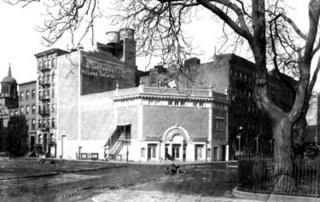 • • Greenwich Village Theatre: 1917 — 1930 • •
• • The Greenwich Village Theatre was made famous by female impersonator Bert Savoy, who performed in the acclaimed "Greenwich Village Follies" there, an annual revue that was so popular that it moved to Broadway.
• • Located until 1930 on the western side of Seventh Avenue South where Christopher Street kisses West Fourth, it faced Sheridan Square and a green oasis of a local park.
• • During the 1920s, the outstanding success of this cultural outpost put Sheridan Square on the map as a mecca for avant-garde entertainment.• • Come up and see Mae every day online: http://MaeWest.blogspot.com/________
Source:http://maewest.blogspot.com/atom.xml
Mae West
• • Photo: • • Mae West • • Greenwich Village Theatre c. 1917 • •
• • Feed — — http://feeds2.feedburner.com/MaeWestNYC
Mae West.
It was 1922 during the month of July — —and MAE WEST was rehearsing a new show built around her special talents, running through her numbers with pianist Harry Richman and the rest of the cast in Greenwich Village across the street from Sheridan Square Park.
• • That summer, New York's air was jagged with mosquitoes as shadows stretched across vaudeville, slowly going under, a bare bright emptiness in its future.
• • Expanding her horizons, Mae had written "The Ruby Ring" [1921] and "The Hussy" [1922] and she also was very excited about starring in "The Ginger Box Revue," scheduled to open in August 1922 at The Greenwich Village Theatre on Seventh Avenue South between West Fourth Street and Christopher Street.
• • Built in 1917 by the architect Herman Lee Meader, this modest-size playhouse [425 seats] was the dream of Mrs. Marguerite Abbott Barker, who felt there ought to be alternatives to a male-dominated theatre scene.
• • In 1923, a local literary magazine wrote this: The Greenwich Village Theatre is still the home of experimental plays or rather plays that are for the limited, discerning public. And Marguerite Abbott Barker [d. 1930], who built this theatre, should always be remembered as the great benefactor of the Village, for as it is written among the Sumarians, nobody ever got rich educating the public above their usual banal or to speak ephemerally, banal tastes. ... [from The Quill, September 1923 issue].
• • The dreamed-of outcome was not to be — — and the cast was left with no income — — but Mae West was enthusiastically working on her dance numbers that July, imagining the applause that would greet her efforts.
• • Come up and see Mae every day online: http://MaeWest.blogspot.com/________
Source:http://maewest.blogspot.com/atom.xml
Mae West
• • Photo: • • Mae West • • Greenwich Village Theatre c. 1917 • •
• • Feed — — http://feeds2.feedburner.com/MaeWestNYC
Mae West.
Few people made MAE WEST laugh louder than vaudevillian Dave Apollon.
• • Born in Kiev, Russia on 23 February 1897, Dave's heavy "sour cream accent" was so hilarious that Mae West knew exactly how to increase his comic capital when they worked together during 1922 in the ill-fated "Ginger Box Revue" [slated to open at the Greenwich Village Theatre in Sheridan Square].
• • When a shady producer short-changed the cast by not producing the expected costumes and scenery, Mae pushed Dave Apollon onstage to deliver a prologue. Apologizing for the third-rate production the audience was about to see, Apollon muttered under his breath, "Ach! It was better under the czar with the lousy pogroms!"
• • Though Dave Apollon also worked as a mandolin player, it was not his musicianship that brought him the enormous popularity and success he was to achieve in vaudeville. Instead it was his Russian accent. Always on the lookout for entertainers with unique charms, Mae West first noticed his built in assets.
• • In "Goodness Had Nothing To Do With It," Mae described her first encounter with Dave during the Ginger Box Review debacle.
• • Mae West wrote: "At a rehearsal of this show I first met Dave Apollon. He had just arrived in this country, after some hardships, and was in the show. He was a fine mandolin player and Russian dancer. I first saw him dressed in a very tight-fitting green tweed suit that looked as if it had been made for a smaller brother, high button shoes, and a high Hoover collar. He was short but slender, with a round elf's face, and a turned-up nose over a mocking mouth. He had a sour-cream heavy Russian accent, and a very amusing way of expressing himself in a fractured English almost like double-talk. Dave was very funny, I thought, but in the show he just played the mandolin and did a short dance. I couldn't help being amused by him and I would have him come to me so that I could ask him questions just to hear him mangle the language. I would try not to laugh out loud, just inwardly, and somehow everything became funnier that way. When Dave Apollon would start talking it would break me up inside. He'd ask, 'Whut suz funnik I'm saying please to tell me?'"
• • I said to him, "Dave, with your mannerisms, voice, and puzzled expression that seems to struggle to understand what is said, you make me scream with laughter. What would you be able to do to an audience?"
• • "But no thenk you — — I serious minded fella, this mandolin and dancing very serious for me is enough."
• • Mae West persisted and soon had Dave reading lines in a skit about Circe and her lovers. When the show opened in South Norwalk, Connecticut, it was discovered that the scenery was too small for the theater. The producer was about to write a formal apology for the theater manager to read to the opening-night audience, when Mae came up with an idea.
• • "Get Dave Apollon to go out before the curtain, in a spotlight, in his own tight little green street suit, and with that borscht dialect he should really be, funny telling them about the scenery." They captured Dave, fed him hot tea, patted his back, told him he could do it. Finally, Dave did go out on the stage to make the announcement. The more he got tangled up in the English language, the more scared and bewildered he looked, the more the audience howled. He became so screamingly funny the audience doubled up in the seats. They applauded madly, thinking it was all a part of the original show. He came off pop-eyed. "I sweating like a hoss," he said.
• • Dave Apollon died in Las Vegas at age 75 during the month of May: 30 May 1972.
• • Come up and see Mae every day online: http://MaeWest.blogspot.com/
________
Source:http://maewest.blogspot.com/atom.xml
Mae West
• • Photo: • • Mae West • • none • •
NYC
Mae West.


