Tuesday, November 30, 2004


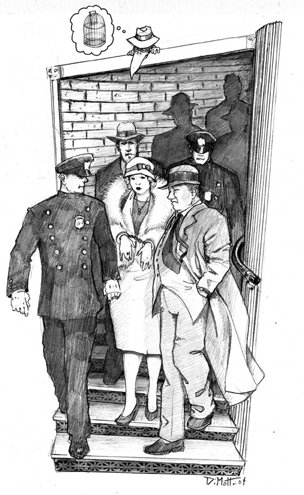
Mae West is escorted to Jefferson Market Jail on Feb. 9, 1927. Sketch by Michael DiMotta. Posted by Hello

Frightened, Mae West is led to jail on February 9, 1927 in New York City. Posted by Hello

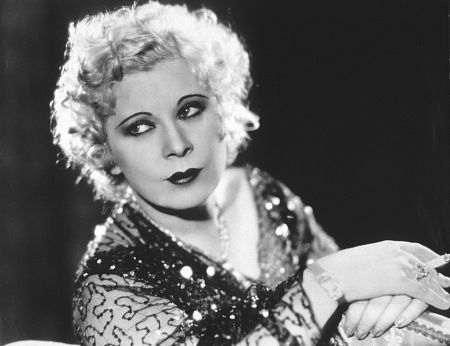
Mae West in 1927. Posted by Hello

Mae West: Close Up

Mae West once again will be ready for her close-up -- and fans can visit her for free during a month-long-period that begins on Monday January 3, 2005.

Where: NY Public Library [Jefferson Market branch, 2nd floor] on 6th Avenue at West 9th Street in Greenwich Village.

When: during the building's regularly scheduled hours January 3rd-30th, 2005.

What: an illustrated version of the play "Courting Mae West" written by dramatist LindaAnn Loschiavo and depicted in 16 colorful panels by artist Michael Di Motta. This play is based on TRUE EVENTS that took place in Manhattan during 1926-1929 when actress-playwright Mae West suffered a social injustice and endured a lengthy court trial, a jail term, and enormous fines as well as legal fees. Discovering New York City history during the Roaring 20s has never been so entertaining. No "reality TV" show can compare to these episodes in Mae West's life, long-forgotten and about to be placed on view. DiMotta's sketches are based on archival photos.

Why: to commemorate the February 9, 1927 arrest and incarceration of Mae West that took place in this very location when the building was a courthouse and jail and also to announce a staged reading of the play "Courting Mae West" at 8 PM on February 9, 2005 at C.U.N.Y. Graduate Center [365 Fifth Avenue, NYC 10016].

Admission: free and open to the public.

Information: 212-243-4334.

Public transportation: IND E, F, D, A, C trains to West Fourth Street station.

Come Up and See Mae - - at the library during the month of January and also at CUNY Graduate Center [365 Fifth Avenue, NYC] at 8:00 PM on Feb. 9th, 2005.

Discovering New York City's 1920s history has never been so entertaining.

Tuesday, November 23, 2004

Mae West in Two Dimensions

In honor of the architect Yoshio Taniguchi's new design, and in honor of the re-opening of the modernized Museum of Modern Art this week [in Manhattan], here's a thought: What would Mae West look like if painted in "modern art" style?
.
The museum's film library contains the classic 1933 Mae West movie "She Done Him Wrong" - - based on Mae's Broadway play "Diamond Lil" - - even though Mrs. John D. Rockefeller Jr. expressed dismay when curator Iris Barry programmed it for a film audience at the Museum of Modern Art on West 53rd Street.

Monday, November 22, 2004

Mae West & Mrs. John D. Rockefeller Jr.

Mrs. John D. Rockefeller Jr. expressed dismay when Iris Barry programmed the 1933 Mae West vehicle "She Done Him Wrong" for a film audience at the Museum of Modern Art on West 53rd Street. . . .

All eyes will be fixed on Yoshio Taniguchi's design when the Museum of Modern Art reopens today [in Manhattan], but film lovers should be forgiven if their sights narrow on the escalators leading down to the movie theaters. After two years . . . , the film department returns home this week with three series. . . .

This program is merely an appetizer, however. Starting tomorrow, the film department gets down to serious cinematic business with the first of two massive series, "Premieres" and "112 Years of Cinema." The second, which opens Wednesday, provides an overview of the seventh art from its late 19th-century beginnings to the present. In sheer scope - the museum will screen a film from every year in movie history - the "112 Years of Cinema" program will afford an overview of the medium, however implicit. . . .

. . . . Founded in 1935, the [film] department, the first in the country, aimed to "trace, catalog, assemble, preserve, exhibit and circulate to museums and colleagues single films or programs of all types of films." The initial film curator, Iris Barry, sought out quality movies along with disintegrating prints; she was, for instance, a champion of D. W. Griffith when the great director was in the lonely twilight of his career. . . .

. . . More than anything it was the democratization of taste intrinsic to the movies that made even the idea of a museum film department so heretical. In her history of the department, the chief curator Mary Lea Bandy recounts how Mrs. John D. Rockefeller Jr. expressed dismay when Iris Barry programmed the 1933 Mae West vehicle "She Done Him Wrong." What Mrs. Rockefeller didn't know was that movies were changing her world and her museum.

In a talk he gave at the Modern around the same time and which was published in 1934, the art critic Erwin Panofsky argued: "Whether we like it or not, it is the movies that mold, more than any other force, the opinions, the taste, the language, the dress, the behavior and even the physical appearance of a public comprising more than 60 percent of the population of the earth."

The movies, Panofsky wrote, had "re-established that dynamic contact between art production and art consumption" absent in the other arts. If all the poets put down their pens and all the artists laid down their easels, he coolly added, only a small fraction of the general public would notice and even fewer would care. Decades later, the bitter truth of these words seems to have been borne out. The movies did more than revitalize the relationship between art producers and art consumers; they radically changed the other arts, which have increasingly bent to the logic of entertainment. It's a logic to which museums ceded long ago, evident in blockbuster shows and all those bells and whistles designed to keep the paying public from getting too bored by the art. . . .

Against the backdrop of the really big show that has become the Modern's reopening there is something almost a touch subversive about the film department . . .

- - - - this was an excerpt from - - - -

CRITIC'S NOTEBOOK
Putting the Movies Back Into the Modern
By MANOHLA DARGIS
The New York Times - - Published: November 20, 2004

Forever Mae West

Mae West was born in Brooklyn, New York on a cool night during a hot month: August 17, 1893. After many adventures, Mae West closed her eyes in Hollywood, California on November 22, 1980.

.
As long as someone remembers and celebrates you, you are not dead.
.
MAE WEST is being commemorated in New York City during January and February 2005 at several events and also in the exciting new play "Courting Mae West."
For info: ComeUpSeeMae [at] aol.com


Saturday, November 20, 2004

Mae West: Dead or Alive?

Mae West, at age 87, suffered a series of strokes which finally resulted in her death on November 22,1980 in Hollywood, California.
The actress passed away quietly in her Hollywood apartment (Ravenswood). Private services [conducted by Dr. Lloyd Ogilvie and attended by about 100 close friends and family] were held in the Old North Church at Forest Lawn, Hollywood Hills.
.
Her eulogy, written by Kevin Thomas and delivered by producer Ross Hunter, concluded: “Mae West always said that no one was ever to feel sorry for her, and she would not want anyone to start now. Mae West figured that in one way or another she would live forever. And she probably will.”

Entombment was in the West family mausoleum at Cypress Hills Abbey in Brooklyn, New York.

Cause of death: Complications from stroke


Burial: Cypress Hills Cemetery
Brooklyn, Kings County, New York, USA
- - -
But if you miss her, come up and see Mae on Wednesday evening February 9th, 2005 in New York, NY. Mae West will be onstage in a theatre at 365 Fifth Avenue, NYC 10016.
Need info?
ComeUpSeeMae (at) aol.com

Friday, November 19, 2004

Mae West: Under the Sign of Leo

Watch Mae sashay.
Isn't she the cat's meow, though?

Memorable Quotations from Famous People Born Under the Sign of Leo
"He who hesitates is last." -- Mae West (born August 17th, 1893)

The Sun rules Leo, making these sun-stroked souls just a little bit extra special.
Most astrologers agree on this: you can always tell a Leo -- you just can't tell them too much.

Thursday, October 28, 2004

Mae West’s beauty tip

Charlotte Chandler: Tinsel Town's other blonde
• • The Californian-born author of several bestsellers about Hollywood, Charlotte Chandler won the show business scoop of last century when she interviewed Mae West before the iconic movie star died. "I never see women interviewers," West snarled. Nevertheless, the blonde bombshell spent six hours primping and preening for their first meeting. Charlotte Chandler was invited to stroke West’s porcelain complexion. "I did so very nervously," she recalls.
• • Mae West’s beauty tip? "Warm baby oil - - applied daily by a man."
• • Mae West told her the secret of perfect skin. Federico Fellini cooked pots of pasta for her and Tony Curtis revealed all about his affair with Marilyn Monroe. Name any Hollywood star and the likelihood is that Charlotte Chandler will have interviewed them - - from the siren of the silent screen, Gloria Swanson, to Pierce Brosnan.
• • Mae West stared in disbelief at the unmarried Chandler’s ringless fingers. "You have no diamonds!" she exclaimed. "You must find a man to buy you some." But later she confided to Chandler that she had bought her own king’s ransom of jewels herself.
• • As the New York-based author listened to the tape - - the interview was chosen for the Penguin anthology of Great Interviews of the Twentieth Century - - she was puzzled by a soft susurration in the background. "It was as if a butterfly was beating its wings, then I realised that it was the sound of Mae’s false eyelashes flapping," says Chandler, whose latest book, Nobody’s Perfect, is a personal biography of the great director Billy Wilder.
• • Chandler is adept at getting big-name interviews, although in the case of Mae West blonde undoubtedly responded unto blonde. For Chandler also has a luxuriant mane of pale golden hair, untouched by peroxide. Photographs of her - - whether she is lunching with Fellini, about whom she wrote an international bestseller, or sharing a joke with Wilder - - always feature her smiling glamorously beneath her crowning glory. Indeed, Groucho Marx used to say of her fabulous follicles: "You’ve got your own beret."
• • She jests that her fine head of hair helped her to persuade stars such as Gloria Swanson, Barbara Stanwyck, Ginger Rogers, Kirk Douglas, James Stewart, Shirley MacLaine, Jack Lemmon and Tony Curtis (who admitted that he had slept with Marilyn Monroe before she was famous) to be interviewed for the Wilder book. ("Superb name-dropping!" exclaims Chandler.) I suspect it has much more to do with her undoubted skills as an interviewer and writer.
• • Mae West, Henry Fonda, Alfred Hitchcock, Bette Davis, and Tennessee Williams stalked freely to her for her second book, The Ultimate Seduction, about people who are seduced by their creative work.
• • Dressed in a smart navy-blue trouser suit, Chandler is a well-preserved woman of uncertain age - - she politely refuses to tell how old she is. She has a gracious manner and wears her famous hair piled on top of her head. . . .
• • Come up and see Mae online: http://MaeWest.blogspot.com/
________
Source:http://maewest.blogspot.com/atom.xml
Add to Google

Thursday, October 21, 2004

Come Up to See Mae Here!

"Courting Mae West" - a New MAE Play in NYC
"Courting Mae West" is a new play based on true events in the life of Mae West [1926 - 1929].
• • WHERE: C.U.N.Y. Graduate Center (365 Fifth Avenue, NYC 10016)
• • WHEN: Wednesday February 9, 2005 at 8:00 PM
• • INFO: ComeUpSeeMae@aol.com
• • Come up and see Mae online: http://MaeWest.blogspot.com/
________
Source:http://maewest.blogspot.com/atom.xml
Add to Google

Sunday, October 10, 2004

Mae West: Timothy Dalton

MAE WEST co-starred with some handsome leading men such as Timothy Dalton.
• • Timothy Dalton was born in Colwyn Bay, Wales on 21 March 1944. Though Welsh-born, he is of British, Italian, and Irish ancestry. His mother is from the Bronx (New York). He grew up in Manchester, England with a background in show-biz, since both of his grandfathers were vaudevillians. After leaving school, he joined the National Youth Theatre for 3 summers, and studied at the Royal Academy of Dramatic Art for 2 years. He joined the Birmingham Repertory Theatre in 1966, where he played many leading roles.
• • Timothy Dalton first flew to Hollywood in 1977, to become the leading man of the aging movie queen Mae West [1893-1980] in her last film. In Sextette (1978), with a cast that included Tony Curtis, Ringo Starr, George Hamilton, Walter Pidgeon, and George Raft, Timothy even ended up marrying the cinema legend whose sexual suggestiveness was as amorously artful as it was essentially innocent. He will never ever forget the experience.
• • "I'll never forget meeting her for the first time. We went in to see Mae West in a room where everything was white with gold trim on it. It was quite small, I thought, for somebody as fabulously rich as she was. It was only later that I realized that she owned the entire apartment block, though I doubt that she ever spent a penny on herself in her life; everybody was too busy buying her presents and asking her out.
• • "Then Mae West came in. She was wearing a white suit and a large bouffant hairstyle and these long nails ... there was a great lady. I was very curious, very fascinated by her. Not to put too fine a point on it, we were all wondering, knowing how old she was, if we were going to be able to work with her.
• • "As it happened, she was delightful. I think the most extraordinary thing about knowing Mae West was the realization that she was a brilliant lady. When somebody is that famous, you're never quite sure whether her fame stems largely from the publicity hokum, but she could always come up with a line that was funnier than anybody else's. . . ."
• • "Of course," adds Timothy with a smile that conceals more than reveals, "she was a bit of a flirt. But she tried it only once with me! She had a nice twinkle in her eye, a nice sparkle. Oh, it was definitely an experience I wouldn't have missed for the world."
• • Come up and see Mae online: http://MaeWest.blogspot.com/
________
Source:http://maewest.blogspot.com/atom.xml
Add to Google

Monday, October 04, 2004

Mae West on Willoughby Street

Loew's Royal Theatre
in Brooklyn, NY
Pearl & Willoughby Streets, Brooklyn, NY [closed/ demolished]

The Royal was the very first Loew's theatre in Brooklyn and one of the circuit's earliest anywhere. It started life around 1901-02 as Watson's Cozy Corner, which included a vaudeville theatre and a downstairs drinking saloon. It rapidly deteriorated into a notorious burlesque house and place for gents to meet hookers.

In 1907, Marcus Loew wanted to expand into Brooklyn and found the Cozy Corner's downtown location ideal for his purposes. He purchased it cheaply, renovated the interior, increased the seating capcity to about 2,000 seats, and re-named it the Royal. Because of the site's bad reputation, Loew feared that "nice people" might stay away, so he first leased the theatre to an Italian opera company for a short season. It opened in October, 1907, as Teatro Italiano Royal, featuring a company of 25 under the management of Antonio Maiori. In those three months, the theatre became regarded as classy and respectable.

In January, 1908, it emerged as Loew's Royal, with so-called "family vaudeville" and movies at a ten-cent admission. In its first year, the Royal earned $60,000 in profits and helped Marcus Loew to expand rapidly in Brooklyn.
.
Is this the Royal Theatre where the young Mae West once performed? It probably was since it had presented vaudeville and it opened in 1908.
.
According to Emily Wortis Leider in "Becoming Mae West" (Farrar Straus Giroux,1997), "Baby Mae" made her debut at the age of seven (1900) at "The Royal, on Willoughby Street, near Fulton" (p. 32). Leider goes on to describe it: "The theater ... was no great shakes, though large. It seated about seven hundred people. One vaudevillian characterized it as a 'dingy spot,' but Mae upgraded it in her fond recollection to a well-appointed house with two balconies, boxes, and its own twelve-piece orchestra" (pp. 32-33).

Leider's source is John E. Di Meglio, "Vaudeville USA" (Bowling Green Univ Press, 1973), p. 132.

By around 1920, however, Loew's Royal had out-lived its usefulness and was closed forever, eventually to be demolished.
.
- - Contributed by Warren G. Harris

Sunday, October 03, 2004

Mae West Takes a Back Seat

A Movie Queen & Her Cadillacs

. . . OLD-TIME MOVIE FANS can "come up and see" the 1934 V-12 Cadillac Town Cabriolet once owned by movie queen Mae West. The antique luxury Cadillac will star in the All-Car Shootout Show Sunday at the Long Island Arena, Veterans Memorial Highway, Commack.
Now owned by Joseph Amodei of the Long Island Dream Cars Club, the famous Hollywood car recently had a role in the film, "Batman Forever." Mae West had donated it to a convent in Sacramento, Calif. The vehicle was bought by Amodei in 1993.

The show is open to all makes and models, including trucks and vans. . . .
- - excerpt from an article written by Lynn Petry, Newsday [06-23-1995]
.
.
1934 V-12 Fleetwood Town Cabriolet was owned by Mae West.
.
Mae West had a 1938 Cadillac Fleetwood V-16 Limousine. [Model 9033F was purchased new by the actress.]
.
Writing about MAE WEST, author Charles A. Johnson revealed this diva-detail:
For the 1949 play season, the Central City Opera House Association had chosen DIAMOND LIL starring Mae West. Miss West was an aging sex goddess whose charm and hourglass figure belonged more to the Gay Nineties that the mid-twentieth century. Nevertheless, she still exuded the magnetism that had attracted men . . .

During her stay in Central City, Miss West boasted to the press, "I brought sex out of the back room. I gave it a shove with personality. I can order a cup of coffee on the stage, and the censors will be on my neck!"

Miss West made sure her arrival in Central City was noticed. She demanded that two white Cadillac limousines be placed at her disposal courtesy of the Association. She gave a birthday party for herself and invited only men, including Colorado’s governor. (He attended.) [Reportedly,] Mae put mirrors on the ceiling of Penrose #3 where she was staying during the festival.
- - from "Opera in the Rockies: A History of the Central City Opera House Association" by Charles A. Johnson
.
Ah, yes, once upon a time MAE WEST flirted with the idea of acquiring a Bohman & Schwartz Duesenberg Town Car in silver, with an open chauffeur, and with a "Pierce Silver Arrow" aero look. Though that Duesenberg had been designed for Mae West,she never bought it. Instead, the Town Car went to the heiress of the "Mars" candy bar fortune.
.
Reported in the New York Daily News by Mitchell Fink: As a young actor trying to make it in Hollywood, Jerry Orbach (Law & Order, Dirty Dancing, F/X) was Mae West's chauffeur.

Saturday, October 02, 2004

Mae West: 1930 Interview

Mae West [1893 - 1980] Met the Press in 1930

(Article was originally written and published in 1930.)

Mae West was born in Brooklyn, New York on August 17, 1900, according to her life insurance policy and the record on the police blotter at Blackwell's Island. Several acquaintances claim to have known her for seven or eight years before that date.
.
She has a younger brother and a younger sister. Her father was a prize fighter. Later he was a bouncer at Fox's Folly Theater.
.
Besides English, Mae West can speak German, French, and Jewish.
.
She always wears a pendant in the shape of a champagne bottle.
.
She uses a floral perfume in the morning. In the evening she changes to a heavy Oriental perfume.
.
As a kid she was dressed in Little Lord Fauntleroy clothing.
.
Her favorite dish is kippered herring.
.
In vaudeville she also worked in an acrobatic act. She can lift a 500-pound weight. She can support three men each weighing 150 pounds.
.
Years ago she played the Palace in "Songs, Dances and Witty Sayings." She is the originator of the shimmy. Discarded it before Gilda Gray and Bee Palmer took up the sway.
.
All her leading men have been six footers. She prefers the "he-man" type.
.
Doesn't smoke. The cigarettes she smokes on the stage are denicotinized.
.
Her conversation bubbles with slang. Mae West will often invent certain phrases and expressions all her own. Also will render an original pronunciation of a word. When talking she covers a world of territory by continually saying: "Know what I mean."
.
Her ears are really beautiful.
.
Her first big role was with Ed Wynn in Some-time. Later she appeared in Ziegfeld and Shubert revues. In one of these she was Cleopatra and shimmied in a number called "Shakespeare's Garden of Love."
.
She has the same mannerisms offstage as on. When acting, however, her voice is three times lower than usual.
.
In writing a play she needs only an idea. After making a few rough notes, she calls a rehearsal. A script is not essential. She writes the dialogue and works out the situations during rehearsals to fit the cast she has hired. Will often ask the actors if they like a certain line. If they don't she will change it. Reading a part, she believes, makes an actor self-conscious. Before she wrote plays for herself she learned her roles by having them read to her.
.
She likes everything massive. Her furniture, bed, even her car is larger than the average. The swan bed used in Diamond Lil was taken from her home. Formerly it belonged to Diamond Jim Brady.
.
She has never tried to reduce.
.
Seldom reads. When a public event like the Ruth Snyder case interests her, she has it read to her. When she does read, it is an ancient history book.
.
Is of the opinion that Sex will become a classic. That in time it will be revived like Ghosts or Hamlet.
.
She sleeps in a black lace nightgown. Lying flat on her back with her right arm over her eyes.
.
Some day she hopes to own a leopard for a pet.
.
Her ambition is to write a Pulitzer Prize Play.
.
She receives at least four proposals of marriage a week. And from some of the town's best blue blood.
.
When dressing she first puts on her shoes and stockings. Then combs her hair and puts on her hat. Then she puts on her dress. All her dresses are made to order with special slits to enable her to do this. They are all cut very low about the neck.
.
She kisses on the stage with all the fervor that she does off. During an intense love scene in the play her pulse will jump twenty-eight beats.
.
Her pet aversion is a man who wears white socks.
.
She has a colored maid who is a dead ringer for her. She will hand-color her own photograph to show a visitor the likeness.
.
She believes virtue always triumphs over vice.
.
(Author unknown. This article was originally written and published in 1930.)
Mae West & boxer Max Baer

Mae West: Max Baer Bet
.
. . . One day during the 1930s, boxer Max Baer called Mae West from the street outside her apartment in Los Angeles. West invited him to come up and see her sometime - - sometime soon. Sure enough, the couple ended up in bed. When they had finished, Baer rose and went to the window. Then, pulling up the shade, he began to wave - standing, still completely naked - to someone down in the street.
.
It was Baer's agent - who had just lost a $500 bet that Baer could bed West on the spot.
.
[This was one of West's favorite stories. Among her classic lines? "I used to be Snow White, but I drifted," "I've been on more laps than a table napkin," and "I feel like a million tonight - but one at a time, please."]
.
[Trivia: Famed designer Edith Head once put paid torumors about West's sexuality. "No hermaphrodite," she explained, "could have bosoms . . . like two large melons."]
.

Thursday, September 30, 2004

Mae West & the Jazz Age in The Big Apple

On August 15, 1921, Mae West opened in New York at the New Century Roof, as a solo star act. On the opening night, Jack Dempsey, then World Heavyweight Champion, and his manager, Jack Kearns, attended the performance and visited Mae backstage afterwards.
Mae West did a screen test with Dempsey that week with Pathe Studios on 168th Street; it was called "Daredevil Jack." It never made it as a picture.
.
If you'd like to learn more about The Big Apple during the 1920s-1930s, pick up this book:
.
Gangsters and Gold Diggers: Old New York, the Jazz Age, and the Birth of Broadway by Jerome Charyn [Publisher: Four Walls Eight Windows]
.
From Publishers Weekly
Charyn's paean to Jazz Age New York stars the multifarious characters who graced the stages, speakeasies, and diners around Broadway in the 1920s and '30s. Never, he says, was New York "New Yorkier" than in this "lawless, unbridled mecca where everybody could meet - hoodlums, heiresses, jazz singers, funny girls, dentists from Des Moines (so long as they had a little money) ...." Around Broadway, Al Jolson rubbed shoulders with Ellin Mackay, "the richest girl in America," and George Gershwin would run into Mae West.
In the words of nightclub owner Texas Guinan, "Better a square foot of New York than all the rest of the world in a lump."
The author, who has written more than 30 books of fiction, memoir and cultural studies, presents a huge array of characters . . . . ., Those who already know the major and minor stars of this era will glean some colorful anecdotes, taken from disparate sources. Al Capone, for example, "liked to drink whisky out of a teacup" and Zelda Fitzgerald, before her breakdowns, was prone to dive into the fountain at Union Square. The force of the running prose, reminiscent of the high-kicking Follies girls, might carry interested readers through the disorganized narrative. . . .
.
One reader gave this off-the-cuff opinion: Author Jerome Charyn provides the reader with a cast of colorful characters such as Arnold Rothstein who used to enjoy wasting his time in Lindy's Restaurant, Al Jolson who was very difficult to live with and a self promoter, Legs Diamond [detective Johnny Broderick once stuffed this gangster into a garbage can], Flo Ziegfeld, who glamorized the American girl, former singing waiter Irving Berlin who sang at Nigger Mike's and then went on to become the writer of over one thousand songs. Author Francis Scott Key Fitzgerald and wife Zelda, gangster Owney Madden, Fannie Brice and her husband Billy Rose who was 5' 3 1/2" in his elevator shoes "who walked with the bounce of an over-wound toy." Bert Gordon, W.C. Fields, Ruby Keeler, boxers Jack Dempsey and Johnson, and, of course, The Bambino himself, George Herman Ruth.
The book is filled with anecdotes of these and other famous and infamous characters who made The Great White Way the historic place it is today. If you like social history you will enjoy this book. . . .

Wednesday, September 29, 2004

Mae West Cocktail & Celebrities on Ice

Mae West reigned on Broadway during Prohibition.
• • Though never a serious drinker, Mae West was often associated with champagne.
It seems that one brandy distiller was hoping that a MAE WEST cocktail would catch on.
Did it?
.
• • Mae West Cocktail • •
Yolk of 1 egg
1 tsp. Powdered Sugar
1 ounce Brandy
Shake well and strain into a medium sized glass. Top with a dash of cayenne pepper.
.
Cocktail named for the star of "Blue Angel" herself:
• • Marlene Dietrich Cocktail
3/4 wineglass Rye or Canadian Whisky
2 Dashes Angostura Bitters
2 Dashes Curacao
Shake well and strain into a wineglass. Squeeze orange. Add lemon peel on top.
.
Cocktail named for "America's Sweetheart"
— — and wife of Douglas Fairbanks, Jr.:
• • Mary Pickford Cocktail
1/2 Bacardi Rum
1/2 Pineapple Juice
1 tsp. Grenadine
6 Drops Maraschino
Shake well and strain into a cocktail glass.
.
Vincent Sardi's establishment is a Broadway hang-out:
• • Sardi's Delight Cocktail
1/4 ounce Passionfruit Syrup
1/8 ounce Lime Juice
Dash of Grenadine & Absinthe
1 shotglass of Gin
Shake well.
.
A non-alcoholic favorite:
• • Shirley Temple
Ginger Ale
Dash of Grenadine
.
• • A Jimmy Durante delight:
Schnozzla Durante Cocktail
(6 People)
In a shaker filled with cracked ice, place a spoonful of Curacao, 2 glasses of Gin, 2 glasses of Sherry, 2 glasses of French Vermout. Stir thoroughly with a spoon, shake strain and serve. Add an olive and two dashes of Absinthe to each glass.
.
Positively Presidential:
• • President Roosevelt Cocktail
2 Dashes Grenadine
1 shotglass of Bacardi Rum
Shake well and strain into a cocktail glass.
.
• • What's YOUR pleasure . . .?

Wednesday, September 22, 2004

Mae West Slept Here

The Avalon Hotel Beverly Hills
9400 W Olympic Blvd
Beverly Hills, CA 90212
Phone: (310) 277-5221

Claim to fame: Marilyn Monroe and Mae West lived here in the '50s when it was the Beverly Carlton. The glamour parade subsequently slowed, but it started up again in the late '90s when interior design "it girl" Kelly Wearstler transformed the space into the sublime Avalon Hotel. Designer Randolph Duke has stayed during Oscar season, as have Rupert Everett and model Shalom Harlow.

~ O Q ~ O Q ~ O Q ~ CoMe Up & See Mae ~ O Q ~ O Q ~ O Q ~

Knickerbocker Hotel

1714 North Ivar Avenue,
Hollywood, CA. / (323) 962-8898 (All-StarCafe)

Just looking at this aging, unassuming hotel on Ivar Avenue, you probably wouldn't guess that it had much of a Hollywood history. But you'd be dead wrong.

Today it may be just an apartment house for senior citizens, but back in the 1920's, the Knickerbocker Hotel was at the heart of Hollywood - and it played a key role in Tinseltown history for decades. The Renaissance Revival/ Beaux Arts style structure began life as a luxury apartment building, before becoming a hotel later in its history.
.
Rudolph Valentino hung out at the hotel bar, and reportedly liked to tango dance here. Other stars who lived at the Knickerbocker include Mae West, Frank Sinatra, Barbara Stanwyck, Lana Turner, Larry Fine of the Three Stooges, and Cecil B. DeMille.
.
The hotel lobby features a large crystal chandelier, which cost $120,000 in the 1920's - which would be over $1 million today's dollars. It is under this very chandelier that epic film director D.W. Griffith ("Birth of a Nation," "Intolerance") died of a stroke on July 21, 1948.

Tuesday, September 21, 2004

Mae Plays

Three Plays By Mae West
Lillian Schlissel, editor

This volume brings an underexplored part of Mae West's career to the fore by offering, for the first time in book form, three of the plays West wrote in the 1920s: Sex, set in a Montreal brothel; The Drag, which used the theatricality of the drag "queens" who had become her friends; and Pleasure Man, a revenge fantasy. 8 illustrations.
.
About the Author
Lillian Schlissel is Director of the American Studies Program, Brooklyn College.
.
Book Description
Mae West, wise-cracking vaudeville performer, was one of the most controversial figures of her era. Rarely, however, do people think of Mae West as a writer. In Three Plays By Mae West, Lillian Schlissel brings this under explored part of West's career to the fore by offering for the first time in book form, three of the plays West wrote in the1920s -- Sex (1926), The Drag (1927) and Pleasure Man (1928). With an insightful introduction by Schlissel, this book offers a unique look into to the life and early career of this legendary stage and screen actress.