skip to main |
skip to sidebar
A Texas exhibition currently open to the public features MAE WEST.
• • Publicity materials announced that the title of this show "There is Never Only One Game in Town" is (supposedly) a Mae West quote and this statement is also on one of the drawings in the project starring the Brooklyn bombshell.
• • Artist Mary Beth Edelson is offering a look at work created from 1981 — 1997. Most of the 46 framed mixed-media wall pieces are being exhibited for the first time and feature collages inspired by feminine power. The artist's imagination was fed by Hollywood nostalgia, which can be seen in her renderings of marquee names such as Mae West, Judy Garland, Marlene Dietrich in a military uniform, Helen Reddy, and also TV's Wonder Woman Lynda Carter. There was rather too much self-important nose-blowing set adrift in the publicity materials and paraphrasing it here might actually turn off museum-goers, so just check out the artwork for yourself in The Lone Star State.
• • The exhibit will continue till 11 December 2010 at McKinney Avenue Contemporary, 3120 McKinney Avenue, Dallas, TX 75204; tel. 214.953.1212.• • Come up and see Mae every day online: http://MaeWest.blogspot.com/
________
Source:http://maewest.blogspot.com/atom.xml

Mae West
• • Photo: • • Mae West • • none • •
• • Feed — — http://feeds2.feedburner.com/MaeWest
NYC
Mae West.

MAE WEST was cast in "Vera Violetta," a musical that opened in November — — on 20 November 1911 — — at the Winter Garden Theatre.• • Most of the music was prepared by composer Edmund Eysler who was born in Vienna [on 12 March 1874]. The lyricist for "Vera" — — a show set in Paris, France — — was Harold Atteridge.
• • Mae West was assigned the second number in Act I. Backed by the chorus, Mae [as Mademoiselle Angelique] was to sing "Angelique of the Opera Comique," a song whose lyrics were written by Melville Gideon to music composed by Louis A. Hirsch.
• • During the out-of-town previews, Mae had the brilliant idea of performing this second number . . . a few minutes into the show . . . wearing an elaborate headpiece. Intentionally, the Brooklyn teenager was mistaken for Gaby Deslys (who played Mme. Adelle de St. Cloche) and the audience applauded wildly. Thus when Gaby Deslys finally did appear onstage for the sixth song, the audience did not realize that "Madame de St. Cloche" was the French-born star.
• • Gaby Deslys got Mae West fired before opening night in Manhattan.
• • Looking back with regret, Mae said, "I should have waited until the Winter Garden premiere before I tried that maneuver."
• • Despite introducing the Gaby Glide, a new dance choreographed for her by Ned Wayburn, Gaby Deslys was not as successful in this show as crowd-pleaser Al Jolson.
• • Come up and see Mae every day online: http://MaeWest.blogspot.com/
________
Source:http://maewest.blogspot.com/atom.xml
Mae West
• • Photo: • • Mae West • • none • •
• • Feed — — http://feeds2.feedburner.com/MaeWest
NYC
Mae West.
MAE WEST enjoyed club-hopping in Harlem during the Prohibition Era. Set on and above 125th Street, her novel The Constant Sinner offers several scenes in nightspots. For instance, fictional clubs were modeled after The Clam House, Connie's Inn, and The Nest.
• • The Immerman brothers, who operated Connie's Inn on West 133rd Street mainly for white tourists and Park Avenue types, put Louis Armstrong at the head of Luis Russell's band in 1928.
• • Thirteen.org took a time machine trip to 133rd Street in Harlem during the lawless decade for their City Concealed series, focusing on the early jazz music there. Especially interesting to Mae-mavens would be their visit to The Nest, which was housed in the basement of 169 West 133rd Street, where another successful hang-out had been.
• • According to Thirteen.org: The Nest, which lies padlocked behind the doors of an abandoned building on a quiet residential block, is arguably one of New York City’s greatest unsung cultural landmarks. The development of jazz as an artistic movement in the city is linked to this spot, which opened on October 18, 1923, in the basement of what was then a barbecue club. In its heyday, during the height of Prohibition, the Nest hosted some of the most popular names in Harlem. It also attracted super star patrons like Mae West. Eventually more speakeasies opened in basements along the same block as the Nest, fostering a culture of clandestine drinking and improvised performance for a mixed audience of black and white club goers alike. ...
• • Come up and see Mae every day online: http://MaeWest.blogspot.com/
________
Source:http://maewest.blogspot.com/atom.xml
Mae West
• • Photo: • • Mae West • • none • •
• • Feed — — http://feeds2.feedburner.com/MaeWest
NYC
Mae West.
Christina Aguilera’s remake of “A Guy What Takes His Time” is every bit as steamy as the original made popular by 1930s screen siren MAE WEST, according to Ty Walker, who reviewed the soundtrack for the Yamhill Valley News Register on 18 November 2010. The Yamhill Valley residents (out in Oregon's fertile wine region in the Pacific Northwest) also learned from Ty Walker that "Muted horn sections playing to the beat with a marching snare drumbeat give it an authentic sound." Muted percussion probably goes very well with Pinot Noir.
• • It was a busy time for the screen queen when "Go West Young Man" was released on 18 November 1936.
• • Actor James B. Carson [1884 — 1958] worked with Mae West in "Vera Violetta," which opened on 20 November 1911 at the Winter Garden Theatre. The Broadway veteran was cast as Professor Otto von Gruenberg. It was in the month of November — — on 18 November 1958 — — that Carson died in Los Angeles, California.
• • Come up and see Mae every day online: http://MaeWest.blogspot.com/
________
Source:http://maewest.blogspot.com/atom.xml
Mae West
• • Photo: • • Mae West • • none • •
• • Feed — — http://feeds2.feedburner.com/MaeWest
NYC
Mae West.
Under the golden gaze of Oscar, MAE WEST made beautiful music with this actor who was born in mid-November. 
• • Hailing from Winnetka, Illinois, handsome Rock Hudson [17 November 1925 — 2 October 1985] was a film and television actor who was a popular leading man during the 1960s and 1970s, most notably in several romantic screen romps with his most famous co-star Doris Day.
• • Rock Hudson was voted "Star of the Year," "Favorite Leading Man," and similar titles by numerous movie magazines, and was one of the most popular and well-known movie stars of the time. He completed nearly 70 motion pictures and starred in several television productions during a career that spanned over four decades. Hudson was also one of the first major Hollywood celebrities to die from an AIDS related illness.
• • In 1958, the tall, dark, and handsome heart-throb sang a memorable duet with Mae West — — "Baby, It's Cold Outside" — — during an Academy Awards Show. This was a rare invitation extended to Mae to perform during the annual Hollywood awards ceremony. As they concluded the number, Rock offered Mae a cigarette, noting that it was "king-sized" — — and Mae replied, "Mmmm, it's not the men in your life, it's the life in your men!" They ended with a long, slow, passionate kiss.
• • It would never be cold inside — — if Mae West was there.
• • Come up and see Mae every day online: http://MaeWest.blogspot.com/
________
Source:http://maewest.blogspot.com/atom.xml
Mae West
• • Photo: • • Mae West • • March 1958 • •
• • Feed — — http://feeds2.feedburner.com/MaeWest
NYC
Mae West.
MAE WEST, often in the news during her lifetime, continues to be part of the public discourse.
• • "Diabetics who changed the course of history" (a feature published by Catholic Online) offered this intriguing though awkwardly phrased sentence: "In the world of show business, comedian Jack Benny, actress Halle Berry, actor and diabetic spokesman Wilford Brimley, actress Delta Burke, movie tough guy James Cagney, comedian Drew Carey, actress Nell Carter, Broadway regular Carol Channing, perennial teenager Dick Clark of "American Bandstand," movie icon Mae West all had or live with diabetes.
• • This took place on 12 November 2010 in California — — The City Commons Club of Berkeley offered a program on Mae West at their Friday Luncheon on November 12th. Jennifer King spoke about "Mae West, America's Actress, Dancer, and Entertainer Extraordinaire" in the Venetian Room of the lovely Julia Morgan City Club, 2315 Durant Avenue.
• • This took place on 12 November 2010 in Illinois — — "Hollywood Revisited," a show including movieland's icons such as Mae West and Marilyn Monroe, was brought to the Masonic Temple stage by Greg Schreiner, an Orangeville native, now living in Los Angeles. The glitz and glamour of Hollywood was presented at 7:30pm in Freeport, Illinois on November 12th.• • Come up and see Mae every day online: http://MaeWest.blogspot.com/
________
Source:http://maewest.blogspot.com/atom.xml
Mae West
• • Photo: • • Mae West • • none • •
• • Feed — — http://feeds2.feedburner.com/MaeWest
NYC
Mae West.
 A song recorded by MAE WEST on 7 May 1934 has been neglected by singers — — until this year. "Troubled Waters" by New York City lyricist Sam Coslow and composer Arthur Johnson was created expressly for the motion picture "Belle of the Nineties." Backed by Duke Ellington and his Orchestra, Mae archived her performance in the recording studio.
• • Arthur Johnston and Sam Coslow have provided four crimson chansons — — "My Old Flame," "Troubled Waters," "My American Beauty," and "When a St. Louis Woman Comes Down to New Orleans" — — which are quite perfect, and Miss West delivers them in her inimitable adenoidal contralto, noted The New York Times review printed on 22 September 1934.
• • Vocalist Catherine Russell, a native New Yorker, inherited her love for jazz from her father, Luis Russell, the longtime musical director for Louis Armstrong. Instead of focusing on the usual standards, Russell has decided to revive forgotten numbers from the 1930s and 1940s performed by giants such as Mae West and Fats Waller.
• • Writing for NPR.org on Friday, 5 November 2010, Grant Jackson noted: On this "Piano Jazz" with guest host Jon Weber, Catherine Russell is accompanied by the Tin Pan Alley keyboard talents of Mark Shane for a set of tunes from Waller, Harold Arlen, and more.
• • Grant Jackson offered these program notes: Russell starts the set with "Troubled Waters," a tune that appeared in the 1934 Mae West film Belle of the Nineties. "I was digging through some tunes performed by Duke Ellington, and the chord changes and lyrics just grabbed me," Russell says. "When you listen, it can mean many different things." Mae West had enough clout to sing "Troubled Waters" with Ellington's band — — a breakthrough performance for a white singer and a black band in 1934. ...
• • You might have missed Catherine Russell on "Piano Jazz" earlier this month, however, NPR.org does archive certain programs — — so check out her rendition of this Mae West favorite.• • Come up and see Mae every day online: http://MaeWest.blogspot.com/
________
Source:http://maewest.blogspot.com/atom.xml
Mae West
• • Photo: • • Mae West • • 1934 • •
• • Feed — — http://feeds2.feedburner.com/MaeWest
NYC
Mae West.
MAE WEST may have preferred to forget her last fading silver screen beams in "Sextette," which opened in 1978.
• • True-hearted Mae-mavens know that, in her earliest years of being cast in productions, Mae often played an Irish maid. Surrounded in childhood by Irish relatives, Mae became an expert mimic and enjoyed being applauded for her ability to imitate several different shadings of Irish accents. However, to pole vault herself over the wall of that low comedienne ghetto, Mae knew she had to write her own scripts. Not every actress can convince a Hollywood studio boss, however, that she was not made to be a maid forever.
• • Born as Marie Alice Pradel in Paris in the month of November — — on 14 November 1902 — — the French voice actress Alyce Ardell lent her sexy accents to several intriguing cartoons as well as shorts and many motion pictures in which she was often cast, mais oui, as a French maid from 1925 — 1939.
• • When she worked with Mae West in "Go West, Young Man" [1936] she portrayed Jeanette, a French maid. She retired early from the cinema, perhaps out of frustration.
• • Alyce Ardell died at age 95 in Laguna Hills, California on 3 March 1996.
• • Come up and see Mae every day online: http://MaeWest.blogspot.com/
________
Source:http://maewest.blogspot.com/atom.xml
Mae West
• • Photo: • • Mae West • • none • •
• • Feed — — http://feeds2.feedburner.com/MaeWest
NYC
Mae West.
A signed letter from MAE WEST will change hands at Julien's Auctions' Icons & Idols sale — — scheduled to take place next month on December 3rd — 4th in Beverly Hills.
• • Rare items from the worlds of film, music, and pop culture along with an extensive selection of Beatles memorabilia will go on the auction block within the next two weeks in California.
• • Fans of Michael Jackson will be able to bid on a red leather "Beat It" jacket signed by the late King of Pop. Also up for grabs are storied female garments: a D&G coat from Madonna's Girlie Show tour, Vivien Leigh's blouse from Gone With the Wind, and Barbra Streisand's Funny Lady dress. Signed correspondence from Mae West and Bette Davis will certainly attract attention.
• • For details, contact Julien's Auctions at 310-836-1818.
• • Come up and see Mae every day online: http://MaeWest.blogspot.com/
________
Source:http://maewest.blogspot.com/atom.xml
Mae West
• • Photo: • • Mae West • • none • •
• • Feed — — http://feeds2.feedburner.com/MaeWest
NYC
Mae West.
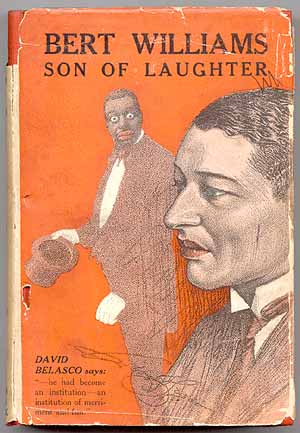
Stage star Lionel Perry [born in Key West, Florida in 1902] seems to have modeled his act on MAE WEST's favorite: the great black minstrel and vaudevillian Bert Williams [12 November 1874 — 4 March 1922].
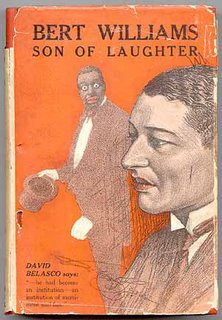 • • In an interview with Charlotte Chandler, Mae described meeting the great Bert Williams when she was a child. Little Mae was so enchanted by him that she had learnt his theme song "Nobody" — — along with a stylish imitation of the superb timing and gestures that Bert Williams used to dramatize the sad words. This number was unusual for Mae, who never liked anything downbeat.
• • Knowing how much his daughter idolized the star, Mae's father made his acquaintance and invited him home in 1903. Unfortunately, Mae did not recognize the mocha-skinned West Indian entertainer without his blackface make-up and ran into her room crying, "It's not him!" To convince her, Bert Williams started to sing, whereupon Mae emerged from her bedroom and happily sat down to supper with Bert Williams and her family.
• • Bert Williams went on to star on Broadway in the Ziegfeld Follies and In Dahomey. Mae West remained a lifelong admirer of his comedic talents.
• • [Source: Charlotte Chandler, The Ultimate Seduction, Doubleday, 1984.]
• • Nobody: Since she sang the song for years in vaudeville as an amateur, Mae West would have known that Alex Rogers and Bert Williams co-wrote the song "Nobody" [New York: Attucks Publishing Co., 1905]. Though the cover of the song sheet shows Williams in blackface, it avoids the grotesque caricatures common in sheet music at the time. The song was published by the Attucks Publishing Co. (later Gotham-Attucks), the only notable black-owned music publishing company in New York before the 1920s. The firm was named for Crispus Attucks [c. 1723 — 5 March 1770], the martyred black sailor of the American Revolution. "Nobody" was the firm's biggest success.
• • On this day, the November 12th birthdate of the great Bert Williams is remembered.
• • Come up and see Mae every day online: http://MaeWest.blogspot.com/
________
Source:http://maewest.blogspot.com/atom.xml
Mae West
• • Photo: • • Mae West's idol • • Bert Williams • •
• • Feed — — http://feeds2.feedburner.com/MaeWest
NYC
Mae West.
MAE WEST was cast in "A Winsome Widow," a Broadway success in 1912.
• • Produced by Florenz Ziegfeld, Jr., "A Winsome Widow" had several numbers created by a diverse group of songwriters and composers, for instance, Jerome Kern, then 27 years old.
• • A native New Yorker like Mae West, Jerome Kern [27 January 1885 — 11 November 1945] was an American composer of musical theatre and popular music who was raised in Manhattan. One of the most important American theatre composers of the early 20th century, he wrote more than 700 songs, used in over 100 stage works, including such classics as "Ol' Man River," "Can't Help Lovin' Dat Man," "A Fine Romance," "Smoke Gets in Your Eyes," "All the Things You Are," "The Way You Look Tonight," "Long Ago (and Far Away)," "Who?" — — and songs intended to be performed in "Winsome Widow" by Mae West. During his long career, Kern collaborated with many of the leading librettists and lyricists of his era, including George Grossmith Jr., Guy Bolton, P. G. Wodehouse, Otto Harbach, Oscar Hammerstein II, Dorothy Fields, Johnny Mercer, Ira Gershwin and E. Y. Harburg.
• • In the fall of 1945, Kern returned to New York City to oversee auditions for a new revival of Show Boat, and began to work on the score for what would become the musical Annie Get Your Gun, to be produced by Rodgers and Hammerstein. On 5 November 1945, he suffered a cerebral hemorrhage while walking at the south west corner of Park Avenue and 57th street, apparently in search of a drugstore for the pills he depended on, but had forgotten to bring with him. Today we mark the passing of this astonishingly talented composer.
• • On this November date, Veterans Day, we also salute those who have served this country.
• • Come up and see Mae every day online: http://MaeWest.blogspot.com/
________
Source:http://maewest.blogspot.com/atom.xml
Mae West
• • Photo: • • Mae West • • none • •
• • Feed — — http://feeds2.feedburner.com/MaeWest
NYC
Mae West.
Even MAE WEST's charm and charisma could not save "Myra Breckinridge" [released on 24 June 1970] — — but two numbers she performed onscreen were pressed on a promotional disk and the record has become quite a keepsake. It took the efforts of three adults worshipping at the grotto of improbable thoughts to come up with an astonishing sweetcake fat with brag like "You Gotta Taste All the Fruit," copyrighted in 1964 and only used in this particular motion picture. Maybe it became tainted fruit, especially for morose types who prefer songs about ummm . . . suffering heroically. Tsk! So many can't take a joke.
• • Born in Brooklyn, New York during the month of November — — on 10 November 1929 — — Marilyn Bergman is a composer, songwriter and author. She and her husband Alan Bergman, whom she married in 1958, were born in the same hospital and raised in the same Brooklyn neighborhood, but did not meet until each had relocated to Los Angeles. Together they have written the music and lyrics for numerous television shows, films, and stage musicals. And the couple teamed up with Sammy Fain to create "You Gotta Taste All the Fruit." Fain wrote the music and the Bergmans collaborated on the lyrics.
• • Marilyn Bergman was inducted into the Songwriters Hall of Fame in 1980, and in 1995 she was awarded an honorary doctorate by the Berklee College of Music. Join us in wishing this talented woman a very happy birthday.
• • Come up and see Mae every day online: http://MaeWest.blogspot.com/
________
Source:http://maewest.blogspot.com/atom.xml
Mae West
• • Photo: • • Mae West • • none • •
• • Feed — — http://feeds2.feedburner.com/MaeWest
NYC
Mae West.
In "Sometime" MAE WEST perfected her performance style. The 26-year-old vaudevillian discovered fresh inspiration in Ed Wynn, who was at the peak of his stage career.
• • While playing opposite the seasoned 32-year-old cut-up in Arthur Hammerstein's Broadway hit "Sometime" (with a music score by Rudolf Friml), Mae came to the realization that she was throwing away her lines. Observing the crafty comic timing of Ed Wynn, said Mae West, and watching how he made sure he caught the audience's attention before delivering a line, was the best lesson. Her character in this production was Mayme Dean, his was Loney Bright.
• • Premiering during October of 1918, "Sometime" — — the "musical comedy of commerce" — — was designed to showcase the talents of laughmeister Ed Wynn. The show had opened at the Shubert Theatre on Saturday 4 October 1918 (and went on to enjoy a nice healthy run until June 1919 on West 44th Street).
• • One of the most repeated jokes in "Sometime" was Ed Wynn's line: What is a man to do in wartime when he can't make both ends meet? [Answer: Make one end vegetables.] But the somber echoes of the World War were growing less oppressive by the time autumn arrived. The Armistice was signed on 11 November 1918 amid national fanfare and rejoicing.
• • Born in Philadelphia during the month of November — — on 9 November 1886 — — Ed Wynn [1886 — 1966] was a popular American comedian and actor noted for his Perfect Fool comedy character, his pioneering radio show of the 1930s, and his later career as a dramatic actor. Wynn became a headliner in vaudeville in the early-1910s, and was a star of the Ziegfeld Follies starting in 1914. Today we pay tribute to a legend on his birthday.
• • Come up and see Mae every day online: http://MaeWest.blogspot.com/
________
Source:http://maewest.blogspot.com/atom.xml
Mae West
• • Photo: • • Mae West • • none • •
• • Feed — — http://feeds2.feedburner.com/MaeWest
NYC
Mae West.
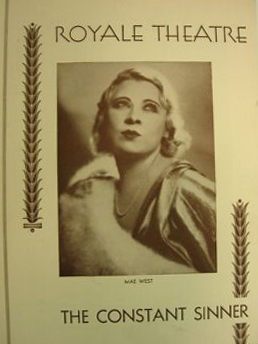
Imagine how MAE WEST felt coming back to Brooklyn on 8 November 1931. After the final curtain came down at the Royale Theatre on "The Constant Sinner" starring and written by Mae West, the show moved across the river and opened at the grand Majestic Theatre, 651 Fulton Street. 
• • Set in Harlem, the play had opened in Manhattan on 14 September 1931 and it ran for 64 performances on Broadway.
• • The Great Depression increased the number of jobless adults and, by 1931, the unemployment rate had reached nearly 16 percent. Obviously, the bleak economic downturn took a bite out of the box office, lowering everyone's ticket sales — — not only Mae West's productions. But the storyline of "The Constant Sinner" — — Babe Carson's love for Money Johnson, a dark-skinned Harlem hoodlum with a bootlegging empire, kept many theatre-goers away. Miscegenation was a touchy subject in 1931, as Mae West knew. The Harlem Breakfast Club scenes also featured inter-racial couples. Racial attitudes being what they were during the 1930s, several critics who reviewed the play said that these scenes "turn the stomach."
• • Mae West had a large pool of African-American talent to pick from. She cast fourteen black actors and actresses, many with serious stage credentials. However, Mae was not allowed to cast the dashing, debonair actor she really wanted — — LORENZO TUCKER, billed as "The Black Valentino" — — for the role of "Money Johnson."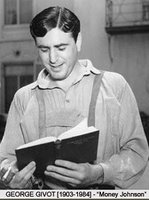
• • The Shuberts and Jim Timony refused to let Mae West cast a black man as her lover, afraid this would trigger police raids and worse. Forced to give in, Mae agreed to hire vaudevillian George Givot to play the Harlem hotshot during the play's Broadway run. George Givot [shown here in 1936] played the role in blackface. The Shuberts wrote it into his contract that, at the end of each performance, Givot would have to remove his wig to assure the audience that it was a Caucasian who was embracing the curvy blonde "Babe Carson" [Mae West] onstage.
• • When a detective warns Babe Carson she is in a tight spot, she shoots back, "I can always handle tight spots."
• • Another suggestive line was this one from Babe Carson: "COME UP SOMETIME, BOYS," she purrs to a group of guys. "I'LL TELL YOUR FORTUNE."
• • Two years later Mae was Hollywood's box office queen. On 8 November 1933 a cover story ran in the Nation: "Mae West and the Classic Tradition" by journalist William Troy.• • Come up and see Mae every day online: http://MaeWest.blogspot.com/
________
Source:http://maewest.blogspot.com/atom.xml
Mae West
• • Photo: • • Mae West • • 1931 • •
• • Feed — — http://feeds2.feedburner.com/MaeWest
NYC
Mae West.
 MAE WEST worked with one burly British actor who relocated to Hollywod and was cast, invariably, whenever the script called out for a large, brutish, but soft-hearted man of action.
• • Born in Tunbridge Wells, Kent, Victor McLaglen [10 December 1886 — 7 November 1959] was an English boxer and World War I veteran who became a leading American film actor.
• • Tsk-tsking over "Klondike Annie" in his film review for The New York Times on 12 March 1936, Frank S. Nugent wrote: As a Westian improvisation, the story is no worse than most of her English compositions, but that, alas, does not apply to its dialogue and treatment. It is downright discouraging to hear Miss West perplex Mr. McLaglen by saying she was "heading for the arms of Morpheus" and it is worse when McLaglen remarks, "I can always tell a lady when I see one" and she comes back with a "Yeah? What do you tell 'em?" If that is what the Legion of Decency meant when it rated "Annie" as objectionable in part, then we agree with the legion. ...
• • Victor McLaglen eventually became a U.S. citizen. He died on 7 November 1959 of a heart attack. He was buried in Forest Lawn Memorial Park in Glendale, California.
• • Come up and see Mae every day online: http://MaeWest.blogspot.com/
________
Source:http://maewest.blogspot.com/atom.xml
Mae West
• • Photo: • • Mae West • • with Victor McLaglen, 1936 • •
• • Feed — — http://feeds2.feedburner.com/MaeWest
NYC
Mae West.
 Harvey Francis Thew — — who died in the month of November — — massaged a famous screenplay with MAE WEST.
• • Born in Missouri on 4 July 1883, writer Harvey F. Thew collaborated with Mae West, and screenwriter John Bright, and Lowell Sherman in 1932 on the film version of the bombshell's best-known three act stage play "Diamond Lil." For Paramount Pictures, Mae turned her 3-hour Bowery melodrama into a trim 66-minute comedy with the aid of Harvey Thew.
• • The studio released "She Done Him Wrong" on 9 February 1933. A Hollywood Valentine for movie-goers! • • A screenwriter since 1916, Harvey Thew actually spent most of his movie career at Warner Brothers Pictures. One of his in-laws was John Barrymore (which did not hurt his career at all).
• • According to TCM's film historian Frank Miller: Hays' demands actually improved the film. Screenwriter John Bright, who had scored a hit with The Public Enemy (1931), was assigned to collaborate on the screenplay — — but he didn't click with West, and her script didn't impress him either. Bright thought it was a creaky old melodrama filled with cheap jokes and tried to make it more of a straight crime film. West hated his ideas, but had a battle getting the studio to side with her. Then one of Hays' associates suggested that the film might be more palatable if played for comedy. That was the excuse she needed to cut Bright's additions and return many of her laugh lines (eventually she had him replaced by Harvey Thew). When Hays suggested toning down references to Lou's past affairs, West added a maid character (played by Louise Beavers) who knew of her past so the two could discuss it in a series of veiled references.• • Those references — — and West's ability to make even the most innocent lines sound risque — — made the film a hit and made her one of the world's most quoted writers.
• • At the age of 63, hard-working Harvey F. Thew died in Los Angeles on 6 November 1946.
• • Come up and see Mae every day online: http://MaeWest.blogspot.com/
________
Source:http://maewest.blogspot.com/atom.xml
Mae West
• • Photo: • • Mae West • • 1932 publicity shot for "She Done Him Wrong" • •
• • Feed — — http://feeds2.feedburner.com/MaeWest
NYC
Mae West.
No prude, MAE WEST did not hide the fact that she had worked in Burlesque as well as in Vaudeville.
• • An interesting article by Divinity Rose discusses these forms of popular entertainment and their individual appeal. Divinity Rose writes: One of the first specific applications of "vaudeville" to describe a variety show was by "Sargeant's Great Vaudeville Company" in Louisville in 1871. The word “vaudeville” carried with it the sophistication and romance associated with Paris. We have seen one theory for the word's origin, the troubadours of the Val-de-Vire region of France. Another theory is that it comes from voix de ville, meaning “voice of the city.” Seen in this light, the phrase reminds us of vaudeville's identity as a folk form, an expression of the people's voice. The word “vaudeville” distinguished the new business from variety, which was used by some people like a curse word. Vaudeville is where Marx and Chaplin — — along with Mae West, Harry Houdini, Milton Berle, and countless others got their start.
• • Divinity Rose adds: Burlesque was a little different than Vaudeville. Burlesque had a lot of comedy, charm, and girls taking off their clothes. When it began, it was about witty and charming women and clever comedy. Although, performers in Vaudeville often looked down on Burlesque, many great comedy acts polished their performances there. Burlesque offered stable work during tougher times, and so many bigger acts performed in burlesque shows under aliases. . . .
— — Excerpt: — —
• • Article: "Vixens and Vaudeville Part 1: The history of Vaudeville, Burlesque and the Vixens"
• • Written by: Divinity Rose
• • Published on: Monday, 1 November 2010
• • Published by: Louisville.com• • Come up and see Mae every day online: http://MaeWest.blogspot.com/
________
Source:http://maewest.blogspot.com/atom.xml
Mae West
• • Photo: • • Mae West • • none • •
• • Feed — — http://feeds2.feedburner.com/MaeWest
NYC
Mae West.
Come up and see MAE WEST in The Garden State, a perfect place to reacquaint yourself with Flower Belle Lee.
• • During the month of November, it will be free to enjoy four classic comedies from the 1940s — 1950s starting at 1 o'clock every Monday afternoon. Sidney Krueger, professor emeritus of Kean College, will introduce these motion pictures at The Library of The Chathams, 214 Main Street, Chatham, NJ 07928-2458. Info: call 973-635-0603.
• • On Monday, 29 November 2010, they will screen "My Little Chickadee" [1940, 83 mins.]. Singer Flower Belle Lee (Mae West) is run out of the Old West town of Little Bend because of her illicit relations with a masked bandit. On the train she meets con man Cuthbert J. Twillie (W. C. Fields) and pretends to marry him for respectability. In Greasewood City with his bride, Twillie is named sheriff by the town boss who has an ulterior motive.
• • Come up and see Mae every day online: http://MaeWest.blogspot.com/
________
Source:http://maewest.blogspot.com/atom.xml
Mae West
• • Photo: • • Mae West • • none • •
• • Feed — — http://feeds2.feedburner.com/MaeWest
NYC
Mae West.
Did MAE WEST "save" Paramount Pictures? Maybe — — and maybe not. A new eight-part program on TCM "Moguls and Movie Stars" will tell you she did, and that little Shirley Temple rescued Fox.
• • TV writer Hal Boedeker calls TCM’s epic “Moguls & Movie Stars” a "beautifully arranged scrapbook of Hollywood history that salutes hard-driven businessmen. In covering so much time — — 1889 to 1969 — — and so many people, this documentary isn’t especially deep."
• • Boedeker continues: But the seven-part series, which debuts at 8 tonight [i.e., 1 November 2010], is a fun, fast-moving overview of one of America’s greatest industries. Christopher Plummer reads the narration with obvious delight. The speakers include Sidney Lumet, Peter Bogdanovich, Samuel Goldwyn Jr., Richard Zanuck, Gore Vidal and TCM host Robert Osborne.
• • Revelations about the screen stars will surely surprise many viewers. Did you know, for instance, that tough guy actor James Cagney briefly worked as a female impersonator and spoke Yiddish?
• • In his TV column, Boedeker has fun emphasizing some eye-raising quotes he spotted along the way. Example: Film historian Ian David Thomson says of Cary Grant, “You could not believe how insecure he was.” Thomson also calls attention to Clark Gable’s false teeth. And Film critic Molly Haskell says of Marilyn Monroe, “She’s America pretending to want sex and not wanting it at all.” . . .
• • “Moguls & Movie Stars” sounds entertaining and TV buffs will have a few weeks worth of episodes to digest.
— — Excerpt: — —
• • Article: "Moguls & Movie Stars’ studies Hollywood dreams and nightmares"
• • Written by: Hal Boedeker, TV blogger
• • Published on: Monday, 1 November 2010
• • Published by: The Orlando Sentinel — — orlandosentinel.com
• • Come up and see Mae every day online: http://MaeWest.blogspot.com/
________
Source:http://maewest.blogspot.com/atom.xml
Mae West
• • Photo: • • Mae West • • none • •
• • Feed — — http://feeds2.feedburner.com/MaeWest
NYC
Mae West.
Raise your eyebrows if you remember MAE WEST's Slick Wiley, for whom we nod in November.
• • Born in Pittsburgh, Pennsylvania on 17 May 1899, Ralf H. Wigger wiggled his name to Ralf Harolde and headed for the Hollywood Hills. Often cast in bit parts, Ralf Harolde racked up nearly 100 motion picture credits between 1920 — 1963.
• • In "I'm No Angel," the slinky five-foot-eleven Easterner played Tira's jealous boyfriend, Slick, who tails her to the hotel where she is romancing a big spender from Dallas. When Slick knocks the Texan unconscious and robs him, he puts Tira in a compromising position.
• • Hal Erickson describes the screen veteran briefly in his excellent All Movie Guide: The best way to physically describe actor Ralf Harolde is to note his striking resemblance to Zeppo Marx. However, Harolde projected a far more sinister image than Marx, beginning with his film debut as the "gentlemanly" villain in Bebe Daniels' "Dixiana" (1930). Often cast as a low-life crook, he played an escaped convict who hid behind his wife and children in "Picture Snatcher" (1933) and the erstwhile kidnapper of little Shirley Temple in "Baby Take a Bow" (1934). He also showed up in such minor roles as a Tribunal prosecutor in "Tale of Two Cities" (1935) and a tuxedoed society gangster in Laurel and Hardy's "Our Relations" (1936).
• • Hal Erickson adds: Ralf Harolde's film career came to a screeching halt when, in 1937, he was involved in a traffic accident that resulted in the death of fellow actor Monroe Owsley. When Ralf re-emerged on screen in 1941, it was clear that the tragedy had taken its toll: Harolde's facial features had taken on a gaunt, haunted look, and his hair had turned completely white. Remaining active until the mid-1950s, Ralf Harolde still had a few good screen characterizations left in him — — most notably the sleazy sanitarium doctor in "Murder My Sweet" (1944).
• • Born in 1901, Monroe Owsley was featured in the Mae West vehicle "Goin' to Town" [1935]; often cast as a debauched young playboy, he played Cleo Borden's "husband-by-convenience" Fletcher Colton. Monroe died on 7 June 1937 from a heart attack suffered during a car accident. He was 36 years old.
• • On 1 November 1974, Ralf Harolde died of pneumonia in Santa Monica, California at age 75.
• • Come up and see Mae every day online: http://MaeWest.blogspot.com/
________
Source:http://maewest.blogspot.com/atom.xml
Mae West
• • Photo: • • Mae West • • none • •
• • Feed — — http://feeds2.feedburner.com/MaeWest
NYC
Mae West.