skip to main |
skip to sidebar
MAE WEST made some lifelong friends in Ridgewood such as Gus Van.
• • According to Walter Hutter of Ridgewood: "Van and Schenck discovered each other in a tavern at Knickerbocker and Willoughby Avenues, their meeting coming through an introduction by Jack West, father of Mae West. Mae was another famous personality with a Ridgewood background."
• • Joe Schenck rehearsed with Mae and his musicians in a clubhouse located at 70-12 Cypress Hills, Ridgewood, NY.
• • Born in Brooklyn, New York on 2 June 1891, Joseph Thuma Schenck was a musician, a pianist, and a singer with strong ambitions.
• • Schenck died at age 39 while working with Van in Detroit on 28 June 1930.
• • Joe's partner was Gus Van [birthname: August von Glahn].
• • Gus Van [12 August 1886 —12 March 1968] • •
• • Born in Brooklyn, New York on 12 August 1886, Gus Van was a performer, lyricist, and composer who appeared in Broadway musicals from November 1916 — February 1947. Starting with the show "Miss 1917," directed by Ned Wayburn, Gus Van also contributed the music. Van and Schenck appeared in the Ziegfeld Follies from 1919 — 1921; Van wrote some of the music for the 1920 edition of this popular series. He was also known for his amusing novelty songs such as "Pastafazoola" and "She Knows Her Onions."
• • Van and Schenck both starred with Bessie Love in "They Learned About Women" [1930], a musical scripted by Arthur "Bugs" Baer, et al. After Schenck's death, the five-foot-seven entertainer also appeared in four other projects for the silver screen between 1935 — 1939.
• • In 1944 Gus Van sang a vaudeville song in Atlantic City written by Tommy Gray and first performed by Mae West: "That's How You Can Tell They're Irish."
• • Gus Van died in Miami Beach in the month of March — — on 12 March 1968. He was 80.
• • Mildred Katherine West [8 December 1898 — 12 March 1982] • • 
• • In the month of March, we honor Mae's younger sister Beverly.
• • In March 1924, Variety noted a new act listed on Manhattan's stagebill: "Beverly West and Co., Piano and Singing." While not mentioning that she was Mae West's sister, Variety's reviewer admitted that "she puts over her numbers acceptably." Proctor's East 58th Street location had engaged Beverly and her musicians in 1924. Back in 1895, F.F. Proctor had built his playhouse, Proctor's Pleasure Palace Palm Gardens, on 154 East 58th Street, New York, NY in midtown on the eastside [now zipcode 10022]. During the same interval (mid-March in 1924), Mae West was trouping in vaudeville in Texas.
• • Born in Brooklyn on 8 December 1898, Beverly changed her stage name a few times. She was Beverly Osborne, then it was Beverly Arden. Afflicted with polio and a limp, Beverly favored long dresses that covered her imperfect legs. Beverly died two years after her older sister on Friday, 12 March 1982. She was 83.
• • Born on 12 March 1874 • •
• • Mae West was cast in "Vera Violetta," a musical that opened on 20 November 1911 at the Winter Garden Theatre when she first worked with Mr. Atteridge.
• • Most of the music was prepared by composer Edmund Eysler who was born in Vienna in March — — on 12 March 1874.
• • On Thursday, 12 March 1936 in The N.Y. Times • •
• • The reviewer for The N.Y. Times Frank S. Nugent was aware of the uproar from the Hays Office that delayed Mae's latest motion picture. Nugent wrote: Mae West's "Klondike Annie" really does not merit the agitation it has caused. His comments appeared in The N.Y. Times on Thursday, 12 March 1936.
• • In Her Own Words • •
• • Mae West said: "lt just breaks my heart when the censors take out my best cracks."
• • Quote, Unquote • •
• • An article about Raquel Welch mentioned Mae West.
• • ContactMusic.com wrote: Actress RAQUEL WELCH has finally spoken out about her notorious feud with MAE WEST — — accusing the late screen legend of being scared to work with her. The two appeared alongside each other in 1970 movie "Myra Breckinridge," and their feud became legendary in Hollywood.
• • ContactMusic.com wrote: Raquel Welch discusses the rift on the movie's DVD. She says, "Mae didn't really work until after 5 pm. Those were her hours, and it was even stipulated in her contract. I only had one scene with her, and she was quite apprehensive about working with me. She hadn't done a movie in a long time, and in all her previous films, she had been the only star and the only woman, and she was not very inclined to share the screen. So there were a few shenanigans."
• • ContactMusic.com wrote: Their battle came to a head just before their scene together was shot, says Welch, who recalls, "She had my costume removed from the dressing room. When I went to my closet, it wasn't there. I called my producer and told him my dress had disappeared, and he told me it had been confiscated." West's costume was white, and she objected to Welch wearing a black gown "because black is also a non-colour." Welch adds, "This poor woman was really scared — — and I've got to say some of this now because I'm doing a book." . . .
• • Source: Article: "Raquel Welch Opens Up On Mae West Feud" for ContactMusic.com; posted on 12 March 2004
• • By the Numbers • •
• • The Mae West Blog was started seven years ago in July 2004. You are reading the 2236th blog post. Unlike many blogs, which draw upon reprinted content from a newspaper or a magazine and/ or summaries, links, or photos, the mainstay of this blog is its fresh material focused on the life and career of Mae West, herself an American original.
• • Come up and see Mae every day online: http://MaeWest.blogspot.com/
________
Source:http://maewest.blogspot.com/atom.xml

Mae West
• • Photo: • • Mae West's sister • • Beverly West • •
• • Feed — — http://feeds2.feedburner.com/MaeWest
NYC
Mae West.

On 6 December 1911 "Vera Violetta" was still on Broadway, however, MAE WEST had been dismissed for her attempts at up-staging the star. One of the women Mae had rehearsed with was the British beauty Jose Collins, age 24, who was cast in this musical as Mme. von Gruenberg.
• • Born in London on 23 May 1887, Jose Collins was born to a famous music hall star and got into the business quickly as a child performer. By her 17th birthday, the vivacious brunette had appeared in both pantomime and music hall as a singer and actress. In 1908, she made her West End debut in a principal role in The Antelope (1908). On Broadway, she appeared in Vera Violetta (1911), The Merry Countess (1912), and The Whirl of Society (1912), in which she performed a duet with Al Jolson, etc. Her revue appearances included the Ziegfeld Follies (1913), and The Passing Show (1914). Starring roles in London and on Broadway and in revivals came her way in 1916.
• • Though her movie career was brief, lasting from 1915 — 1933, after appearing in 13 features for the silver screen — — including her role as Bessie, the vengeful model, in "The Light That Failed" [1916] based on Rudyard Kipling's poem — — Jose Collins would spend the remainder of her career in revues, variety, and also non-musical roles.
• • Though Jose Collins was married three times, she had no children. She died in London in December — — on 6 December 1958. She was 71.
• • In December, Let's Remember John Lorenz [1886 — 1972] • •
• • More than anything, variety artist Mae West wanted to be "in the legit" — — on The Gay White Way — — and Jesse Lasky gave her an opportunity. The extravaganza, produced by Ned Wayburn, Mae's dancing teacher, was titled "A La Broadway."
• • In 1911, Jesse Lasky opened the Folies-Bergere, a plush dinner theatre restaurant on West 46th Street and he cast a pretty 18-year-old Mae to appear in the revue along with a comedy duo, Cook and Lorenz. Supposedly, these comedians could not master their props in time to accompany her, therefore, Mae was unable to perform her first song, a ballad called "They Are Irish," the way it had been staged originally.
• • But what if the real explanation had to do with racial bias instead? James Cook was a black man and maybe that's why the producers yanked the team away from sharing a spotlight with Mae.
• • John Lorenz was cast as Nick O'Teene in "A La Broadway." Born in Buffalo, NY in December — — on 6 December 1886 — — his Broadway career began in 1909 when he was attached to a musical comedy "The Motor Girl." After doing several shows, he took his final bows in "Ramshackle Inn," a farce, in 1944.
• • He seems to have teamed up with a mature performer James Cook by 1910 and they actively toured on the vaudeville circuit. Considered to be one of the "monarchs of minstrelsy," James Cook had done a blackface act in 1885 with Rankin's Minstrels. (Blacks were recognized as musicians of talent, due to the popularity of minstrel shows.) Additionally, James Cook was an early member of the White Rats. James Cook was cast as Jim Jamb in "A La Broadway" and he may have been cast in another production on the Gay White Way in 1932.
• • John Lorenz died in Paramus, New Jersey on 30 April 1972.
• • On 5 December 1939 • •
• • In the year 1939, December's first musical on Broadway was "DuBarry Was a Lady," which opened on 6 December 1939 at the 46th Street Theatre, where Mae had once shared the stage twenty years before with Sophie Tucker. The female lead was said to have been tailored at first for Mae West.
• • On 6 December 1994 in NYC • •
• • It was on Tuesday, 6 December 1994 that Christie's New York held an auction listed as "Film and Television Memorabilia." One light-hearted Mae West item was "A box of approximately 120 red, white, and blue poker chips; a deck of cards from the Roosevelt Hotel." This lot of goodies was sold for $345.00 and now the deck is stacked at someone's house.
• • On 6 December 2008 in Santa Monica • • 
• • Michael Gregg Michaud devoted his exhibit to Mae West figurines and it opened on Saturday, 6 December 2008 in the Project Room of the Lora Schlesinger Gallery in Santa Monica, California.
• • At the opening, on December 6th, attendees were handed programs. This is the text the West Coast gallery on Michigan Avenue had composed: With one hand firmly on her hip and the other primping her blond curls, Mae West represented the promise of good times ahead. Beginning in the 1930s, her figure was reproduced as a “chalk doll,” which became a popular prize at carnival games. These so-called “Carnival Dolls” were made of plaster of paris using a mould, and individually hand-painted. Several companies located on the West Coast produced these “Carnival Dolls.” One of the largest manufacturers was located in Venice, California and called the Venice Doll Company. Seventy years later, Mae West Carnival Dolls not only invoke a sense of nostalgia, but still represent the promise of fun. Mae West said it best, “It’s better to be looked over, than overlooked.” Mr. Michaud's display was on view there until 17 January 2009.
• • In Her Own Words • •
• • Mae West said: "To me the most difficult part of placing a successful motion picture story is getting it cast correctly."
• • Quote, Unquote • •
• • An article on the initial Cannes Film Fest mentioned Mae West.
• • Kenneth Turan writes: The initial Cannes film festival was scheduled for the first three weeks of September 1939. Hollywood responded by sending over "The Wizard of Oz" and "Only Angels Have Wings" along with a "steamship of stars" including Mae West, Gary Cooper, Norma Shearer, and George Raft. The Germans, however, chose 1 September 1939 to invade Poland, and after the opening-night screening of "The Hunchback of Notre Dame," the festival was cancelled and didn't start up again until 1946. .. .
• • Source: Article: "A festival of art and prostitution" written by USA critic Kenneth Turan for The Guardian [UK]; published on Thursday, 9 May 2002
• • By the Numbers • •
• • The Mae West Blog was started seven years ago in July 2004. You are reading the 2137th blog post. Unlike many blogs, which draw upon reprinted content from a newspaper or a magazine and/ or summaries, links, or photos, the mainstay of this blog is its fresh material focused on the life and career of Mae West, herself an American original.
• • Come up and see Mae every day online: http://MaeWest.blogspot.com/
________
Source:http://maewest.blogspot.com/atom.xml
Mae West
• • Photo: • • Mae West • • chalkware 1930s • •
• • Feed — — http://feeds2.feedburner.com/MaeWest
NYC
Mae West.
Stage star Lionel Perry [born in Key West, Florida in 1902] seems to have modeled his act on MAE WEST's favorite: the great black minstrel and vaudevillian Bert Williams [12 November 1874 — 4 March 1922].
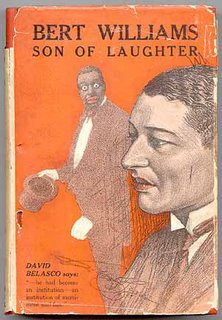 • • In an interview with Charlotte Chandler, Mae described meeting the great Bert Williams when she was a child. Little Mae was so enchanted by him that she had learnt his theme song "Nobody" — — along with a stylish imitation of the superb timing and gestures that Bert Williams used to dramatize the sad words. This number was unusual for Mae, who never liked anything downbeat.
• • Knowing how much his daughter idolized the star, Mae's father made his acquaintance and invited him home in 1903. Unfortunately, Mae did not recognize the mocha-skinned West Indian entertainer without his blackface make-up and ran into her room crying, "It's not him!" To convince her, Bert Williams started to sing, whereupon Mae emerged from her bedroom and happily sat down to supper with Bert Williams and her family.
• • Bert Williams went on to star on Broadway in the Ziegfeld Follies and In Dahomey. Mae West remained a lifelong admirer of his comedic talents.
• • [Source: Charlotte Chandler, The Ultimate Seduction, Doubleday, 1984.]
• • Nobody: Since she sang the song for years in vaudeville as an amateur, Mae West would have known that Alex Rogers and Bert Williams co-wrote the song "Nobody" [New York: Attucks Publishing Co., 1905]. Though the cover of the song sheet shows Williams in blackface, it avoids the grotesque caricatures common in sheet music at the time. The song was published by the Attucks Publishing Co. (later Gotham-Attucks), the only notable black-owned music publishing company in New York before the 1920s. The firm was named for Crispus Attucks [c. 1723 — 5 March 1770], the martyred black sailor of the American Revolution. "Nobody" was the firm's biggest success.
• • On this day, the November 12th birthdate of the great Bert Williams is remembered.
• • Come up and see Mae every day online: http://MaeWest.blogspot.com/
________
Source:http://maewest.blogspot.com/atom.xml
Mae West
• • Photo: • • Mae West's idol • • Bert Williams • •
• • Feed — — http://feeds2.feedburner.com/MaeWest
NYC
Mae West.
In "Sometime" MAE WEST perfected her performance style. The 26-year-old vaudevillian discovered fresh inspiration in Ed Wynn, who was at the peak of his stage career.
• • While playing opposite the seasoned 32-year-old cut-up in Arthur Hammerstein's Broadway hit "Sometime" (with a music score by Rudolf Friml), Mae came to the realization that she was throwing away her lines. Observing the crafty comic timing of Ed Wynn, said Mae West, and watching how he made sure he caught the audience's attention before delivering a line, was the best lesson. Her character in this production was Mayme Dean, his was Loney Bright.
• • Premiering during October of 1918, "Sometime" — — the "musical comedy of commerce" — — was designed to showcase the talents of laughmeister Ed Wynn. The show had opened at the Shubert Theatre on Saturday 4 October 1918 (and went on to enjoy a nice healthy run until June 1919 on West 44th Street).
• • One of the most repeated jokes in "Sometime" was Ed Wynn's line: What is a man to do in wartime when he can't make both ends meet? [Answer: Make one end vegetables.] But the somber echoes of the World War were growing less oppressive by the time autumn arrived. The Armistice was signed on 11 November 1918 amid national fanfare and rejoicing.
• • Born in Philadelphia during the month of November — — on 9 November 1886 — — Ed Wynn [1886 — 1966] was a popular American comedian and actor noted for his Perfect Fool comedy character, his pioneering radio show of the 1930s, and his later career as a dramatic actor. Wynn became a headliner in vaudeville in the early-1910s, and was a star of the Ziegfeld Follies starting in 1914. Today we pay tribute to a legend on his birthday.
• • Come up and see Mae every day online: http://MaeWest.blogspot.com/
________
Source:http://maewest.blogspot.com/atom.xml
Mae West
• • Photo: • • Mae West • • none • •
• • Feed — — http://feeds2.feedburner.com/MaeWest
NYC
Mae West.
A strolling impersonator — — made up to resemble MAE WEST — — will delight New Year's Eve celebrants in Coconut Creek, Florida.
• • A party-planner at the Seminole Casino had the idea of offering a Ziegfeld Follies-style show along with the usual sit-down supper and balloon-drop on 31 December 2009. The New Century Dance Company will perform onstage show. A live band will play music from the 1930s to today.
• • Topping off the retro entertainment in the butterfly capital of the world will be strolling impersonators of Mae West, WC Fields, and others.
• • WHERE: Seminole Casino Coconut Creek — — Entertainment Pavilion, 5550 NW 40th St., Coconut Creek, FL, 33073; T 954-977-6700.• • Come up and see Mae every day online: http://MaeWest.blogspot.com/________
Source:http://maewest.blogspot.com/atom.xml
Mae West
• • Photo: • • Mae West • • none • •
• • Feed — — http://feeds2.feedburner.com/MaeWestNYC
Mae West.
Nineteen-year-old MAE WEST claimed to be "The Original Brinkley Girl." 
• • During 1912-13, when Mae was still trying to find her way in her career, she was billing herself as a "Nell Brinkley Girl." At the time, she was a fresh-faced brunette teenager with a penchant for physically energetic routines in vaudeville. Unlike other performers who had but one act to offer the audience, Mae was always testing new approaches and buying new material. She tried to dazzle the ticket-holders with her versatility: fast tap dancing and acrobatic feats onstage combined with "character" [novelty] songs often in an ethnic idiom.
• • Nell Brinkley [1886—1944] • •• • What's there to remember about Nell Brinkley — — born on the 5th day in the month of September? Plenty.
• • Seven years older than the Brooklyn bombshell, beautiful Nell Brinkley [5 September 1886 — 21 October 1944] was born in Denver, Colorado, and taught herself portraiture.  In 1903, while she was still in high school, the Denver Post hired her to draw romantic cartoons. Her enchanting "Brinkley Girls" — — with their free flowing dresses and curly hair depicting a vivacious feminine beauty — — were quite unlike the passive, sedate (and sedated looking) Gibson Girl.
• • Her exposure in a Denver newspaper led to an invitation, in October 1907, to come to The Big Apple as an illustrator/ reporter for publisher William Randolph Hearst (and his editor Arthur Brisbane) at the New York Evening Journal. Now her drawings became even more popular.
• • Soon Nell Brinkley was getting assignments as a reporter to interview celebrities such as Evelyn Nesbitt-Thaw, the wife of the millionaire murderer Harry Thaw (who had killed architect Stanford White).
• • Within a few months, her artistic talent inspired a spin-off onstage. Her "Brinkley Girl" became the theme for the 1908 Ziegfeld Follies, played by Mae Murray. A young Helen Hayes also played a Brinkley Girl in the play "Jack the Giant Killer" [1909].
• • As Mae West did in her plays, Nell Brinkley widened her scope to include pen and ink depictions of working women. Brinkley used her fame to campaign for better working conditions and higher pay for women who had joined in the war effort, and who were suffering economic and social dislocation due to acting on their patriotism.
• • Unlike most of her contemporaries, she drew women of different races and cultures.
• • Nell Brinkley's illustrations influenced many artists. Brinkley's career was the model for Dale Messick's "Brenda Starr, Girl Reporter" comic strip series.
• • Come up and see Mae every day online: http://MaeWest.blogspot.com/
________
Source:http://maewest.blogspot.com/atom.xml
Mae West
• • Photo: • • Mae West • • circa 1913 • • Nell Brinkley in 1915 • •• • Feed — — http://feeds2.feedburner.com/MaeWestNYC
Mae West.
As a child, MAE WEST heard fascinating recollections about New York City's Chinatown and the Bowery. Aware of the attractiveness of these lively locales, authors found creative ways to situate their narratives in these neighborhoods.
• • Charles H. Hoyt, for instance, wrote the immensely popular musical comedy "A Trip to Chinatown." The story focuses on a widow who connives and contrives to bring romance to several couples and herself in a big city restaurant [think of "Hello, Dolly!"].
• • Still capitalizing on the "Trip to Chinatown" craze, clever showmen reworked the play again and presented it under a new title: "A Winsome Widow."
• • Nineteen-year-old brunette Mae West was featured in the show "A Winsome Widow" as La Petite Daffy in 1912.
• • The musical was presented at the Moulin Rouge, then located at 1514-16 Broadway [West 44th Street], New York, NY. This showplace was demolished in 1935.
• • This extravaganza was produced by Flo Ziegfeld, and during its latest revision the Eastside musical was relocated to the West Coast — — to San Francisco's Chinatown.
• • As La Petite Daffy, Mae West won acclaim for her vivacity and sauciness. "Mae West assaults the welkin vigorously," applauded the New York Dramatic Mirror from their tony perch on West 42nd Street right opposite the New York Public Library.
• • Florenz Ziegfeld, Jr. • • • • Born in Chicago, Illinois, Florenz Ziegfeld, Jr. [1867 — 1932] was a Broadway impresario. He is best known for his series of theatrical revues, the Ziegfeld Follies [1907 — 1931], inspired by the Folies Bergères of Paris. Ziegfeld, who also built his own theatre on The Great White Way, earned a reputation as the "glorifier of the American girl."
• • At 65 years old, Flo Ziegfeld died in Hollywood, California during the month of July — — on 22 July 1932 — — from pleurisy related to a former lung infection. • • Come up and see Mae every day online: http://MaeWest.blogspot.com/
________
Source:http://maewest.blogspot.com/atom.xml
Mae West
• • Photo: • • Mae West • • none • •
• • Feed — — http://feeds2.feedburner.com/MaeWestNYC
Mae West.
Eighteen-year-old brunette MAE WEST got her first big break when she was cast in the legitimate show "A la Broadway" at New York's Folies Bergere Theatre. Ned Wayburn — — Mae's former dancing teacher — — who was staging this, pulled her in. The revue premiered 22 September 1911 and lasted eight performances.
• • The New York Times applauded Mae's debut, however, the theatre's limited seating capacity made it financially foolish to mount such an expensive entertainment there.
• • Ned Wayburn, born Edward Claudius Weyburn, was the most famous and influential choreographer in the early twentieth century.
• • Ned Wayburn [30 March 1874 — 2 September 1942] was born in Pennsylvania but spent much of his childhood in Chicago where he was introduced to theater and studied classical piano. At the age of 21, he abandoned his family’s tradition of manufacturing and began teaching at the Hart Conway School of Acting in Chicago.
• • After leaving the school, Wayburn spent many years in theater staging shows for producers. He worked with such teams as Oscar and William Hammerstein, and Marc Klaw and A.L. Erlanger.
• • In 1906, Ned Wayburn began his own management group called the Headline Vaudeville Production Company. Through his own firm he staged many feature acts, while collaborating with other producers such as Lew Fields, William Ziegfeld, and the Shuberts. In 1915, he began working with Florenz Ziegfeld and created the incredibly successful Ziegfeld Follies [1907 — 1931].
• • Ned Wayburn’s choreography was based on six idioms or techniques: musical comedy, tapping, stepping, acrobatic work, modern American ballet, toe specialties, and exhibition ballroom. His choreography was greatly affected by social dances of the time. His dancers moved in units of two or four, following popular trends. He also used a group of dancers to form shapes, as inspired by the Cotillion. He also was famous for taking dances such as the tango, the Turkey Trot, the Grizzly Bear, the Black Bottom, and the Charleston, and re-creating them for stage performances by using strong exaggerations of movement.
• • Ned Wayburn taught Mae West to do the Grizzly Bear, a dance craze that started in San Francisco (along with the Bunny Hug and Texas Tommy). The Bear dance (as it was also called) was done on the Staten Island ferry boats in the 1900s. It has been said that dancers John Jarrott and Louise Gruenning introduced this dance as well as the Turkey Trot at Ray Jones Cafe in Chicago around 1909.
• • The Bear Goes Bigtime • • • • The Grizzly Bear was first introduced to New York's Broadway audiences in the 1910 show "Over the River" via the song "Everybody's Doin' it Now." That song contained the repeated phrase "It's a Bear!" Later the Ziegfeld Follies of 1911 would feature the Bear dance by Fanny Brice. The dance was rough and clumsy since the Grizzly Bear step was imitating the movements of a dancing bear. After a very heavy step to the side, there was a decided bending of the upper part of the body from one side to the other, a deliberately ungraceful and undignified movement when performed as a dance.
• • In 1910, Sophie Tucker was arrested for singing the Grizzly Bear and the "Angle Worm Wiggle."
• • In addition to incorporating "scandalous dances" for the stage, Ned Wayburn was the one who created steps such as the “Ziegfeld Walk” and the “Gilda Glide” (for Mae's rival Gilda Gray), and worked with many well-known performers of the time such as Mae West, Fred Astaire, Marilyn Miller, Ann Pennington, Barbara Stanwyck, Clifton Webb, Evelyn Law, Fanny Brice, Gilda Gray, and others.
• • Some of his best remembered shows were Phantastic Phantoms (1907), The Daisy Dancers (1906), The Passing Show (1913), and all of the Ziegfeld Follies.• • Come up and see Mae every day online: http://MaeWest.blogspot.com/
________
Source:http://maewest.blogspot.com/atom.xml
Mae West
• • Photo: • • Mae West • • none • •
• • Feed — — http://feeds2.feedburner.com/MaeWestNYC
Mae West.
MAE WEST's idol was showman Bert Williams [1874 — 1922], who became the first African American performer in the Ziegfeld Follies from 1910 — 1920. 
• • A new book has just been published about this outstanding entertainer.
• • Introducing Bert Williams: Burnt Cork, Broadway, and the Story of America's First Black Star
• • By Camille F. Forbes
• • [NY: Basic/ Civitas Books, 404 pages]
• • Michael Feingold's review for The Village Voice ["The Sad Funny Man: Rethinking the career of Bert Williams, who raised blackface to the level of an art form] begins like this:
• • Melancholy was his stock in trade. All his songs deal with misery, pain, and violence, usually visited on him. His primary activity in performance consisted of being lured from one hideous situation into a worse one. Onstage, his melancholy made audiences laugh immeasurably; offstage, a deeply inward soul, he carried it with him, retreating into his dressing room or his library at home to read philosophy and poetry. One of his dearest friends among the colleagues of his later career supplied the character matrix that everyone writing about him inevitably quotes: "[He] was the funniest man I ever saw, and the saddest man I ever knew."
• • Michael Feingold continues: The sad funnyman's name was Bert Williams. That the colleague quoted above was W.C. Fields, whose own melancholy ran nearly as deep, says something not only about the sadness of great comic artists but also about America. Bert Williams (1874–1922) was black. For an African-American in that time of upheaval, he had a life that might have seemed to justify only joy. One of the most beloved public figures of his day, a star whose name and stock phrases were known to virtually everybody, in good years he earned an income substantially above that paid to any public official, including the president. Though not a crusader by temperament, he used his position to make many small breaches in the Jim Crow barriers behind which African-Americans were then trapped: He led the first black theater troupe to play in a Broadway house, and the first to give a royal command performance in England. He was the first black artist to become a recording star, and the first to play a leading role on Broadway on an equal footing with white artists. He is, unmistakably, a hero of our culture. ...
• • Clearly appreciating the showmanship of versatile Bert Williams — — if not the talents of his latest biographer Camillie Forbes — — book reviewer Michael Feingold adds: Yet he was both a hero and a great artist. That comes through clearly in Camille F. Forbes's ploddingly written but exhaustive new biography, Introducing Bert Williams. Forbes, an academic preoccupied with the social meanings she can read into Williams's career, gives only a hollowly theoretical sense of his life and achievements as an artist, and her sense of the era's theatrical culture is erratic at best, but the social questions she belabors are those with which Williams grappled, and she leaves no doubt that "realness" was indeed the driving passion behind his art. ...
• • Luckily for us, Michael Feingold points out, Bert Williams left his monument on disc: The immaculate timing and ripe musicality of his songs and spoken routines (available on a 3-CD set from Archeophone) make the optimal antidote for Forbes's muzzy prose.
• • Michael Feingold's complete review was published in The Village Voice.
— — Excerpt: — —
• • The Sad Funny Man: Rethinking the career of Bert Williams, who raised blackface to the level of an art form.
• • by Book Reviewer Michael Feingold
• • Published in: The Village Voice — — www.villagevoice.com
• • Published on: 12 February 2008 • • Come up and see Mae every day online: http://MaeWest.blogspot.com/
________
Source:http://maewest.blogspot.com/atom.xml
Mae West
• • Photo: • • Mae West's idol • • Bert Williams • •
NYC
Mae West.
Nineteen-year-old MAE WEST claimed to be "The Original Brinkley Girl."
• • During 1912-13, when Mae was billing herself as a "Nell Brinkley Girl," she was a fresh-faced brunette teenager with a penchant for energetic routines in vaudeville. Unlike other performers who had but one act to offer the audience, Mae was always testing new approaches and buying new material. She tried to dazzle the ticket-holders with her versatility: fast tap dancing and acrobatic feats onstage combined with "character" [novelty] songs often in an ethnic idiom.
• • What's there to remember about Nell Brinkley — — born in the month of September? Plenty.
• • Seven years older than the Brooklyn bombshell, beautiful Nell Brinkley [5 September 1886 — 21 October 1944] was born in Denver, Colorado, and taught herself portraiture. In 1903, while she was still in high school, the Denver Post hired her to draw romantic cartoons. Her enchanting "Brinkley Girls" — — with their free flowing dresses and curly hair depicting a vivacious feminine beauty — — were quite unlike the passive, sedate (and sedated looking) Gibson Girl.
• • Her exposure in a Denver newspaper led to an invitation, in October 1907, to come to The Big Apple as an illustrator/ reporter for publisher William Randolph Hearst (and his editor Arthur Brisbane) at the New York Evening Journal. Now her drawings became even more popular.
• • Soon Nell Brinkley was getting assignments as a reporter to interview celebrities such as Evelyn Nesbitt-Thaw, the wife of the millionaire murderer Harry Thaw (who had killed architect Stanford White).
• • Within a few months, her artistic talent inspired a spin-off onstage. Her "Brinkley Girl" became the theme for the 1908 Ziegfeld Follies, played by Mae Murray. A young Helen Hayes also played a Brinkley Girl in the play "Jack the Giant Killer" [1909].
• • As Mae West did in her plays, Nell Brinkley widened her scope to include pen and ink depictions of working women. Brinkley used her fame to campaign for better working conditions and higher pay for women who had joined in the war effort, and who were suffering economic and social dislocation due to acting on their patriotism.
• • Unlike most of her contemporaries, she drew women of different races and cultures.
• • Nell Brinkley's illustrations influenced many artists. Brinkley's career was the model for Dale Messick's "Brenda Starr, Girl Reporter" comic strip series.
• • Come up and see Mae every day online: http://MaeWest.blogspot.com/
________
Source:http://maewest.blogspot.com/atom.xml
Mae West
• • Photo: • • Mae West • • 1914 • •
NYC
Mae West.