skip to main |
skip to sidebar
 In October 1931 MAE WEST, starring on Broadway in her play "Constant Sinner," was also in talks to bring the show to Washington, DC.
• • The play had its Broadway premiere at the Royale Theatre on 14 September 1931 and would last there until November. Set in Harlem during the Prohibition Era, the play followed the escapades of a honey-haired prizefighter groupie named Babe Gordon who enjoys taking risks.• • Since the drama was set in and around West 125th Street, the Pittsburgh Courier (a black weekly newspaper) was keeping tabs on this. Reporter Floyd G. Snelson, Jr. signaled his appreciation. On 17 October 1931, Snelson told his readers: "Mae West Employs 30 Race Artists In Her Latest Production." Praising Mae's plans to bring a bi-racial cast with her to D.C., he pronounced the project "the cleverest piece of artistry to be expected from a woman of the Caucasian race."
• • Lorenzo Tucker: Tucker-ed Out • •
• • Later on, however, when the Mid-Atlantic area theatre owners received criticism from the media along with anonymous threats about lynching the black actor Lorenzo Tucker, Mae had to hide him in a D.C. hotel for two weeks to get the local bigots off the scent, and then smuggle Tucker back to New York City. Meanwhile, George Givot, in blackface and a curly wig, had been hired by the Schuberts to portray the Harlem pimp Money Johnson on stage.
• • On 17 October 1933 • •
• • A review of the latest Mae West motion picture was published by Variety on 17 October 33. Movie critic Land wrote: "I'm No Angel" is going to help redistribute a nice chunk of the nation's coin. That the Mae West film is going to make tubs of coin was crystal-clear opening day at the Paramount. Ushers were riding herd on a permanent corral of waitees in the lobby. As to quality, "I'm No Angel" can stand alone, although without "She Done Him Wrong" as a benediction and a million bucks worth of assorted publicity, high-brow and hoi pollil, the gross probably wouldn't reach the big brackets now looming. ...
• • On 17 October 1968 in The N.Y. Times • •
• • Mae West had plans for a cinema version of the stage play "Sextet" back in 1968.
• • Writing for The New York Times, Motion Picture Editor A.H. Weiler announced: Mae West, who has not appeared in movies for a quarter of a century, will return to the screen early next year in a film version of her play — — "Sextet" — — in which she starred in Florida in 1961.
• • This is how A.H. Weiler began his article about Mae West, whose producer was going to be Warner Brothers Seven Arts when Abe's article was published in The New York Times back on 17 October 1968. The actress was 75 years of age when she was interviewed.
• • "Sextet" — — explained Miss West — — is a comedy about a movie star who has six husbands. I appeared in it only in Florida [sic] because I didn't want to spend the time and the energy needed to bring it to Broadway.
• • I am also happy to say that I'm not doing this for the money, added Mae West. I'm fortunate in having a lot of young fans, who, I suppose, have been watching my old films on TV and listening to my rock 'n' roll records such as "Way Out West" and "Wild Christmas," who have been pleading with me to do a picture. I guess you could call "Sextet" a return by popular demand. Anyway, it's very flattering. I think "Sextet" is very funny and I hope they'll think it is, too. ...
• • On 17 October 1968 • •
• • Mae West was more interested in protecting her brand than chasing after Federico Fellini's carrot. When asked by reporters to confirm her role in his next film, Mae replied: "I will not sign until I see the script." Fellini had seen her cinematic character in his screenplay as "an erotic witch."
• • In Her Own Words • •
• • Mae West said: "I gave up a lot. I love kids but I never had any. Never let myself eat too much. That might have been fun, once in awhile. Still I can't regret anything really."
• • Quote, Unquote • •
• • An article in an Australian paper mentioned Mae West.
• • Bronwyn Haynes writes: There were many different themes during the 1920s and some included Gangsters, Prohibition, Radio, Art deco, Jazz, Silent, and Black and White movies. The Celebrities are all remembered today for changing history like Mae West, Al Capone, Charlie Chaplin, Coco Chanel, Greta Garbo, Harry Houdini, Jean Harlow, Louis Armstrong, Henry Ford and . . . .
• • Source: Article: "Crossroads Café head back in time" written by Bronwyn Haynes for The Crookwell Gazette; posted on 13 October 2011
• • By the Numbers • •
• • The Mae West Blog was started seven years ago in July 2004. You are reading the 2086th blog post. Unlike many blogs, which draw upon reprinted content from a newspaper or a magazine and/ or summaries, links, or photos, the mainstay of this blog is its fresh material focused on the life and career of Mae West, herself an American original.
• • Come up and see Mae every day online: http://MaeWest.blogspot.com/
________
Source:http://maewest.blogspot.com/atom.xml

Mae West
• • Photo: • • Mae West • • onstage with Arthur Vinton in 1931 • •
• • Feed — — http://feeds2.feedburner.com/MaeWest
NYC
Mae West.

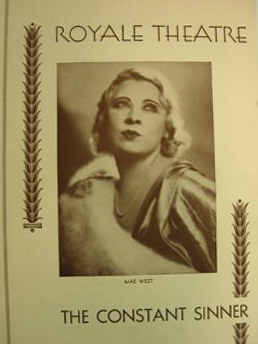
Imagine how MAE WEST felt the morning after. After all that effort, on 4 November 1931 the final curtain came down at the Royale Theatre on "The Constant Sinner" starring and written by Mae West. 
• • Set in Harlem, the play opened on 14 September 1931 and ran for 64 performances on Broadway.
• • The Great Depression increased the number of jobless adults and, by 1931, the unemployment rate had reached nearly 16 percent. Obviously, the bleak economic downturn took a bite out of the box office, lowering everyone's ticket sales — — not only Mae West's productions. But the storyline of "The Constant Sinner" — — Babe Carson's love for Money Johnson, a dark-skinned Harlem hoodlum with a bootlegging empire, kept many theatre-goers away. Miscegenation was a touchy subject in 1931, as Mae West knew. The Harlem Breakfast Club scenes also featured inter-racial couples. Racial attitudes being what they were during the 1930s, several critics who reviewed the play said that these scenes "turn the stomach."
• • Mae West had a large pool of African-American talent to pick from. She cast fourteen black actors and actresses, many with serious stage credentials. However, Mae was not allowed to cast the dashing, debonair actor she really wanted — — LORENZO TUCKER, billed as "The Black Valentino" — — for the role of "Money Johnson."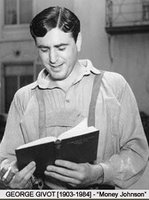
• • The Shuberts and Jim Timony refused to let Mae West cast a black man as her lover, afraid this would trigger police raids and worse. Forced to give in, Mae agreed to hire vaudevillian George Givot to play the Harlem hotshot during the play's Broadway run. George Givot [shown here in 1936] played the role in blackface. The Shuberts wrote it into his contract that, at the end of each performance, Givot would have to remove his wig to assure the audience that it was a Caucasian who was embracing the curvy blonde "Babe Carson" [Mae West] onstage.
• • When a detective warns Babe Carson she is in a tight spot, she shoots back, "I can always handle tight spots."
• • Another suggestive line was this one from Babe Carson: "COME UP SOMETIME, BOYS," she purrs to a group of guys. "I'LL TELL YOUR FORTUNE."
• • Come up and see Mae every day online: http://MaeWest.blogspot.com/
________
Source:http://maewest.blogspot.com/atom.xml
Mae West
• • Photo: • • Mae West • • 1931 • •
• • Feed — — http://feeds2.feedburner.com/MaeWestNYC
Mae West.
On September 28th MAE WEST's latest play was reviewed by Time Magazine's critics. Here's the view from an aisle seat. 
• • The Theatre: New Plays in Manhattan: 28 Sep. 1931, Time Magazine • •
• • "The Constant Sinner" • •
• • Three seasons ago Mae West's lusty singing of "Frankie and Johnnie" and the nostalgic flavor of bar and brothel scenes made Diamond Lil a Broadway hit. In The Constant Sinner, which Mae West wrote from her own novel, the bars and brothels are Harlem, 1931, and Mae West does not sing. But The Constant Sinner is no tame play, nor is it a dull play.
• • Though handicapped by a more effete period, Mae West in some of her lines attains the lush bawdiness of her earlier production:
• • "That dame [Cleopatra] went in for everything . . . she even went to bed with snakes."
• • "I never turn anything down but the bed-covers."
• • She plays the part of Prostitute Babe Gordon with a forthright enthusiasm, sometimes tempered by irony, as in the curtain line, after she has convinced her husband that she is not living with another man (which she is) and the husband has mouthed a few platitudes about Faith. Says Babe Gordon: "I used to know a fine poem about Faith. It begins — Oh, Hell! I've forgotten it."
• • [Review printed on Monday 28 September 1931, Time Magazine]
• • • • • • • • • • • • • • • • • • • • • • • • • • • • • • • •
• • Excerpt from Babe Gordon by Mae West [NY: The Macaulay Company, 1930] • •
• • • • "Well, it was a woman. A beautiful woman. She was seated at a table in a corner of the room with a big negro — — actually enjoying him, fascinated by him."
• • • • "Do you mean that stunning blonde woman in an ermine wrap?" asked Jack Rathburne. "I did notice her, but I didn't see the negro."
• • • • "Well, he came in later," explained Wayne Baldwin. "Come to think of it, you were at the opposite side of the table. Your back was to them. How in the name of all that's decent, Jack, could a woman like that, obviously a person of refinement, allow a black to make love to her?"
• • • • Jack crushed out his cigarette in a green-glass tray.
• • • • "A matter of taste, Wayne. In this case, a very depraved taste."
• • • • • • • • • • • • • • • • • • • • • • • • • • • • • • • •• • Come up and see Mae every day online: http://MaeWest.blogspot.com/
________
Source:http://maewest.blogspot.com/atom.xml
Mae West
• • Photo: • • Mae West • • as Babe Gordon • •
• • Feed — — http://feeds2.feedburner.com/MaeWestNYC
Mae West.
MAE WEST looked at Lorenzo Tucker and saw a leading man. 
• • Born in Philadelphia on 27 June 1907, the light-skinned black actor was known in the 1920s as "the colored Valentino." Tucker claimed that the olive-skinned Italian hearthrob was, in reality, darker complected than he was.
• • Tall, broad-shouldered, and dashing, Lorenzo was tapped by Mae to play the role of the pimp Money Johnson in her controversial Broadway play "The Constant Sinner." The Shuberts refused to permit this, therefore, the Greek-American thespian George Givot played the role in blackface.
• • But Mae West wasn't through. She then cast Lorenzo Tucker in a few minor parts in the production. For example, he played a non-speaking Spaniard and walked across the stage in one scene. When a woman asks the Babe Gordon [Mae West] character who is that hunk, Babe responds, "Oh, he's Spanish — — he's my Spanish fly!"
• • This photo was taken when Lorenzo Tucker was 20 years old.
• • The actor died in August — — on 19 August 1986.• • Come up and see Mae every day online: http://MaeWest.blogspot.com/
________
Source:http://maewest.blogspot.com/atom.xml
Mae West
• • Photo: • • Mae West • • Lorenzo Tucker • •
NYC
Mae West.
It's easy to see why sparks would fly when MAE WEST looked at Lorenzo Tucker.
• • Born in Philadelphia in June [27 June 1907], the light-skinned black actor was known in the 1920s as "the colored Valentino." Tucker claimed that the olive-skinned Italian hearthrob was, in reality, darker complected than he was.
• • Tall, broad-shouldered, and dashing, Lorenzo was tapped by Mae to play the role of the pimp Money Johnson in her controversial Broadway play "The Constant Sinner." The Shuberts refused to permit this, therefore, the Greek-American thespian George Givot played the role in blackface.
• • But Mae West wasn't through. She then cast Lorenzo Tucker in a few minor parts in the production. For example, he played a non-speaking Spaniard and walked across the stage in one scene. When a woman asks the Babe Gordon [Mae West] character who is that hunk, Babe responds, "Oh, he's Spanish — — he's my Spanish fly!"
• • This photo was taken when Lorenzo Tucker was 20 years old.• • Come up and see Mae every day online: http://MaeWest.blogspot.com/
________
Source:http://maewest.blogspot.com/atom.xml
Mae West
• • Photo: • • Mae West's co-star Lorenzo Tucker • • c. 1927 • •
NYC
Mae West.
 In October 1931 MAE WEST, starring on Broadway in her play "Constant Sinner," was also in talks to bring the show to Washington, DC.