skip to main |
skip to sidebar
MAE WEST was woven into the wool within London's Times as the editors whiled away one column on Collins’s latest dictionary, which loops in some fuzzy neologisms culled from the argot of web-users. How time combs the golden debris out of human communication, separating and lifting each strand.
• • Weighing the expanding lexicon of the English language, the editors grew reflective, noting: The words available to Shakespeare sufficed to write Hamlet, didn’t they? Churchill not only favoured short words, but also believed that “the old words, when short, are best of all.” Mae West liked to keep her conversation snappy, if for different reasons, claiming that she was “a woman of very few words, but lots of action.” Collins’s answer is that additions to its 30th Anniversary Edition have been picked to show how (and how fast) society is changing. ... [quoted from "Word Perfect: A new dictionary reflects our growing interest in climate change and digital culture" in The Times, 31 August 2009, www.timesonline.co.uk]. Attempting to be folksy, the British editors fell back on trite expressions such as "looking on the bright side," indicating perhaps too much pallid light in that U.K. newsroom.
• • Unnecessary to quote more from "Word Perfect" — — unless you're in need of a sleeping potion — — so gallop along to the bright side of the barnyard.
• • Mae-mavens and Cleo Borden fans will recognize the "woman of very few words" quote from the screenplay of "Goin' to Town," directed by Alexander Hall and released in the USA on 25 April 1935 (her only motion picture in 1935).
• • "Cigarette me, Cossack!" • • • • A lesser known bit is Cleo's snappy command: "Cigarette me, Cossack!" Mae directs the line to Ivan Valadov (played by actor Ivan Lebedeff, 1895—1953).
• • In the half-light of the projection booth, black and white images sputter, sizzle, leap to life. A 1930s cigarette Mae held is gone — — yet the moviehouse air is sharp with memory. Inhale, dear comrades.• • Come up and see Mae every day online: http://MaeWest.blogspot.com/
________
Source:http://maewest.blogspot.com/atom.xml

Mae West
• • Photo: • • Mae West • • none • •
• • Feed — — http://feeds2.feedburner.com/MaeWestNYC
Mae West.

Lily Birnbaum once made sensational hats for MAE WEST. 
• • During the 1920s, this talented native New Yorker was head milliner for the Shubert Brothers, and kept busy designing show-stopping creations for their Broadway hits.
• • Born in 1895, Lily was raised amid hatboxes, hatpins, ostrich plumes, osprey feathers, glove boxes, and genteel feminine adornment. After she wed attorney Benjamin A. Javits, she focused on raising a family. Still tethered to the thrills of showbiz, she was one of the founders of the Palm Beach Film Festival. When she was in her sixties, she took up painting and had several exhibitions in Palm Beach and NYC galleries.
• • Following in her footsteps, one of her grandsons was so inspired by her colorful backstage stories that he became a milliner. Lily served for years as his consultant.
• • Lily Birnbaum Javits died at age 91 during the month of August — — on Thursday, 7 August 1986 — — after a series of strokes, at the Good Samaritan Hospital in Palm Beach, Florida.• • Come up and see Mae every day online: http://MaeWest.blogspot.com/
________
Source:http://maewest.blogspot.com/atom.xml
Mae West
• • Photo: • • Mae West • • 1918 • •
• • Feed — — http://feeds2.feedburner.com/MaeWestNYC
Mae West.
During the Prohibition Era, this personable actress worked with MAE WEST and garned high praise from many film critics — — and yet she was often not credited in the cast. Since this talented thespian was born during the month of June, she's on our mind today. 
• • After years as a radio and vaudeville performer, Kansas native Hattie McDaniel [10 June 1895 — 26 October 1952] began her film career in the early 1930s playing bit parts such as Marlene Dietrich's servant in "Blonde Venus" [1932] and one of Mae West's jovial maids.
• • Hattie McDaniel, who starred in dozens of films and appeared briefly (often uncredited) in hundreds, was also the first black woman to sing on the radio.
• • On 29 February 1940 Hattie McDaniel — — who played Tira's maid and manicurist (uncredited) in "I'm No Angel" [1933] — — became the first black actor to win an Oscar for her role as Mammy in "Gone with the Wind" [1939].• • Hattie McDaniel, who has two stars on the Hollywood Walk of Fame, was also a professional singer-songwriter, comedienne, stage actress, radio performer, and TV star.
• • For her contributions to radio, her star is located at 6933 Hollywood Boulevard; commemorating her achievements in motion pictures is another star at 1719 Vine Street.
• • She had just gotten signed to a TV sit-com "Beulah" when she discovered she had breast cancer. Hattie McDaniel died at age 57 in a California hospital. • • In 1975 she was posthumously inducted into the Black Filmmakers Hall of Fame.
• • In 2006 she became the first black Oscar winner recognized with a US postage stamp — — a permanent postal honor Mae West has yet to receive, unfortunately, in this country.
• • Come up and see Mae every day online: http://MaeWest.blogspot.com/
________
Source:http://maewest.blogspot.com/atom.xml
Mae West
• • Photo: • • Mae West • • 1933 • •
• • Feed — — http://feeds2.feedburner.com/MaeWestNYC
Mae West.
MAE WEST told a reporter that she almost married George Raft [26 September 1895 — 24 November 1980], a native New Yorker and an actor most closely identified with his portrayals of gangsters in crime dramas of the 1930s — 1940s.
• • Born George Ranft in Washington Heights [in New York City zip code 10032] to Conrad Ranft (who was of German descent), he adopted a slick "tough guy" persona that he would later use in his films. 
• • In 1910, little Georgie was living with his sister and parents on West 163rd Street.
• • As with the case of Mae West's maternal side, George's mother was also born in Germany; she emigrated to the USA in 1878. Eva Glockner Ranft taught dancing to theatre people — — and gave her son lessons. His smooth tango and dance-floor style led to performances at some of Times Square's most fashionable nightspots. He became part of the stage act of "Texas Guinan and Her Gang."
• • In 1923 George Raft wed Grayce Mulrooney. Though it was soon apparent that this was a bad move, the devout Roman Catholic refused to give him a divorce. Grayce finally died in 1970, when her husband was 75.
• • A former boxer, George Raft also ran errands for Owney — — such as retrieving his box office cut every evening after "Sex" and "Diamond Lil." Raft handled more than cash inside Mae's dressing room, where the dapper New Yorker staged a steamy (private) performance of his own on Broadway.
• • In 1928 Mae West tried to recruit him for the role of Juarez in "Diamond Lil" but George said he "wasn't ready." In truth, his lack of schooling made him worry that he might not be able to remember all the lines and cues for a stage play. As a dancer, he didn't have to worry about memorizing a lot.
• • In 1929 Raft moved to Hollywood and took small roles. His success came in Scarface [1932], the role that was originally offered to Jack LaRue, an actor who played opposite Mae West in her 1928 Broadway hit "Diamond Lil." George Raft's convincing portrayal of the gangster led to speculation that he himself was a mobster — — not far from the truth.
• • When the studio was casting Raft's new feature Night after Night, the role of Maudie Triplett, a former gal pal, was to be offered to a well regarded actress and night club personality: Texas Guinan. Raft suggested Mae West for this cameo, and Mae's three little scenes set the so-so film on fire. "Mae stole everything but the cameras," admitted George Raft.
• • One of his final film appearances was in "Sextette" (1978) with Mae West. He played himself in a brief cameo that went like this:
• • MAE WEST: "Why George Raft, I haven't seen you in 20 years. What have you been doing?"
• • GEORGE RAFT: "Oh, about 20 years!"
• • Come up and see Mae every day online: http://MaeWest.blogspot.com/
________
Source:http://maewest.blogspot.com/atom.xml
Mae West
• • Photo: • • Mae West • • 1932 • •
NYC
Mae West.
"MAE WEST, author, loses her pianist," noted Variety on 8 September 1922.
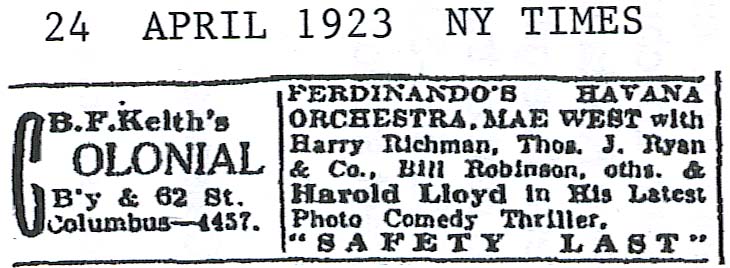
• • Born like Mae during the month of August [10 August 1895], Harry Richman — — an unknown talent in 1922 when Mae West gave him a break and hired the tall piano man with a pronounced lisp — — was performing on the big-time B.F. Keith vaudeville circuit with the Brooklyn bombshell. They were a good team. Wherever their act was booked, the pair got excellent reviews. 
• • Ungrateful for the mega media exposure Mae had afforded him, Harry split with her and joined Texas Guinan's friend, singer Nora Bayes, in her act. However, as this clipping shows, Mae and Harry reunited and appeared together in April 1923 at the Colonial Theatre [Broadway and West 62nd Street].
• • Entertainer Harry Richman [10 August 1895 — — 3 November 1972] was an actor, a singer, dancer, comedian, pianist, songwriter, bandleader, and cabaret performer. He was born Harold Reichman in Cincinnati, Ohio.
• • A flamboyant personality, Richman joined the George White's Scandals in the 1920s and appeared in the 1931 Ziegfeld Follies. In 1930, he made a splash in Hollywood with this crowd-pleaser: Puttin' on the Ritz. This film featured the Irving Berlin song of the same title, which gave Richman a phonograph record hit that year. His film career was hampered by his limited acting skills. [Writing about Puttin' on the Ritz, Leonard Maltin remarked: "A songwriter drinks and goes blind — — after seeing this you'll want to do the same".]
• • Okay. Maybe the silver screen was not his best medium. Nevertheless, Harry Richman remained a popular nightclub host and stage performer.
• • In 1966, his autobiography A Hell of a Life was published. In it he recounts his private and public relationship with Mae West.
• • Harry Richman married three times. All three marriages ended in divorce. He lived it up until age 77 and died in Hollywood, California in 1972.• • Come up and see Mae every day online: http://MaeWest.blogspot.com/
________
Source:http://maewest.blogspot.com/atom.xml
Mae West
• • Photo: • • Mae West's pianist • • Harry Richman in 1924 • •
NYC
Mae West.
MAE WEST utilized her friend Gene Austin's musical talents in her films "Belle of the Nineties" [1934]; "Klondike Annie" [1936]; and "My Little Chickadee" [1940].
• • In addition to writing the music and lyrics for "Klondike Annie," Gene Austin also appears as a vocalist and organ player during the church service. As the collection is in progress, Gene Austin and the parishioners sing "It's Better to Give Than to Receive."
• • Seven years younger than Mae, Gene Austin was born in the month of June in Texas on 24 June 1900.
• • World heavyweight champion Jack Dempsey came up to see Mae onstage at the premiere of "The Mimic World of 1921." One of the characters Mae played was "Shifty Liz."
• • After the performance, the champ and the actress enjoyed their own private performance in her dressing room. Jack Dempsey retained the title from 1919 —1926 but he may have held Mae's heart a little longer.
• • Two years younger than Mae, the dashing prizefighter was born in Colorado on 24 June 1895.
• • Come up and see Mae every day online: http://MaeWest.blogspot.com/
________
Source:http://maewest.blogspot.com/atom.xml
Mae West
• • Photo: • • Mae West • • none • •
NYC
Mae West.
On 29 February 1940 Hattie McDaniel — — who worked with MAE WEST — — became the first black actor to win an Oscar for her role as Mammy in "Gone with the Wind" [1939].
• • After years as a radio and vaudeville performer, Kansas native Hattie McDaniel [10 June 1895 — 26 October 1952] began her film career in the early 1930s playing bit parts such as Marlene Dietrich's servant in "Blonde Venus" (1932) and one of Mae West's jovial maids in "I'm No Angel" (1933).
• • Hattie McDaniel, who starred in dozens of films and appeared briefly (often uncredited) in hundreds, was also the first black woman to sing on the radio.
• • Hattie McDaniel, who has two stars on the Hollywood Walk of Fame, was also a professional singer-songwriter, comedienne, stage actress, radio performer, and TV.
• • For her contributions to radio, her star is located at 6933 Hollywood Boulevard; commemorating her achievements in motion pictures is another star at 1719 Vine Street.
• • She had just gotten signed to a TV sit-com "Beulah" when she discovered she had breast cancer. Hattie McDaniel died at age 57 in a California hospital. • • In 1975 she was posthumously inducted into the Black Filmmakers Hall of Fame.
• • In 2006 she became the first black Oscar winner recognized with a US postage stamp — — a permanent postal honor Mae West has yet to receive, unfortunately, in this country.
• • Come up and see Mae every day online: http://MaeWest.blogspot.com/
________
Source:http://maewest.blogspot.com/atom.xml
Mae West
• • Photo: • • Mae West • • 1933 • •
NYC
Mae West.
MAE WEST remembers, in September, a man she almost married. 
• • George Raft [26 September 1895 — 24 November 1980] was an American film actor most closely identified with his portrayals of gangsters in crime dramas of the 1930s — 1940s.
• • Born George Ranft in Washington Heights [in New York City zip code 10032] to Conrad Ranft (who was of German descent), he adopted a slick "tough guy" persona that he would later use in his films.
• • In 1910, little Georgie was living with his sister and parents on West 163rd Street.• • As with Mae West, George's mother was born in Germany; she emigrated to the USA in 1878. Eva Ranft taught dancing to theatre people — — and gave her son lessons. His smooth tango and dance-floor style led to performances at some of Times Square's most fashionable nightspots. He became part of the stage act of "Texas Guinan and Her Gang."
• • Mae West tried to recruit him for the role of Juarez in "Diamond Lil" but George said he "wasn't ready." In truth, his lack of schooling made him worry that he might not be able to remember all the lines and cues for a stage play. As a dancer, he didn't have to worry about memorizing a lot. • • In 1929 Raft moved to Hollywood and took small roles. His success came in Scarface [1932], the role that was originally offered to Jack LaRue, an actor who played opposite Mae West in her 1928 Broadway hit Diamond Lil. George Raft's convincing portrayal of the gangster led to speculation that he himself was a mobster - - not far from the truth.
• • When the studio was casting Raft's new feature Night after Night, the role of Maudie Triplett, a former gal pal, was to be offered to a well regarded actress and night club personality: Texas Guinan. Raft suggested Mae West for this cameo, and Mae's three little scenes set the so-so film on fire. "Mae stole everything but the cameras," admitted George Raft.
• • Come up and see Mae every day online: http://MaeWest.blogspot.com/
________
Source:http://maewest.blogspot.com/atom.xml
Mae West
• • Photo: • • Mae West with co-star • • 1932 • •
NYC
Mae West.