Showing posts with label 1890s. Show all posts

Tuesday, September 08, 2009

Mae West: Garden State

MAE WEST and Cary Grant will delight film buffs in The Garden State next month.
• • As part of Monmouth County Library's popular series, Thursday Afternoon Films, the iconic comedy "She Done Him Wrong" [1933, Paramount Pictures] will be shown on Thursday, 15 October 2009 — — from 2:00 PM — 3:10 PM.
• • Starring Mae West and Cary Grant, and inspired by Mae's Broadway hit "Diamond Lil," this 66 minute pre-Code screen classic is set during the 1890s in the lively downtown district where Chinatown meets the Bowery.
• • Location: Monmouth County Library [Eastern Branch, 1001 Route 35, Shrewsbury, NJ 07702-4398]. Tell the Eastern Branch that the Mae West Blog sent you.
• • For details, please phone: 866-941-8188.

• • Come up and see Mae every day online: http://MaeWest.blogspot.com/
________
Source:http://maewest.blogspot.com/atom.xml
Add to Google
• • Photo: • • Mae West • • none • •
• • Feed — — http://feeds2.feedburner.com/MaeWest
Mae West.

Monday, September 07, 2009

Mae West: Lil Thrills

Calendar girl MAE WEST was noted in Playbill's long-running feature: "Today In Theatre History: September 7."
• • Theatre chronicler David Gewirtzman writes: 7 September 1949 Mae West stars in a hit revival of her own play, Diamond Lil, for a 182-performance run at the Plymouth Theatre.
• • Last month, the annual Mae West walking tour paused at this popular playhouse on August 16th, and vintage Mae-memorabilia was shown to the group.
• • The Diamond Lil revival enjoyed great success at the venerable Plymouth Theatre [236 West 45th Street]. It opened there on 7 September 1949 and had four months of performances on Broadway.
• • In his admiring review of her 1949 reinvigorated Bowery queen romp through her popular "naughty nineties" hit, The New York Times drama critic Brooks Atkinson admitted he was moved to acknowledge what he called in an atypically poetic effusion ''the sublime fatalism of the entire business,'' and he went on to ask: ''Is she kidding or is she serious?''
• • Knowing Mae, the likely answer is both.
• • Are you a theatre buff? Then you ought to visit Playbill online — — www.playbill.com — — 'cause playgoers are much more fascinating than playboys.
• • Come up and see Mae every day online: http://MaeWest.blogspot.com/
________
Source:http://maewest.blogspot.com/atom.xml
Add to Google
• • Photo: • • Mae West • • none • •
• • Feed — — http://feeds2.feedburner.com/MaeWest
Mae West.

Monday, July 28, 2008

Mae West: Pyjama Party

They're back in style: those glamorous and practical pyjama pants and cocktail suits that were enjoyed by screen queens such as MAE WEST and Greta Garbo, who radiated a new and an intriguing mix of masculine and womanly sex appeal.
• • According to an article in London's Daily Mail, it was Coco Chanel who first put women in men's PJs. After World War I, she introduced a more practical, sporty look for women, replacing the restrictions of the corset and floor-length dresses.
• • Fashion journalist Stephanie Rafanelli writes: Pyjama trousers became the new loungewear for society femmes, worn at home, for a round of golf and frolicking on the beach. Paquin's Chinese printed pyjamas with embroidered satin jacket were the It-items of the day for bright young things.
• • Stephanie Rafanelli notes: Pyjamas (from paejama, the Hindi word for 'leg coverings') were brought over from the Far East in the 1890s — — and they soon became fashionable bed-wear for the British gentleman, replacing the traditional nightshirt. The popularity of pyjama pants heightened in the Thirties when the more tapered legs of the Twenties evolved into the wide-legged palazzo trouser that went from beach attire to day and eveningwear.
• • The British film "Brideshead Revisited" features seductive 1920s loungewear. Continue reading Ms. Rafanelli's article here: http://www.dailymail.co.uk
• • Come up and see Mae every day online: http://MaeWest.blogspot.com/
________
Source:http://maewest.blogspot.com/atom.xml

• • Photo:
• • Mae West • •
none • •

Mae West.

Sunday, January 13, 2008

Mae West: Owen Moore

MAE WEST will dazzle and delight The Windy City on Monday 14 January 2008.
• • At 7:45 PM "She Done Him Wrong" [1933] will be shown at The Gene Siskel Film Center [164 N State St at Randolph St Loop/ West Loop, Chicago; tel 312-846-2600].
• • Directed by Lowell Sherman, this 66-minute classic set on the Bowery during the Gay Nineties was a blockbuster. Produced for $200,000 half of which went to West for writing and starring it returned $2 million domestically on its initial release and another $1 million in international markets. Despite Mae's claims to the contrary, the box office bonanza was NOT enough to pull Paramount Pictures out of the red. But the film did raise studio morale and their image enough to help them edge back toward profitability. The film made Mae West a household name and boosted the career of co-star Cary Grant, who was just starting in motion pictures. He would later claim that he inhaled his lessons about playing comedy from watching the Brooklyn bombshell.
• • "She Done Him Wrong" made the hourglass figure trendy again and encouraged a rush of films set in the 1890s. A backlash was not far behind.
• • Mae West's suggestive song "A Guy What Takes His Time" was so heavily cut by the censors that Paramount recalled all release prints to cut the middle stanzas. Other lines were cut by local censors, and the film was banned outright in Java, Latvia, Australia, and Vienna. It also resurrected renewed cries for national film censorship that led to the strengthening of the Production Code in 1934. That, in turn, would create even more battles between Mae West and the censors, though the blue-noses could do nothing to diminish the sexual independence of her characters
• • An interesting side-trip down memory lane revisits Owen Moore [12 December 1886 9 June 1939], who portrayed Chick Clark, Mae West's imprisoned ex-boyfriend in "She Done Him Wrong." The novel Diamond Lil opens with the prison inmate on page 1, chafing at Lil from behind bars, angry that she done him dirt.
• • An Irish silent film star, Owen Moore wed 19-year-old Mary Pickford [8 April 1892 29 May 1979] on 7 January 1911. The marriage was stormy due to Moore's alcoholism and they divorced in March 1920; she gave Owen Moore $100,000 to go along with their quickie Nevada divorce scheme. A few days later, Mary wed her dashing lover and colleague Douglas Fairbanks.
• • By 1936, Pickford had also divorced Fairbanks. Is this when she acquired her reputation as an arch-prude? Certainly, Tinseltown's critics turned "America's Sweetheart" into a joke by circulating the story of how she ended Mae West's career by complaining to William Randolph Hearst about the bawdy lyrics of West's songs. Was she jealous of Mae for giving her ex-husband the role he would always be remembered for?
• • Owen Moore has a star of the Hollywood Walk of Fame: 6743 Hollywood Boulevard.
• • Come up and see Mae every day online: http://MaeWest.blogspot.com/
________
Source:http://maewest.blogspot.com/atom.xml

• • Photo:
• • Mae West • • Owen Moore • • 1933 • •

Mae West.

Wednesday, July 18, 2007

Mae West: Barye

MAE WEST was shrewd about self-promotion. Once her "Diamond Lil" revival was booked for Broadway, she knew it was the ideal time for her novel to be reprinted.
• • First published in 1932, this Gay-90s narrative was reissued by Sheridan Books in 1949. Okay, maybe you can't judge a book by its cover but the eye-appeal of this illustration was undeniable.
• • Commercial artist Barye Phillips began his career in Columbia Pictures' advertising department during the early 1940s; he worked on training booklets and American military propaganda during WW II. Around 1943, Barye Phillips started painting paperback bookcovers. Prolific, versatile, and fast, he accepted commissions from several publishers. His most visible work was for Gold Medal and other Fawcett imprints.
• • In demand, he executed covers for Avon, Bantam, Dell, Pocket Books, and Signet. It's been said that he consistently turned out four finished paintings a week. His ability to work in a variety of styles led to his industry-wide reputation as "King of the Paperbacks."
• • In addition to this "Diamond Lil" gem for Sheridan, Barye Phillips did the dustcover for these titles: Case of the Vanishing Beauty by Richard Prather [Fawcett Gold Medal, 1950]; On the Road by Jack Kerouac [Signet, 1958]; The Big Caper by Lionel White [winner of the Frederick Muller Gold Award, 1961]; and the first paperback edition of Casino Royale by Ian Fleming [Signet].
• • Barye Phillips died in 1969.
• • Come up and see Mae every day online: http://MaeWest.blogspot.com/
________
Source:http://maewest.blogspot.com/atom.xml
Add to Google
• • Photo: • • Mae West artwork by Barye Phillips • • 1949 • •
Mae West.

Saturday, April 28, 2007

Mae West: Shirley Temple

During the 1930s, MAE WEST and Shirley Temple were featured together in lavish spreads for Look Magazine and other publications. Occasionally, the curly-headed child star was photographed in an 1890s gown, hand on hip, deliberately imitating Mae's trademark gesture.
• • Shirley Jane Temple was born in Santa Monica, California during April - - 23 April 1928 - - and celebrated her 79th birthday this month.
• • In 1931, her parents propelled her into dance classes in Hollywood when the moppet was only three years old.
• • Extremely talented and enormously popular, Shirley Temple made about 40 films during the Depression, out-performing the box office offerings for many adult actors.
• • In 1967, British artist Jann Haworth put together this collage featuring Mae West, Shirley Temple, and W.C Fields. The "mixed media" piece [50 inches high and 31 inches wide] was created using fabric, wood, and plastic. An English gallery noted that it was available for sale.
• • Come up and see Mae every day online: http://MaeWest.blogspot.com/
________
Source:http://maewest.blogspot.com/atom.xml

Add to Google

• • Photo: • • Mae West collage • • 1967 • •

Mae West.

Wednesday, April 04, 2007

Mae West: April 1974

MAE WEST was prominently featured in the April 1974 issue of Ms Magazine. Their cover story — — "What Movies Have Done to Women" — — featured Hollywood blondes such as Mae, Jean Harlow, Carole Lombard, Ginger Rogers, Marion Davies, Alice Faye, Doris Day, along with non-blondes such as Clara Bow, Joan Crawford, Greta Garbo, Marlene Dietrich, etc.
• • Of all the blondes, Ms decided that Jean Harlow and Mae West were the most interesting — — and the Art Director filled three-quarters of a page with Mae's photo.
• • Ms noted that Mae West "swaggered from one artificial costume epic to another, writing her own scripts, and emanating her brand of vulgarity and ribald comedy. ..." Her nine films were "enough to convulse the censors."
• • Calling Mae a "self-styled drag queen," Ms concluded that it was not the actress's appearance that riled the censors but rather that Mae West "as author and star, controlled plots and manipulated males with the deftness of a puppeteer. ..."
• • Come up and see Mae every day online: http://MaeWest.blogspot.com/
________
Source:http://maewest.blogspot.com/atom.xml

Add to Google

• • Photo: • • Mae West • • in vaudeville • • circa 1916

Mae West.

Wednesday, February 22, 2006

Mae West: 295 Bowery

Mae West had heard all the stories about the infamous Bowery "resort" near Houston Street, namely McGurk's Suicide Hall [295 Bowery]. The second chapter of "Diamond Lil" (a 256-page novelization of the play published by Macaulay in 1932) is SUICIDE HALL. Lil's adventures take her further downtown to the hidden dens of Chinatown; the tenth chapter is A NIGHT ON DIVISION STREET.
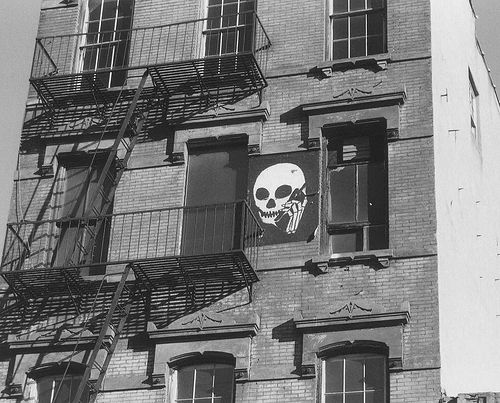
• • Say "cheese"! Ready for the wrecking ball at 295 Bowery. Before demolition, part of the exterior was photographed.


___________________________________
• • Mae West was not the only writer to revisit the Bowery. In May 1904, married actors Mr. and Mrs. Terry McGovern starred in Theodore Kremer's stirring melodrama "The Bowery After Dark" at the People's Theatre. Kremer set his scenes in Suicide Hall, Chatham Square, Chinatown, etc.
• • During the 1890s
The New York World commissioned artist Julius C. Fireman to illustrate the interior of Suicide Hall.
• • Unfortunately, a sketch was sketchy. You really had to BE there - - on site - - to understand how well the place functioned. Rich in real estate, John McGurk owned a 4-story establishment that he joined to a charming one-story annex. Each building fronted on the Bowery (numbered 251-253 Bowery during the 1890s) and could be exited by way of several secret passageways, so that the customer could escape an enemy easily and wind up on First Street, Second Avenue, Houston, or even in a private courtyard.
• • Owen Kildare lived in the Bowery and wrote about it. Stephen Crane set "Maggie, Girl of the Streets" [1893] near Suicide Hall. From 1880 - 1920, it's been said that no street ever made such an impression on writers as the Bowery did. The New York Times called it "the liveliest mile on the face of the earth during 1880-1895." The more the literary types set fiction there, the trendier it became to rediscover
low life.

• • Mae West and the self-confessed saloon scholars understood that the Bowery boy and his female counterpart, the "Tough Girl," had to be made amusing before they would be accepted as entertainment.
• • By the time
Diamond Lil sashays inside Suicide Hall, bejeweled and gowned, the sinister setting had been properly de-fanged. Public acclaim kept Mae busy, touring with the play, and then filming it as a Hollywood movie with her leading man Cary Grant.
• • According to an article [13 May 1999] in The New York Times, the building had been a hotel during the Civil War, catering to returning soldiers. By the 1890s it was a brothel and a dive where . . . a half-dozen destitute courtesans drank carbolic acid and died. John H. McGurk, the owner of the saloon on the ground floor, then capitalized on the notoriety of the place by renaming it McGurk’s Suicide hall.
• • Later, beginning in World War I and continuing into the 1950s and early 1960s, it was a flophouse for Skid Row veterans. In the mid-80’s it was converted into artists’ studios.
• • The N.Y. Times concluded: "Despite this colorful past, the city’s Landmarks Preservation Commission denied landmark status to the building, finding that it did not have sufficient historical, cultural, or architectural merit."
________________________________
Source:http://maewest.blogspot.com/atom.xml

Add to Google

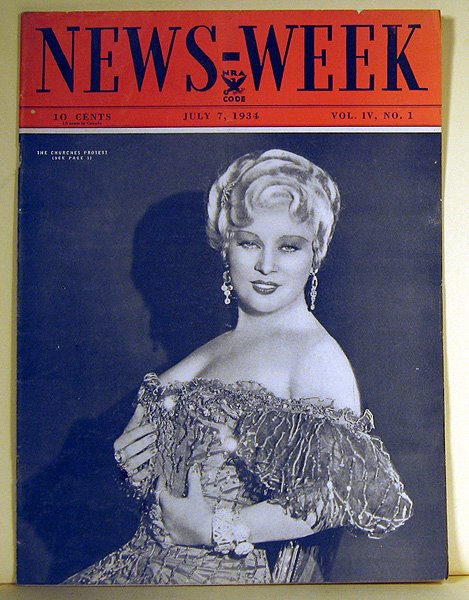
• • Photo • Mae West was interviewed about reprising the role of "Diamond Lil" for the silver screen [1934] • Suicide Hall in 2004

Mae West.