Monday, December 05, 2005

Mae West: 1978 Ringo Starred

In the 1978 film Sextette, musician Ringo co-starred with Mae West. The plot is centered on Marlo Manners, whose ex-husbands are trying to get a tape that contains information about their relationships with her. Ringo Starr portrays Mae's former husband, the European director Laslo Karozny — — the fourth man that "Marlo Manners" has married and divorced.
Ringo Starr revisited the "raunchy shoot" with the 85-year-old West during an interview with WENN [World Entertainment News Network]:
• • Former Beatle Ringo Starr was the target of screen siren Mae West's advances while they worked together on 1978 comedy
Sextette.
• • The iconic drummer, who played one of West's husbands in the film, was amazed by the cheeky sex symbol's advances - especially as she was in her 80s at the time.
• • "Mae was a terrible flirt. She tried it on me twice. I didn't mind really." He laughed. "She said she was 85, her maid said she was 87, and George Raft, who appeared with us in the film, said she was more likely to be 94."
• • "I'd like to know what she was on because I tell you she looked bloody fantastic." [Born in 1893, actress Mae West was 85 when Ringo met her.]
— — Source: WENN Friday December 2, 2005 — —
Source:http://maewest.blogspot.com/atom.xml

Add to Google

Photo: "Sextette" poster
Mae West.

Saturday, December 03, 2005

Mae West's Dirty Little Secret

Book Review, The Sunday Times

Sex, movies, and a dirty little secret
REVIEWED BY TOM SHONE
MAE WEST: It Ain’t No Sin [Faber £20 pp 491]
by Simon Louvish

• • Mae West’s reputation will never be the same again. There we were, thinking of her as the goddess of gyrating libidinousness, snacking on men like peanuts, and all the while her truly shocking secret lay simpering in the back of her bedroom. Make your way past the alabaster nudes and sepia prints of West in better days; step over the polar bear shagpile rug, and into the salmon-pink inner sanctum of her boudoir, and what would you find? West hard at work over a typewriter. This was “Mae West’s great secret”, writes Simon Louvish, in his splendid biography: “that she went home to her apartment or hotel room at night and wrote”. Come up and see her sometime, and you would discover nothing more x-rated than West polishing her adverbs. In all, she wrote 12 plays, and three novels, not to mention the 20,000-plus bon mots in her joke-book, honed assiduously over four decades, and that she sprinkled over every film she was in, like confetti. Give a part in a movie to West and you also had to find supporting roles for West’s one-liners, crisp with sex-war sagacity: “A hard man is good to find”, “It isn’t the men in my life, it’s the life in my men” and so on. Hollywood’s first sex symbol (or “sex personality” as the Boston Herald quaintly put it) caused riots wherever she went.
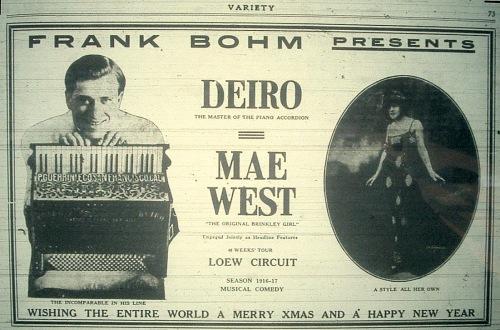
• • In Hartford, in 1938, “Mae West Safe Driving Week” was disrupted when 30,000 fans flooded the streets, although it was really in the bedroom that DeMillean skills of crowd control were called for. Louvish keeps track of West’s conquests like a man racing mice: an accordionist, a xylophone player, a Frenchman named Dinjo with with whom she coupled 26 times in one night: “the results were like a high-speed film, blurred but exciting”. None of these men, he notes, was permitted to stay the night. Only her pet monkey Boogie got to share West’s breakfast table and, despite one short-lived marriage, she died childless, having put sex to every possible purpose except the one for which it was intended.
• • The closest West came to procreation was, it seems, the medical textbook she pored over with a friend, aged seven, when growing up in Brooklyn: “I had a funny feeling about my parents,” she remembered. “A peculiar feeling — disgust you might say. It took me a long time to get over it. They suddenly weren’t gods anymore.” A long time, indeed. That godlike tumble from grace is one she would replay again and again in her career, flushing society’s dirty little secret out into the open, and using sex as the great leveller. “I’m going to dig under your supposed respectability and show you who you are,” says a docklands prostitute to a society dame in West’s play Sex (1925), with which she kick-started her career. The play was shut down for indecency, and landed West in the slammer for eight days — the first of her energetic bouts of fisticuffs with the guardians of American decency. “I enjoyed the courtroom as any other stage,” she quipped.
• • Her first film, She Done Him Wrong, had the Hays Office crawling all over it; the film regulators cut 100ft of film out of her song I Like a Guy What Takes His Time — a considerable blow to the man’s prowess, one would have thought — and hacked away at most of West’s lines, but the result was to concentrate her oozing licentiousness even more: denied its obvious berths, it simply took up residence in the body language between her and Cary Grant, in the languid glances and pauses of their conversation, and in such seemingly innocuous phrases as “Why doncha come up and see me?”, “Do you get me?” and “You can be had.” These days, of course, the true purpose of the Hays Office is known to all. At the time, they saw it as their God-given duty to keep America’s morals intact and save the nation from mortal sin. Now, it is clear that their real function was to provide comic relief for Hollywood biographies in the many decades to come. One of their best gags here involves a series of ever-more earnest communiqués about the song Pom Tiddley Om Pom, in Belle of the Nineties, whose acceptability “will depend almost entirely upon the manner in which the song is sung and the action accompanying the music”.
• • In a sense, they were quite right: they could hack away at one-liners all they wanted, but the most suggestive thing about West was the way she moved: undulating across the screen as if she were being poured into the room, or sashaying back and forth when she was supposed to be standing still, like an idling motor.
• • “In order to play this shady character and keep the sympathy of the audience there’s one thing I must have — dignity,” said West. Louvish’s biography allows her to keep that dignity at all times, even when she seems most in danger of losing it. There is certainly room for horror when contemplating West’s later career, which was as tawdry as it gets: an appearance opposite Ed the Talking Horse, a film with Ringo Starr, an inevitable Vegas Comeback Tour, featuring gyrating “athletes” in loincloths and hosted by Liberace. But Louvish ploughs through it all, refusing the temptations of camp-critical reclamation, and rather paying tribute to the sheer steamship momentum of this woman. You have to hand it to someone who can step from a limo wearing a diamond-studded dress, two lavender orchids on her lapel, draped in “a white cape of close-clipped fur, as if an albino calf had made the ultimate sacrifice”. West was turning up for a court deposition.
• • BIG BUCKS • •
In her heyday, 1934, Mae West was America’s highest-paid performer, earning over twice as much as Marlene Dietrich, and ten times as much as Cary Grant, her co-star in She Done Him Wrong.
- - from The Sunday Times www.timesonline.co.uk/ 6 November 2005 - -
Source:http://maewest.blogspot.com/atom.xml

Photo: none
Mae West.

Tuesday, November 29, 2005

Mae & Copyright Fair Use: Current

According to Current [21 November 2005 issue], another producer gave up plans for longer Mae West segments in a documentary film, which would have required buying footage. . . . WGBH notably relied on fair use in the 1999 series Culture Shock, including montages of short clips that qualified as commentary, says attorney Jay Fialkov. This fit into the concept of fair use because the series itself commented on trends in the popular arts. Even so, when producers found that extensive footage of Mae West was not available on acceptable terms, they switched the focus of an episode so they could use more material on screen.

----Current_Magazine_excerpt----
Doc-makers get specific about copyright fair use
Originally published in Current, Nov. 21, 2005
By Steve Behrens

Friday afternoon, things changed for producers who need to use somebody else’s footage and music in their documentaries. Clearing rights may still cost a lot and take too much time, as in the past, but Patricia Aufderheide and Peter Jaszi believe producers now have a solid rationale for not paying excessive and confounding fees for copyrighted materials in certain cases. On Nov. 18 [2005], the Association of Independent Video and Filmmakers, the Independent Documentary Association, public TV’s Independent Television Service and the series P.O.V., and other media groups endorsed a Statement of Best Practices defining four kinds of situations when a producer, under the “fair use” provisions of copyright law, need not pay for a film clip, a shot of a painting or a snatch of music. . . .
Jay Fialkov [is] deputy general counsel at WGBH in Boston . . .
Read it online: http://www.current.org/
- - excerpt from article published in Current, Nov. 21, 2005 - -
Source:http://maewest.blogspot.com/atom.xml

Photo: Mae West as an interactive game
Mae West.

Sunday, November 27, 2005

Mae West: The Mimic World of 1921


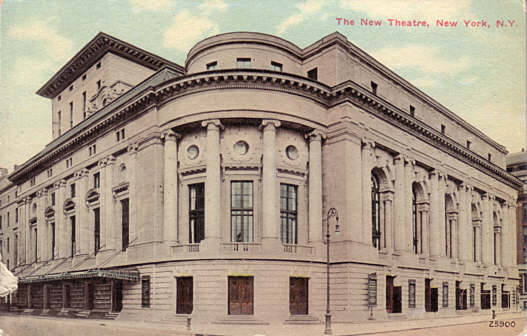
With The Mimic World of 1921, the Shuberts had hoped for a big hit; this revue also inaugurated their new roof theatre that featured a restaurant and promenade overlooking Central Park. However, the show opened to mixed reviews from a number of top critics. Mae West wore a daring black velvet dress onstage, "cut at either side to display her bare hips," wrote Women's Wear [24 August 1921] in shock. Jack Dempsey must have liked what he saw because he went to Mae's dressing room on opening night - - and they hit it off big-time.
Note that 28-year-old Mae is still a brunette in 1921.
Source:http://maewest.blogspot.com/atom.xml

Photo: a new roof theatre, the Century [21-29 Central Park West, demolished in 1930].
Mae West.

Thursday, November 24, 2005

Mae West: Wishbone

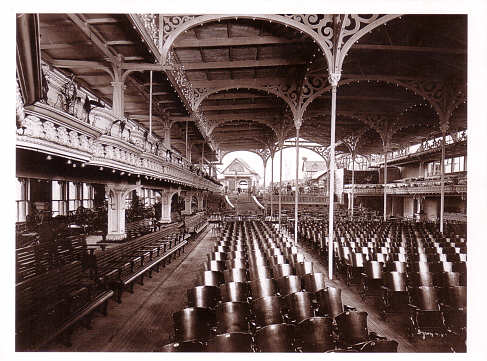
An ex-vaudevillian described Hammerstein's Victoria, where MAE WEST was booked eleven times, as "a big, tinkling pearl box — — all in white and gold with the opals of electricity studding it in profusion."
• • In 1899 this Victorian-style show palace was built by J. B. McElfatrick & Son for Oscar Hammerstein I. Its "Venetian Terrace Roof Garden" (originally a café and petting zoo) was converted to a theatre in 1901. "
The Corner" was the TOP place to be billed.

• • In 1912, Mae West got her first major vaudeville break: a spot on the bill at Hammerstein's Victoria. Though
Billboard gave her performance mixed reviews [12 May 1912], for Mae Thanksgiving arrived early. At last she was in a league with top-ranked headliners such as Eva Tanguay, Sophie Tucker, Fanny Brice, and Nora Bayes.
Source:http://maewest.blogspot.com/atom.xml

Photo: the Roof at Hammerstein's Victoria [1473-1481 Broadway / 201-205 West 42nd Street] closed in 1915 and was demolished shortly after.
Mae West.


Tuesday, November 22, 2005

Mae West: 22 November 1980

Mae West died on 22 November 1980 - - 25 years ago today - - and she is forever in our hearts.

Source:http://maewest.blogspot.com/atom.xml

Thursday, November 17, 2005

Mae West on Swing Street

THE RISE & FALL OF THE ORIGINAL SWING STREET
How Prohibition helped Harlem get jazzed.
By David Freeland


• • Nights and early mornings were filled with the impatient honking of humpbacked taxis jockeying for position within the clamor of the street's western section, close to 7th Ave. Faces of many hues would emerge to slip under awnings imprinted with names like Covan's and Pod's. Society figures and celebrities — Tallulah Bankhead, Langston Hughes, Mae West — crept into the street's basement-level speakeasies, drawn by the bawdy blues belting of the stout, unapologetically lesbian Gladys Bentley, or ribald vocalist Mary Dixon urging her lover to "Take your time with what you do/Make me cry for more of you." Others were content to sit quietly and marvel at the rolling stride piano playing of Willie "The Lion" Smith, who could make a single, beat-up tuneless upright sound like an orchestra.
• • The liquor and (in some places) marijuana was plentiful. And in those days of Prohibition, patrons could get giddy on Harlem's famous "top and bottom" cocktail (gin plus wine), secure in knowing the police rarely came around — except for a drink, of course. Downtown whites called the block "Jungle Alley," but few Harlemites during this age of the Renaissance stooped to that kind of language. To them, 133rd St. was simply a place where they could relax, socialize and escape the segregation of white-oriented clubs like Connie's Inn and the Cotton Club that grew like kudzu in other parts of Harlem.
• • "133rd Street was the real swing street," claimed Billie Holiday, "like 52nd St. later tried to be." Holiday was referring to the midtown block that became a tourist haven, the Disneyland of jazz; but for the scores of musicians who played there, 133rd St. would always be the genuine article, even after it seemed everyone else had forgotten it. . . .
- excerpt from NY Press article * www.nypress.com -
by David Freeland: The Rise & Fall of the Original Swing Street
Mae West died on 22 November 1980.
Source:http://maewest.blogspot.com/atom.xml

Wednesday, November 16, 2005

Eudora Welty Drew Mae West

- excerpt from Associated Press book review -
'Early Escapades' compiles work of Eudora Welty
By HILLEL ITALIE, Associated Press

NEW YORK (AP) - Socialites and other Mississippians were likely struck by a feature story that appeared in the Jackson Daily News in 1930. Flowers Talk in Languages of All Races, written by a young Jacksonite named Eudora Welty, presents a veritable bouquet of floral etiquette and more than a whiff of sarcasm.
• • "A Carolina rose means 'Love Is Dangerous,'" the writer advises, "while a Christmas rose means 'Tranquilize Thy Anxiety' and a Damask rose means 'Brilliant Complexion.' A single rose says 'Simplicity.'
"And a Maiden Blush rose means 'If you love me, you will find it out.'"
• • Welty had always been known for her sense of humour.
• • A new book, Early Escapades, is a compilation of articles, poems, vignettes and cartoons from the author who later became famous for such fiction as Powerhouse, Why I Live at the P.O., and Delta Wedding. It was released by the University Press of Mississippi and edited by Patti Carr Black, who befriended Welty in the 1950s and remained close until the author's death in 2001.
• • "An evening with her was like being at vaudeville. She was great at one-liners and quick responses. She had such clarity and wit you were always taken aback," says Black, who has worked on several books about Mississippi history and literature.
• • For Early Escapades, Black gathered material that had never been assembled in book form, including family documents, college and highschool writings and newspaper clippings. She says the book is meant to display the roots of what readers came to know well later on: "her comic energy, her creative mind and her sense of the ironic and absurd."
• • A writer's juvenilia can look as embarrassing as a yearbook picture, but youthful spark and irreverence sustain Early Escapades. Even the cover photo makes it on sheer nerve: a young Welty camps it up for the camera, a tattered hairpiece pulled around her head, a fat moustache affixed to her mouth.
• • Born in Jackson, Miss., in 1909, Welty profited early on from her writing gifts; she was 12 when she received $25 for winning the Jackie Mackie Jingles Contest, sponsored by the Mackie Pine Oil Company of Covington, LA. At 14, she published verse in St. Nicholas, a children's magazine that has also featured early work by Rachel Carson, Ring Lardner, and other famous writers. She was a compulsive reader and learner -- and compulsively funny about it. ...
• • Her illustrations are equally distinctive.
• • A sketch of Hitler leaves his face blank except for the famous toothbrush moustache.
• • William Faulkner, her fellow Mississipian, looks wild-haired and black-eyed, as if he had just been electrocuted.
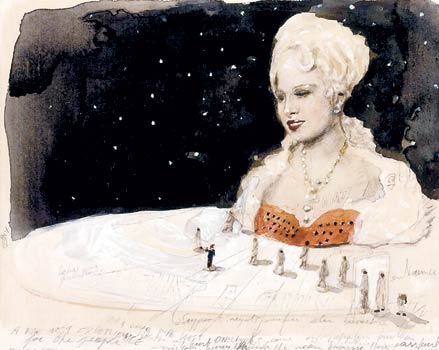
• • Mae West is drawn in a swirl of hair, cleavage, and false eyelashes. ...
- excerpt from Associated Press book review -
Mae West died on 22 November 1980.
Source:http://maewest.blogspot.com/atom.xml

Monday, November 14, 2005

Mae & Texas Guinan: 1930 Trial


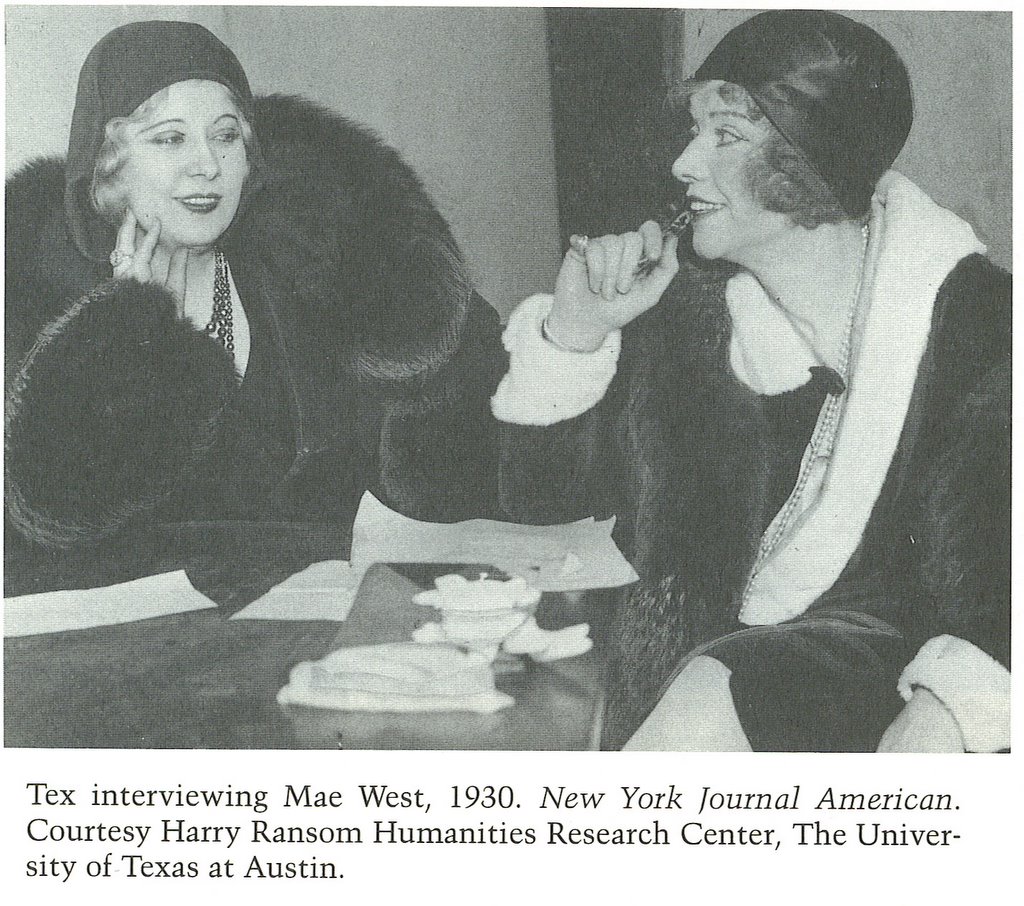
In 1930 Texas Guinan was asked by the New York Journal [a daily newspaper] to do some freelance reporting. Her first assignment: cover the Mae West trial at Jefferson Market Court House on Sixth Avenue.
Actress Mae West had been charged with writing many of the skits in the homosexual-themed play "Pleasure Man" that New York's police and prosecutors declared were too shocking for the stage.

In her popular syndicated column "Texas Guinan Says" [The New York Daily News, 12 April 1929], Texas had playfully mentioned her friend: "Mae's a good girl at heart -- but she's got a bad heart." Of course, Texas Guinan was also a repeat offender [repeat "attender"], frequently on trial in the very same Greenwich Village court house.
Texas Guinan died on 5 November 1933.
Mae West died on 22 November 1980.
Source:http://maewest.blogspot.com/atom.xml

Source:http://texasguinan.blogspot.com/atom.xml


Source:http://jeffersonmarketcourthouseny.blogspot.com/atom.xml
Jefferson Market.

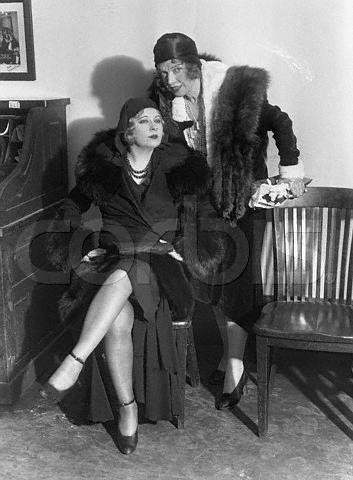
PHOTO: April 1930 Mae West with Texas Guinan - - doing an interview for the newspapers during a recess at the "Pleasure Man" trial, Jefferson Market Court

Sunday, November 13, 2005

Edith Head: Dressing Mae West

Filmed in black and white, the outfits worn by Mae West onscreen always looked expensive -- but how many knew what COLOR they were?

As costume designer at Paramount Pictures, Edith Head took on a side chore: the custodian of a score of costumes that had been sentimentally preserved because they contributed to movie history. In November 1960, an article in The New York Times discussed the final appearance of these glamourous gowns. "I'm only managing to hold them together with emergency sewing now. This will be about their last time out," said Edith Head [October 28, 1897 – October 24, 1981].

The collection, referred to as a "million dollar" affair, included Mae West's emerald green, jewel-encrusted come-up-and-see-me-sometime gown from "She Done Him Wrong," Texas Guinan and Clara Bow outfits, and Ginger Rogers's mink dress from "Lady in the Dark." . . . [excerpt, N.Y. Times 29 November 1960]
Co-starring Cary Grant as a Salvation Army Officer, "She Done Him Wrong" was the only Mae West film that was considered for an Academy Award. Nominated for "Best Picture," it lost out to the winner: "Cavalcade."
http://maewest.blogspot.com/atom.xml

Wednesday, November 09, 2005

Come November We Remember

"All you need to make a movie," the filmmaker Jean-Luc Godard once said, "is a girl and a gun."
* * * Texas Guinan [1884-1933] appeared in several silent films as the gun-slinger.
* * * Mae West [1893-1980] appeared in films as the gun-moll.
* * * During the 1920s, both wound up in Jefferson Market Court.

* * * Both rated a star on the Hollywood Walk of Fame. [Mae's star is at 1560 Vine Street.]
* * * Eventually, both died in the West during November.
* * * While on the road, Texas Guinan contracted amoebic dysentery in Vancouver, British Columbia and died there on November 5, 1933 at age 49, exactly one month before Prohibition was repealed. She is interred in the Calvary Cemetery, Queens, New York.
* * * Mae West was 87 years old when she suffered a stroke. She died in Los Angeles, California on November 22, 1980. She is entombed in the Cypress Hills Cemetery [833 Jamaica Avenue], Brooklyn, New York.

During November, stop in Jefferson Market Library and check out Texas Guinan: Queen of the Night Clubs by Louise Berliner and Becoming Mae West by Emily Wortis Leider.
PHOTO: September 1930 -- Mae West and Texas Guinan take a recess in the judge's chambers during Mae's "Pleasure Man" obscenity trial at Jefferson Market Court.
Source: http://texasguinan.blogspot.com/atom.xml

http://maewest.blogspot.com/atom.xml


Source:http://jeffersonmarketcourthouseny.blogspot.com/atom.xml
Jefferson Market.

Saturday, October 29, 2005

Mae West or Bust


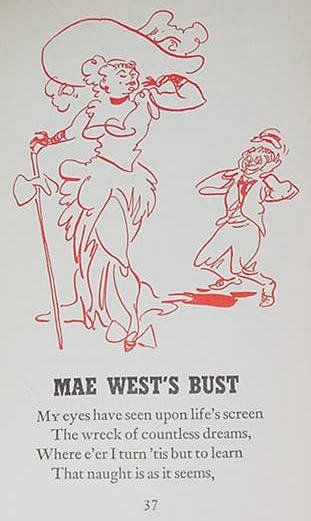
There is an unusual ribald poetry book called “Rowdy Rhymes” -- playfully illustrated by John Barron. Published by Peter Pauper Press during the 1950s, the 62-page hardcover includes unconventional verse such as: Mae West’s Bust; Twin Buttes; Her Mother Never Told Her; The Saga of Rex (a dog and his urination habits); Roll Your Leg Over; The Old Backhouse (outhouse); Ballad of Yukon Jake; the Quartermaster Song; and other silly stanzas.
- -
http://maewest.blogspot.com/atom.xml

Mae West.

Monday, October 17, 2005

Mae's Ginger: Greenwich Village Theatre

Greenwich Village Theatre: 1917 - 1930

It was the summer of 1922 and Mae West was about to celebrate her 29th birthday. Hungry for stardom and going nowhere in vaudeville, Mae bit the bait: a chance to star in a play The Ginger Box that could make her a star. According to biographer Emily Wortis Leider, The Ginger Box served up wall-to-wall Mae West. In addition to featuring her as Circe, turning her lovers into swine, it presented Mae West as a Broadway vamp (played to Harry Richman's victim), Mae West singing "I want a Cave Man," Mae West clowning Tommy Gray's "I'm a Night School Teacher," and torching a song whose regretful tone she would later rule out: "Sorry I Made You Cry." Major troubles were afoot, however, and revealed themselves during a two-performance try-out in Connecticut. Also, the flam-flam producer Edward Perkins was perpetually short of funds and vanished, leaving unpaid debts and I-owe-you notes to his cast. Ginger Revue Now a Pepless Stew as Promoter Disappears announced the New York Daily News [August 13, 1922]. Thirteen Equity actors sued Perkins to recover their salaries -- but not Mae, who was to have received a percentage of the box office.

The Greenwich Village Theatre was made famous by female impersonator Bert Savoy who performed in the acclaimed "Greenwich Village Follies" there, an annual revue that was so popular that it moved to Broadway. Located until 1930 on the western side of Seventh Avenue South where Christopher Street kisses West Fourth, it faced Sheridan Square. During the 1920s, the outstanding success of this cultural outpost put Sheridan Square on the map as a mecca for avant-garde entertainment. A fierce financial beast - the Wall Street crash in 1929 - killed this beauty.

Photos show the former theatre as well as the plain-jane that replaced it in 1931.
- -
http://maewest.blogspot.com/atom.xml

Mae West.

Sunday, October 16, 2005

Mae-trek: "Sex" in Michigan

Here is the latest revival of Mae West's tantalizing play SEX in the midwest -- Sex without the X, by 21st century standards. :-D
Big 'Sex' show plays small Creole stage (Icarus Falling)
• Theater By Mike Hughes | Lansing State Journal

Like most writers or actors, Mae West didn't want to be ignored. That was never a problem for "Sex," her show that is being revived locally in Michigan.

As soon as it opened in 1926, it drew comment.
It was "feeble and disjointed," the New York Times said.
It was a "disgrace," the New Yorker said.
Walter Winchell called it "a vulgar affair ... amateurish in script and cast."
The Daily Mirror, a Hearst paper, was less mellow. This was, it said, "a monstrosity plucked from the garbage can, destined for the sewer."

Life was different, back in '26.

"It's actually a sweet show, a very nice show" said Lamont Clegg, who's directing the Icarus Falling production, which opens Oct. 20.

"It looked at the social mores of the time," said Jeff Croff, the Icarus Falling artistic director. "They shut it down for indecency; now people wouldn't raise an eyebrow."

Even back then, people weren't sure. The first attempt to close "Sex" failed; officials barely missed getting the required three-fourths vote of a citizens' panel.

Celebrities - including authors Robert Benchley and Zora Neale Hurston - wrote favorably about "Sex." Some papers had second reviews, reversing their verdicts.

After making a fortune on the show, West was fined $500 and sentenced to 10 days in jail. "This will be the making of me," she said.

That would take a while. Five years later, nearing 40, West began a string of movies in which she often wrote her own lines, oozing sexual references

She died in 1980 at 87, having outlived the era she mocked. "Mae West really pushed the boundaries," Croff said.

Icarus tackles her show in a change-of-pace season.

In previous years, Icarus won praise and awards for intense, intimate dramas. "We hadn't really focused on comedies," Croff said. "And we didn't have enough strong roles for women."

Then he spotted "Sex" and decided it would be a good show - and a good theme for the season. Sex is also a theme in the ancient Greek "Truculentus" (in February) and the modern Elaine May comedy "Adult Entertainment" (in May).

In the 1920s, West was a modestly successful playwright and vaudeville performer, big and buxom and brassy.

She faced rigid rules, Croff said. "They weren't allowed to show prostitutes in America. They could if it was set in another country."

West toyed with that in "Sex." Her central character, Margy Lamont (Sara Frank), is a Montreal prostitute; she mixes with rich people, then heads to Trinidad.

There's a breezy cynicism to Margy, her pimp (Daryl Thompson) and her friend (Laura Croff). "You see them as fairly sharp-tongued," Clegg said, "but underneath it are very human characters."

There's also a complication: Like others from this era, "Sex" has lots of characters. "It does tend to fill up the stage," Croff said.

That's a 12-by-16-foot stage, at one end of Creole Gallery, which seats 90-100 people. Clegg [a theater veteran who has taken over as Boars Head's education director] had to figure out how to squeeze an epic show into an intimate space.
"This show has 22 characters," he said. "I eliminated one, but you still hear him yelling offstage." Otherwise, actors switch places quickly. Except for the leads, most people fill two or three roles. It's a brash undertaking. No one said it would be easy to perform "Sex" on an Old Town stage.

(Sources: "Mae West: An Icon in Black and White," Oxford Press, 2001; "Mae West," William Morrow and Company, 1982; "The Ultimate Encyclopedia of the Movies," Carlton, 1995.)
Oldest profession
• "Sex," an Icarus Falling production
• Performances: now 8 p.m. Oct. 20, Oct. 22 and Oct. 28-29
• Onstage: Creole Gallery, 1218 Turner St.; a talk-back discussion of censorship follows the opener.
• $10, at the door; info: tickets (at) icarusfalling.com.
Published: October 13, 2005
Printed: Lansing State Journal
By Mike Hughes
- -
Source:http://maewest.blogspot.com/atom.xml

Saturday, October 15, 2005

Mae West: A Florida Enchantment

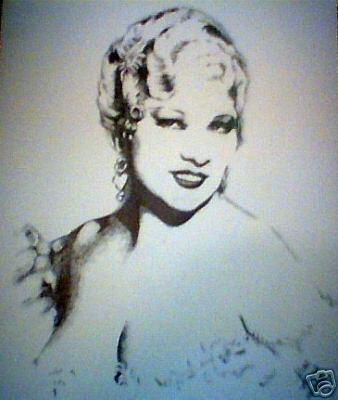
Mae West fan Kim Leone [from Clearwater, Florida] did a drawing of Mae. Kim said it's "on 11x14 vellum bristol board paper, done in graphite pencil."


Speaking of Florida, in 1911 when 18-year-old Mae signed on with Frank Wallace [along with Jacobs and Jermon] to tour on the Columbia burlesque circuit in "A Florida Enchantment," they decided to get married.
http://maewest.blogspot.com/atom.xml

Mae West: 1918 Shimmy Queen


In Chicago, a 25-year-old Brooklyn actress studied the Black entertainers onstage who were doing an exciting new step. These dancers moved every part of their body -- except their feet. Mae West mastered "The Shimmy" and introduced it to audiences in New York City. To tie herself to the craze, Mae sang a song: "Ev'rybody Shimmies Now." Here is 1918 sheet music of this song with a picture of Mae on the cover, still a brunette during her vaudeville years.
Source:http://maewest.blogspot.com/atom.xml
Add to Google

Friday, October 14, 2005

Radio-Free Mae

Reporter Bobbie Johnson asked:
Where does the broadcasting revolution go from here?

In the heyday of radio, the wireless was the centre of people's lives. The image of families gathered around their radio set is a familiar one -- listening to a broadcast was a group activity. . . . Now, just as people have been carrying their own music around with them, they're taking their own radio shows as well. When Mae West whispered, "Come up and see me sometime when I've got nothing but the radio on," she probably didn't imagine she would be wearing an iPod. . . .
excerpt from: Bobbie Johnson's article [13 October 2005]
Mail & Guardian http://www.mg.co.za/
- -
http://maewest.blogspot.com/atom.xml

Friday, October 07, 2005

Mae West: amNew York

Broadway After Dark - Theater
by Ward Morehouse III
Special to amNew York

_ MAE MAKES BROADWAY _
Plans are moving forward for Courting Mae West to open in a mid-size off-Broadway theater in March 2006. Based on the trials and tribulations that befell the actress during the 1920s -- when Mae was arrested and jailed for trying to bring two gay plays to Broadway -- the play features several characters modeled on real people: Beverly West, Texas Guinan, Jim Timony, Starr Faithfull, and others.
.
"Corsets keep my breasts like the righteous," quips Mae in the hilarious opening scene, "in pain but uplifted."
- - printed in amNew York, Weekend, October 7-9, 2005 [page 20] - -
http://maewest.blogspot.com/atom.xml

Thursday, October 06, 2005

Mae West: 15 Minutes Magazine


What Goes Down by Jules Peimer

LEGENDARY Joe Franklin, who had Mae West on his TV show many times, was guest of honor at the colorful Mae West Birthday Gala at Bill’s Gay Nineties. "Mae was a wonderful guest and a great comedienne," Franklin said. "Besides being the sexiest and highest salaried woman as a filmstar and nightclub performer during her heyday, she was also famous for her witticisms" - - such as:
* * "Keep a diary and someday it will keep you."
* * "I used to be Snow White but I drifted."
.
Marta Reiman, a member of the Workshop Theater, did an admirable job of portraying Mae West’s sexuality, mannerisms, and speech patterns in the opening scene from the play Courting Mae West. "Mae West had a great style, an attitude, and her ahead-of-the-times sexuality made her one-of-a-kind," said Reiman.
.
Playwright Linda Ann Loschiavo said that Mae West had been a failure for 27 years, accepted only by the burlesque community until Mae became a moviestar at age 40. "She was known for her outlandish sexuality and ability to ad lib," said Loschiavo. However, the one-liners in her play Courting Mae West are all original - - such as: "My hour glass figure makes each second count."
.
In the first scene, when a reporter tells Mae West he has to finish writing a biography of General Winfield Scott before his editor will assign him to interview actresses, Mae promises, "Listen, when you're writing about me, the sun won’t be the only thing going down on you."
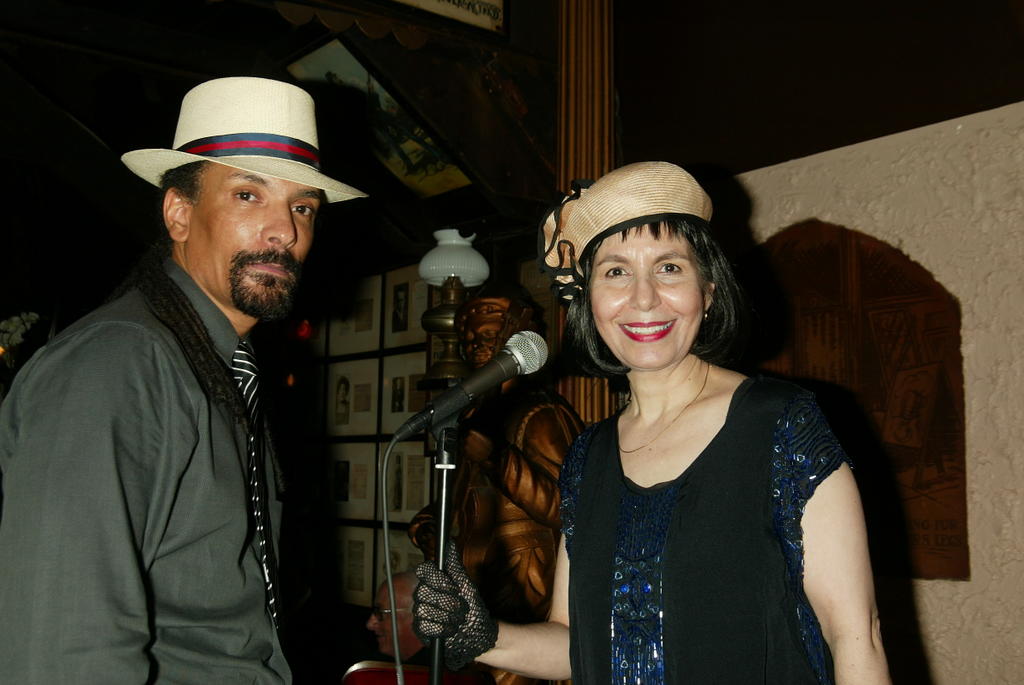
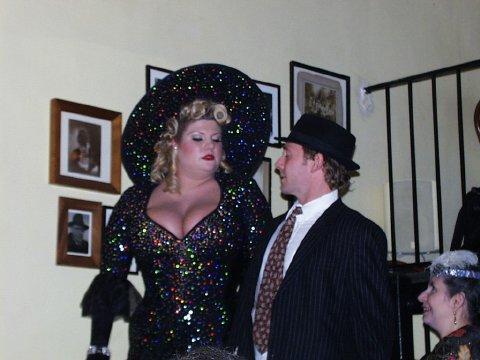
* * PHOTO: Marta Reiman and Linda Ann Loschiavo
* * PHOTO: Talia Castro-Pozo and Joe Franklin
[All photos taken on August 17, 2005 at the Mae West Birthday Gala.]
Text and Photos by Jules Peimer
with Olympus Stylus 400 Digital Camera
www.15minutesmagazine.com
15 Minutes Magazine, Inc.
"In the future, everybody will be famous for 15 minutes." Andy Warhol
Copyright© 1999-2005
http://maewest.blogspot.com/atom.xml

Tuesday, October 04, 2005

Mae West Seance at Haunted Mansion


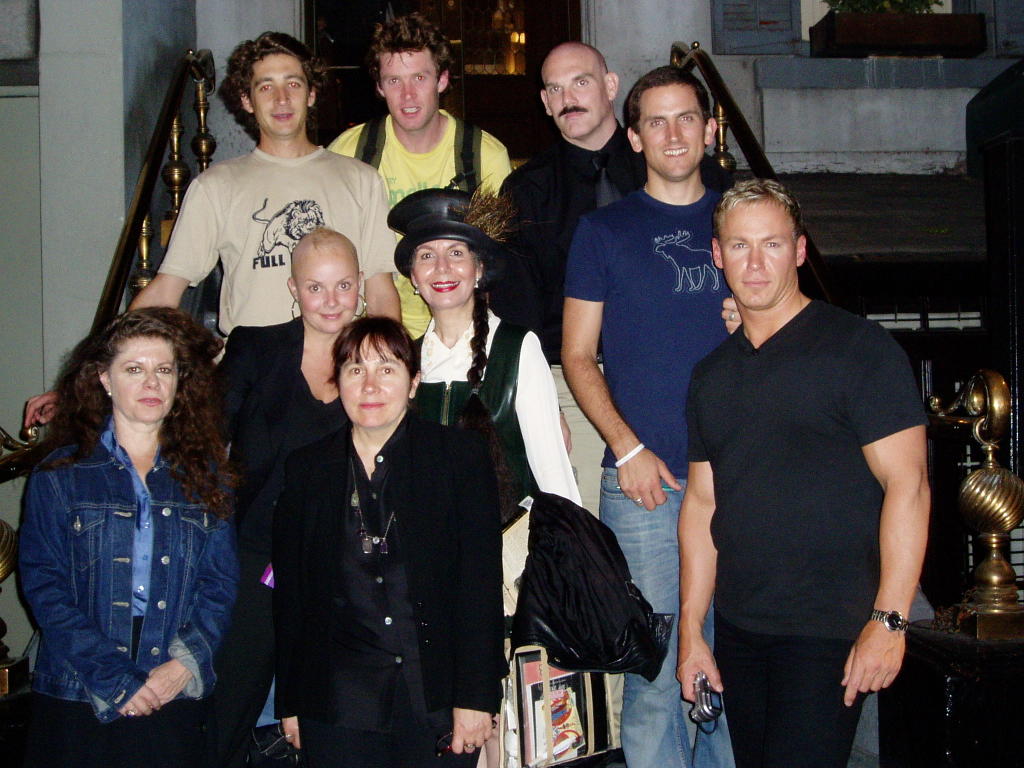
On October 2nd, 2005, several psychic ghost-hunters explored a haunted mansion on East 54th Street where vaudeville veterans -- including Mae West -- used to congregate when it was a speakeasy during the 1920s. TV legend Joe Franklin [not shown in this photo] spoke about interviewing Mae West to divinatrice Terry [Small Mediums at Large] Iacuzzo, British beauty Gail Porter, psychic Chris Fleming, actress Meryl Goodfader, and several other ghost-guides. Here's one of the group photographs taken after an awesome candlelit Mae West seance ended near midnight.
http://maewest.blogspot.com/atom.xml

Saturday, October 01, 2005

Mae West: April 1930 Hung Jury

A hung jury frees Mae West of obscenity charges for her play, Pleasure Man, at Criminal Court in Manhattan.
• • This courtroom scene is dramatized in the full-length play "Courting Mae West" written by another native New Yorker, dramatist and journalist LindaAnn Loschiavo
http://maewest.blogspot.com/atom.xml

Thursday, September 29, 2005

Broadway to Vegas Adores Mae Play


Broadway To Vegas
by Laura Deni


. . . SPREADING THE WORD . . .

BRITISH TV: COURTING MAE WEST the bio play by Linda Ann Loschiavo has tickled interest across the pond.

"The folks who do a TV series in Great Britain and in the USA called me from London," Loschiavo told Broadway To Vegas.

"They want me to host an episode on the Biography Channel on Mae West."

Loschiavo was told to "expect to film in New York City in October and it will air in February or March."

Loschiavo's play Courting Mae West covers the arrest, jailing, and legal aftermath surrounding Mae West's historic obscenity case. On February 9, 1927, Mae West was dragged out of a Broadway theatre, arrested for obscenity, brought to the West Side Court, and jailed there. She was charged and spent ten days at the Women's Workhouse on Welfare Island.
http://www.broadwaytovegas.com/September18,2005.html
- -
http://maewest.blogspot.com/atom.xml

Thursday, September 15, 2005

Molto, molto Mae West [America Oggi]

La poetessa LindaAnn Loschiavo sta
scrivendo ora una commedia sulla vita della
nota stella MAE WEST. Abbiamo visto
una prova, ben diretta da David Copeland. La
bella Marta Reiman e sexy ed e perfetta per
quel ruolo. Sensuale, allusivo dialogo
quando l’ aggressive, divertente Mae seduce
il giornalista Mario DeAngelis [Shade Vaughn],
un giovane che sa destreggiarsi. Una scena
promettente. Tante auguri di un bel successo
a una italoamericana che fa molto per la
cultura italiana. - - Mario Fratti
Teatro: Broadway & Dintorni [America Oggi]
.
.
Poet LindaAnn Loschiavo has just written
a comedy based on the life of the famous moviestar
MAE WEST. We’ve attended a rehearsal, ably
directed by David Copeland. Beautiful Marta
Reiman is sexy and perfect in the role of MAE.
Very sensual, with dialogue dotted with double-
entendres that show her sexually aggressive side,
charming MAE seduces the reporter Mario
DeAngelis [actor Shade Vaughn], a young man
who knows how to manueuver. Quite a
provocative scene. Best wishes for a splendid
success to an Italian American who has done
so much for Italian culture. - - Mario Fratti
Theatre: Broadway and off-Broadway
- - published in August 2005 in America Oggi - -
[Mario Fratti won a Tony Award for Nine.]
http://maewest.blogspot.com/atom.xml

Technorati Profile

Sunday, August 28, 2005

"Mae West Gala" - in Gay City News


Gay City News [Volume 75, Number 34 | August 25 - 31, 2005]

In the noh
When West Meant Best
Mae’s birthday party . . .
By DAVID NOH
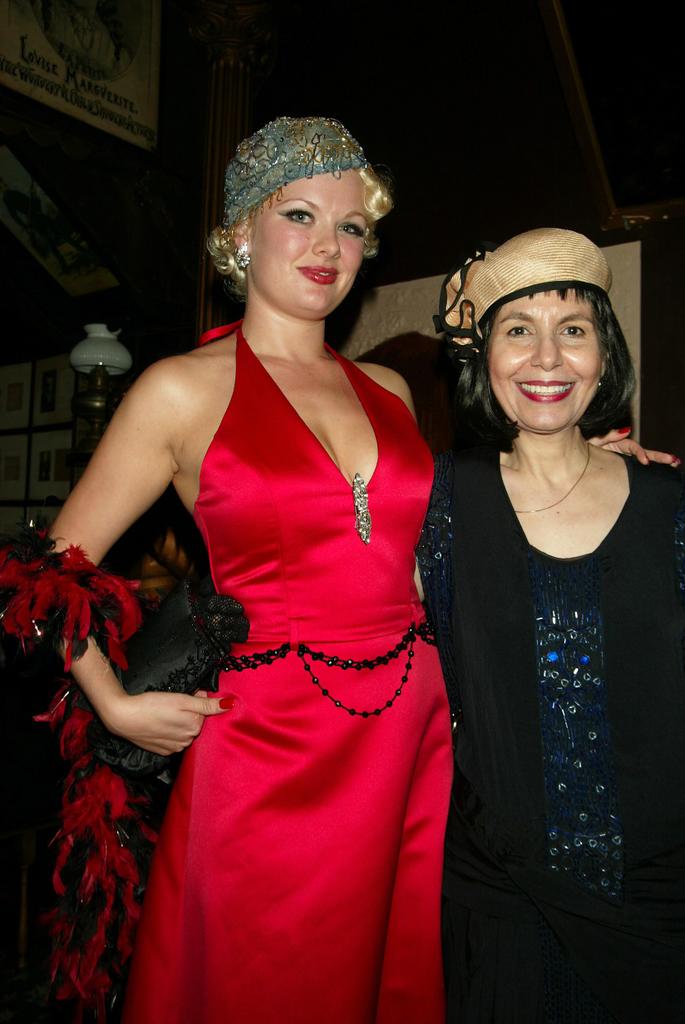
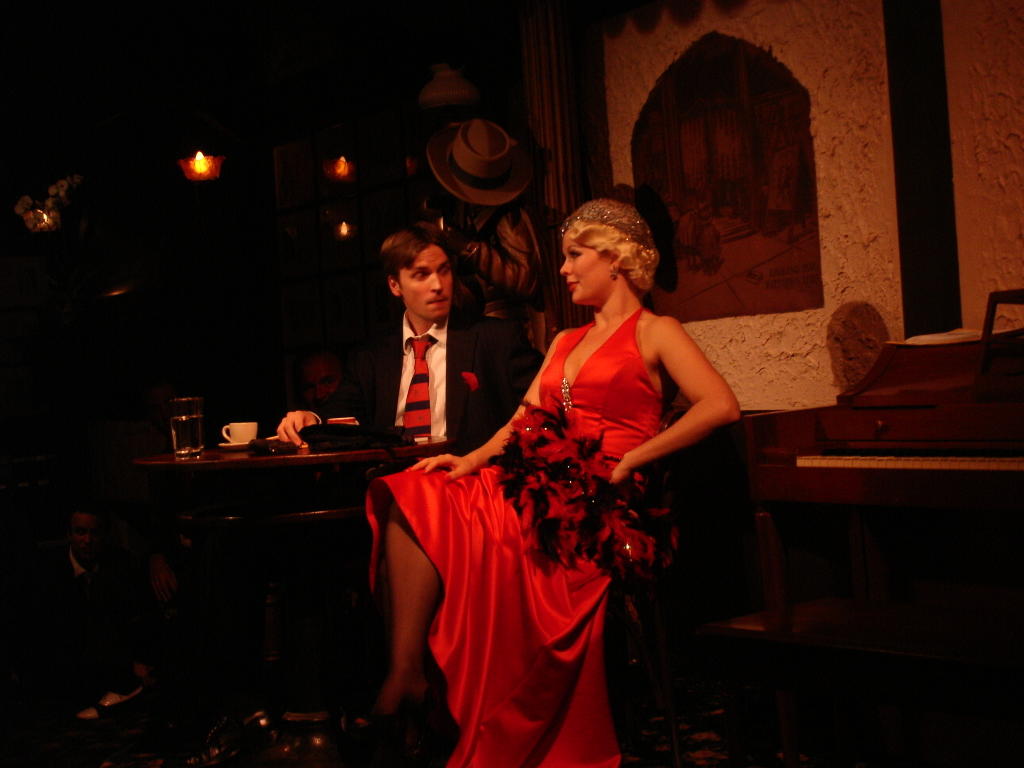
The evening also included an excerpt from LindaAnn Loschiavo’s play, “Courting Mae West,” and, in the title role, charming 24-year-old Marta Reiman had the old girl down, from the snowy, shifting shoulders to those rollercoaster eyeballs.


That we now live in the most debased of times was proven without a doubt by the recent Comedy Central TV Friars’ Roast of Pamela Anderson. Although The New York —don’t you know, we’re really hip, too!— Times saw fit to give it front page arts coverage, this one really scraped bottom as a craven display of vulgarity with Anderson’s ex, Tommy Lee, complacently listening to and adding his own crass references about her vagina and her fellatio expertise. A desperate Andy Dick actually gropes her famous breasts for a TV eternity. What hath Mae West, that pioneering female sex crusader, wrought?

MAE WEST was an original and a brave pioneer and on August 17, Bill’s Gay Nineties restaurant honored film icon Mae West on the occasion of the 112th anniversary of her birth.

These thoughts kept occurring to me as I joined the celebration of what would have been West’s 112th birthday on August 17 at Bill’s Gay Nineties restaurant, the perfect Belle Époque townhouse setting on East 54th, with its gaslight fixtures and vintage posters––Nazimova, Billie Burke, Olga Nethersole, Mary Garden in “Louise.”

All of us owe West, an original if ever there were one, a huge debt of gratitude, for not only breaking down puritanical barriers as a fully empowered, healthily lusty lady, but for all the sheer joy her comic writing and performances have given generations of fans. Her 1926 Broadway play “Sex” landed her in jail as a “lewd corrupter of youth,” while her follow-up work, “The Drag,” was an early attempt to deal with the subculture of homosexuality and cross-dressing, culminating in a big onstage drag ball.

West made her film debut in 1932 when she was nearly 40 with a slightly simian face and fulsome figure that were anything but conventionally beautiful, and yet managed to effectively wipe all her contemporaries off the screen. And she did it with a gift that is fast -- disappearing from our contemporary culture –– true wit, which relied more on a sly suggestiveness and faultless timing than any gross display of t & a or toilet humor.

West’s two best films are “She Done Him Wrong” and, especially, “I’m No Angel,” in which she plays Tyra––yes, the supermodel Banks was named after this character––who tames lions and every man in Manhattan. These pre-Hays Code nifties celebrated Mae in all her unabashed, ogling glory and, if there’s a more delightful film scene than the one in “I’m No Angel,” wherein she shimmies with her cadre of maids to “I Found a New Way to Go to Town,” I don’t know what that is.

Even her films made after censorship bit down hard on her are worth watching, like her engaging “Goin’ to Town” (1935). It includes her jaw-dropping rendition of the aria from “Samson et Delilah,” “Mon coeur s’oeuvre a ta voix,” unrivalled for brazen diva chutzpah until Aretha Franklin’s version of “Nessun dorma” at the 1998 Grammy Awards.

Marta Reiman, a charming 24-year-old actress, had Mae West down cold -— from the shifting shoulders to those rollercoaster eyeballs -— in an excerpt from LindaAnn Loschiavo’s play, “Courting Mae West,” presented at the West tribute at Bill’s Gay Nineties.

Show biz vet Joe Franklin recalled the time the diminutive West appeared on his show, with her muscleman companion towering above her: “She said, ‘Joe, This man’s 6 feet 8, I’m 5 feet tall, and he’s nuts over me,’ and this was on live TV!”

The Tulsa, Oklahoma native, a newcomer to New York, said, “I knew what Mae West looked like, but hadn’t watched any of her movies. Now I’ve seen all of them and, honestly, this is the most fun role I’ve ever played. She was a fabulous comedienne, and I love that she not only was a star, but broke so many barriers with ‘Sex,’ and was always pushing the envelope with censorship. I admire that and the fact that she was a writer and producer as well, and had complete control over her work, which I hope to do.”
Contact David Noh at Inthenoh@aol.com.
gaycitynews.com
- published in Gay City News | 487 Greenwich St. | New York, NY 10013 -
http://maewest.blogspot.com/atom.xml

Technorati Profile

Tuesday, August 23, 2005

Mae West's Watermelon Man


This stunning MAE WEST carving was created for the Mae West Birthday Gala by a NYC master carver Hugh McMahon. For twenty years, Mr. McMahon has been carving pumpkins for Hallowe'en Howls and other occasions but he used a watermelon to render this sculpture of Brooklyn-born Mae West, dramatically lit with a low-wattage bulb.
What a great photo opportunity this was at the MAE WEST BIRTHDAY GALA, huge thanks to Hugh.
.
Want to hire sculptor Hugh McMahon for your event?
Hugh McMahon: T: 718-625-6171 or E: hmcmahonp@hotmail.com

Monday, August 22, 2005

Mae West Loves a Good Man


Usually working effectively backstage and behind the scenes on all aspects of "COURTING MAE WEST" is a versatile, indispensable man: Conrad Bradford.
And he deserves a big round of non-stop applause.
PHOTO: Conrad Bradford and LindaAnn Loschiavo on August 17, 2005 at the Mae West Gala
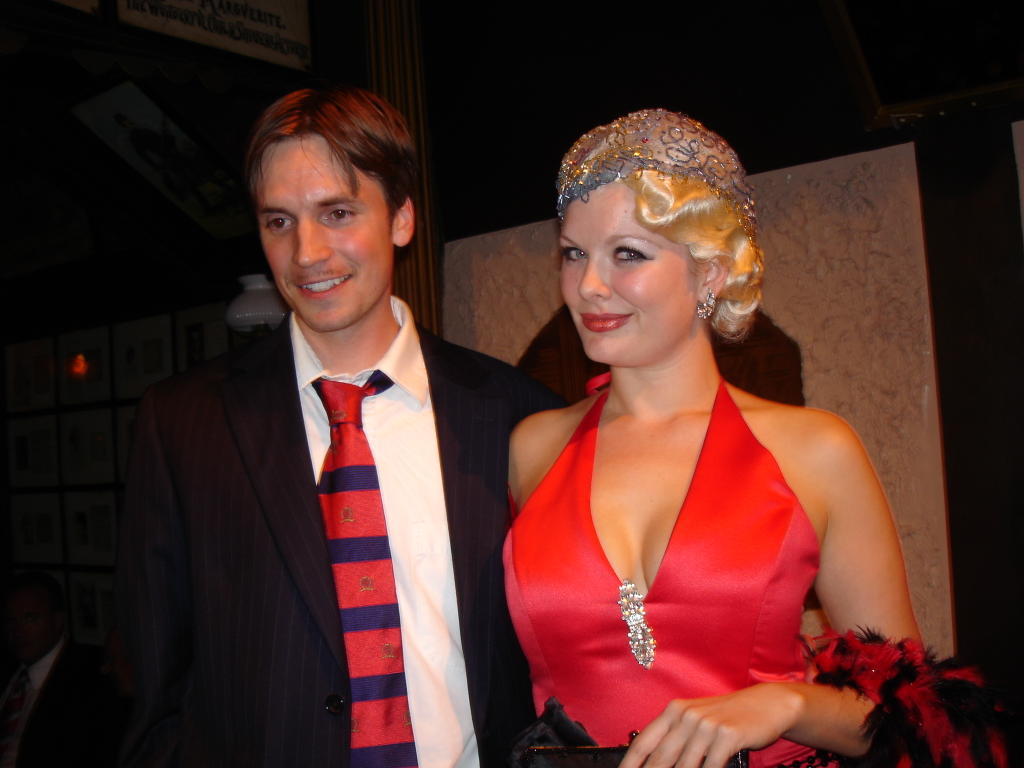
PHOTO: Actress Marta Reiman - in the role of MAE WEST - poses with dramatist LindaAnn Loschiavo who wrote "COURTING MAE WEST" on August 17, 2005
All photos © Joseph Marzullo / All Rights Reserved.
http://maewest.blogspot.com/atom.xml

"Courting Mae West" Appreciation


Thanks to the wonderful sponsors who amplified the enjoyment at the Mae West Gala on August 17th, when Act I, Scene 1 [the speakeasy scene set in 1926] from the comedy "Courting Mae West" was shown to a Manhattan audience, most of whom came attired in colorful Prohibition Era garb to complement the play's 1920s setting as well as the venue: Bill's Gay Nineties, an original New York speakeasy on East 54th Street.

~ ( ) ~ ( ) ~ ( ) ~ ( ) ~ ( ) ~ ( ) ~ ( ) ~ ( )
HUGE HEARTFELT THANKS to Conrad Bradford * NAT SHERMAN * DEWARS * HENDRICKS GIN * IZZE * COMFY CUISINE * COMFY CARBS * THOMPSON'S ORGANIC CHOCOLATES * GLOBAL CONFECTIONS * THE MONSTER * MARTY MARKOWITZ, Brooklyn Borough President; Maria Campanella; John Muscarello; Edward Jackson; as well as the cast and many others who participated in ways big and small.
~ ( ) ~ ( ) ~ ( ) ~ ( ) ~ ( ) ~ ( ) ~ ( ) ~ ( )
http://maewest.blogspot.com/atom.xml

Marta Reiman: Playing Mae West


August 17, 2005
"Courting Mae West"
starring
Marta Reiman and Shade Vaughn
- - photographs from August 17, 2005 Mae West Gala - -

Wednesday, August 17, 2005

Mae West: Tingle for Two


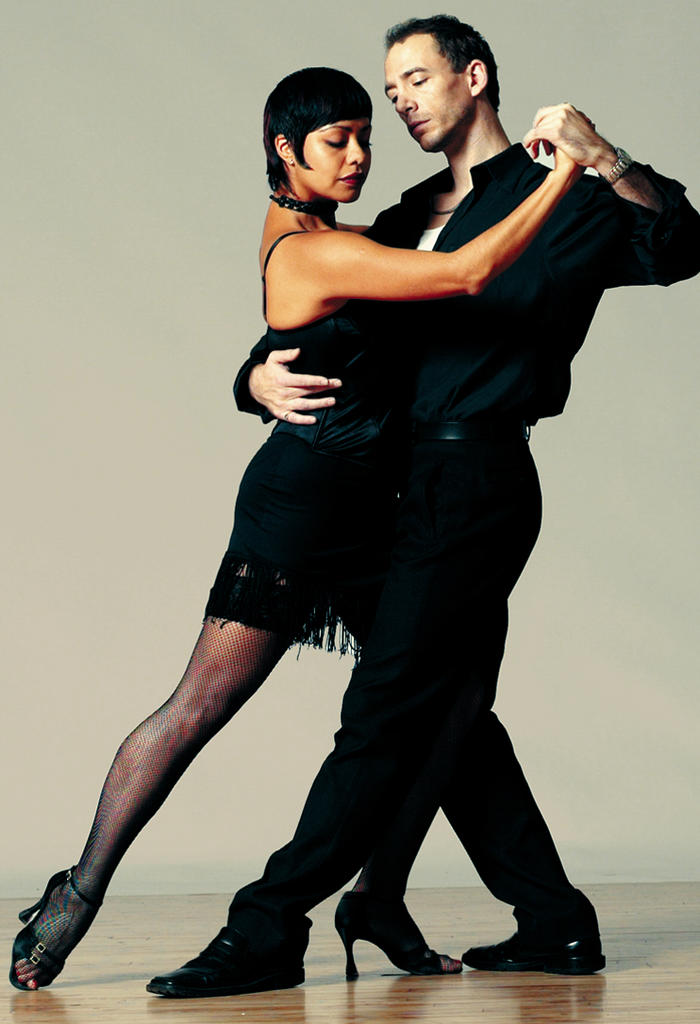
Mae West says: When I have a birthday, I want the right people in the room. And these two do a tango that makes me tingle. Summertime feels hotter when I'm watching Talia Castro-Pozo dance with Jules Helm. Mmmmmm.
http://maewest.blogspot.com/atom.xml

Sunday, August 14, 2005

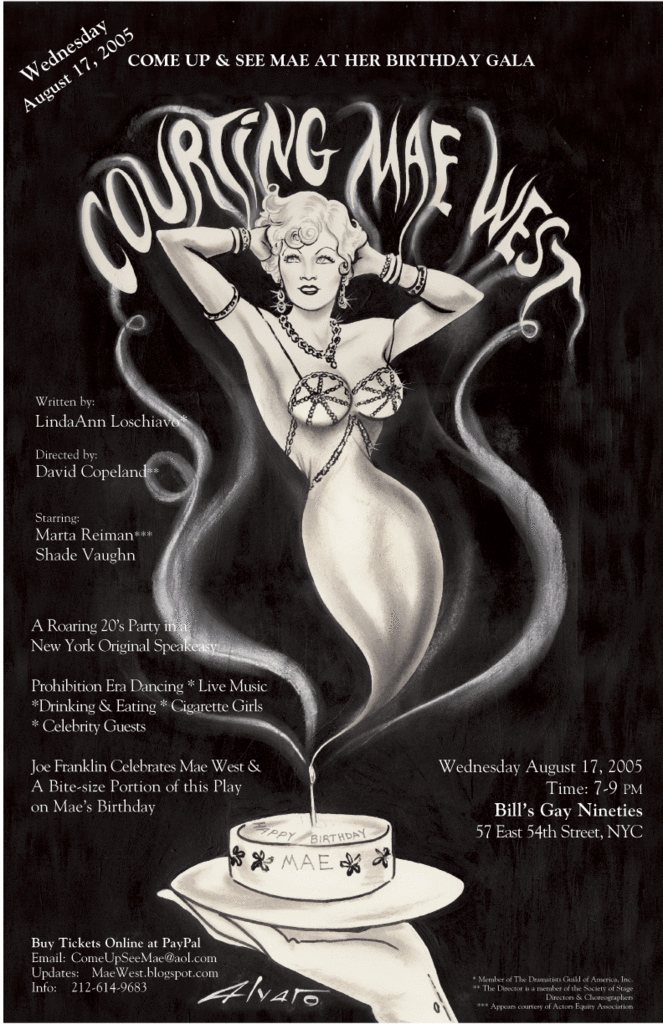
Come Up & See Mae on Her Birthday


Come Up and See Mae on August 17th, Her Birthday
http://maewest.blogspot.com/atom.xml

Spirited Evening with Mae West in NYC


Ghosts and Hosts Reside Side by Side at 57 East 54th Street


New York, NY: Spirits will rise in midtown Manhattan at 7:00 PM on August 17th during the Mae West Birthday Gala at Bill’s Gay Nineties when Joe Franklin, Louise Lasser, and other entertainment industry VIPs gather to pay tribute to Mae West [1893-1980], who performed live in vaudeville and on Broadway as well as in movies.

Earlier, however, spirits of a different sort will be aroused when Dr. Lauren Thibodeau conducts a séance in this haunted mansion on East 54th Street. Built in 1888, and always owner-occupied, there is a full house shared by the living [Barbara Bart and the staff of Bill’s Gay Nineties] – and the undead: two playful girls clad in white dresses along with other noisy entities.

Restaurant manager Aldo Leone, whose work keeps him on the first and second floor, had not known about the ghosts – until recently. But bartender Rich and Elizabeth, a longtime waitress who exercises on the third floor, see and hear these supernatural inhabitants regularly.

Headwaiter Sergio, serving a table of ten last week, turned back towards the kitchen and noticed a light outline of a girl in white, her face so brightly white that her features were indistinguishable. As he tried to beckon a busboy, the girl vanished.

Actress MARTA REIMAN, who plays MAE WEST on August 17th, said she "feels someone" behind her when she's changing her clothes on the third floor.

On August 17th, it will be interesting to see who shows up, said JOE FRANKLIN, who will discuss his friend Mae West after a mini-performance of “Courting Mae West” and a full program of lively Prohibition era entertainment. Since Bill’s Gay Nineties is an original New York speakeasy, strolling Cigarette Girls and other prohibited delights will be on hand.

Tickets to this Benefit are available via PayPal.
Information is online: http://MaeWest.blogspot.com

###

ACT I, Scene 1 of "Courting Mae West"
by dramatist LindaAnn Loschiavo - -
starring MARTA REIMAN and SHADE VAUGHN
[shown rehearsing in this photograph]
and directed by David Copeland - -
will be onstage at Bill's Gay Nineties
[57 East 54th Street, NYC 10022] on Mae's birthday
Wednesday August 17, 2005.
Information: 212-614-9683
- - from I-Newswire - -
http://maewest.blogspot.com/atom.xml

Sex with Mae West for the British

Sex with Mae West, Acoustic Music Centre at St. Bride's
.
As a one-woman one-liner industry, Mae West is a gift to any actress-singer who wants to talk dirty. And a good few of the one-liners are here in a show that presents the Hollywood sex goddess as a raunchy rhythm-and-blues singer in an ill-starred relationship with a jump-jive saxophone-playing W C Fields.
Unfortunately, Corliss Randall doesn't, as it were, rise to the occasion.
Randall's idea of going West consists of teetering around, pawing her audience and saying "aw" as if in a permanent state of semi-arousal. Randall has the required pneumatic assets and she belts out her songs with some gusto. But at the moment her band is carrying the show and she needs to work a whole lot harder at making West more than a one-dimensional character with a not very convincing wig.
Ends August 21.
written by: ROB ADAMS
printed in: The Herald [U.K.] August 11 2005
- - from http://www.theherald.co.uk/ - -
- - Come Up & See Mae on August 17, 2005 - -
http://maewest.blogspot.com/atom.xml

Saturday, August 06, 2005

Mae West: August 2, 1944

It was 2 August 1944.
Mae West adds to the wartime summer heat with her bawdy comedy Catherine Was Great, which co-stars West and her leading man, acctor Gene Barry.
[The play will run 191 performances.]
- - Come Up & See Mae on August 17, 2005 - -
http://maewest.blogspot.com/atom.xml

Sunday, July 17, 2005

Mae West Birthday Gala: August 17


COURTING MAE WEST Gala Fundraiser on August 17th, 2005 in New York

GOAL: to raise funds to stage Courting Mae West in a NYC theatre
PAYMENTS: make checks payable to The Field, earmarked for Courting Mae West - - August 17th Gala.
.
Mail to: L. Loschiavo, 24 Fifth Avenue [Box 6-11], NYC 10011-8817, USA
.
CREDIT CARD PAYMENTS: pay online at www.PayPal.com - the August 17th Gala's account is under ComeUpSeeMae@aol.com

Individual Donations

.
Top Tier attendee: $500 [limited to 40 adults]
(One Ticket for the 6:00 pm Séance; Preferred Seating at the 7:00 pm mini-performance of Courting Mae West; Cocktail Reception with Dewar's scotch and your own private Dewar's barmaid; non-stop food and drinks; unlimited live entertainment; Mae West by artist Sam Norkin: Signed Limited Edition [value: $500]; Photo Opportunity with Mae West and Joe Franklin; One Giftbag; Credit on Event Material and Web Site; $400 of your $500 admission is tax deductible.)
.
Medium Tier attendee: $300 [225 adults will be admitted]
(One Ticket for 7:00 pm Courting Mae West mini-performance; Cocktail Reception; non-stop food and premium brand-name labels such as Dewar's imported scotch and Damrak's imported gin; unlimited live entertainment; Mae West by artist Sam Norkin: Signed Limited Edition [value: $500]; a Free Reading by a Psychic; One Giftbag; $200 of $300 admission is tax deductible.)
.
Lowest Tier attendee: $130 [225 adults will be admitted]
(One Ticket for 7:00 pm Courting Mae West mini-performance; Cocktail Reception; non-stop food and premium brand-name labels such as Dewar's imported scotch and Damrak's imported gin; unlimited live entertainment. NO giftbag, no VIP extras.)
.
NON-attending donor whose contribution is $50 or MORE: you will receive our thanks and a stunning 11" x 17" illustration of Mae West as "Diamond Lil" by artist Sam Norkin: Signed Limited Edition [value: $500].
.
.
The Field is a not-for-profit, tax exempt, 501(c)(3) organization serving the New York City performing arts community. Contributions made to The Field and earmarked for COURTING MAE WEST are tax deductible to the extent allowed by law.
.
For more information about the Field contact:
The Field, 161 6th Avenue, New York, NY 10013, [212] 691-6969, fax: [212] 255-2053, www.TheField.org email: info@thefield.org. A copy of The Field's latest annual report may be obtained, upon request, from The Field or from the Office of the Attorney General, Charities Bureau, 120 Broadway, New York, NY 10271.

Event info line: 212-614-9683.
.
http://maewest.blogspot.com/atom.xml

The Wit of Mae West


"Anyone who says he can see through a woman is missing a lot."
- Mae West
- - Come Up & See Mae on August 17, 2005 - -
http://maewest.blogspot.com/atom.xml

Saturday, July 16, 2005

Mae West on July 16, 1952

On July 16, 1952 - - 53 years ago in Groton, Connecticut:
Mae West traveled to the Groton submarine base to participate in the "debut" of the scarlet red life jackets dubbed "Mae Wests" [a flotation device]. The new color was designed to be visible from greater distances; a cord attached to the jackets, when pulled, caused them to immediately inflate, getting a nod of approval as their namesake stood by for the demonstration. . . .
- published 16 July 2005 * The Day * New London, CT *
.
- - Come Up & See Mae on August 17, 2005 - -
http://maewest.blogspot.com/atom.xml

Thursday, July 14, 2005

Mae West's Sofa Bocca Stars at Charing X

The world's first erotic gallery on its way:
Come up and see the famous Sofa Bocca, based on Mae West's lips
.
London will house the world's first commercial gallery selling erotic art and design.
.
The building covering 5,000 sq ft over four floors on Charing Cross Road, and dedicated to the erotic art opens to the public, on July 15, 2005.
.
Called Charing X, it will stock only the most provocative works from artists including David Hockney, Sir Peter Blake, Damien Hirst, Marc Quinn, and Jenny Saville. It will also have floors dedicated to erotic couture, burlesque, fashion photography and even furniture.
.
Charing X has been co-founded by the Eyestorm gallery's David Grob and Coco de Mer creator Adae-Elena Amats.
.
"Every artist spends a large part of their lives painting nudes," Grob said.
.
Furniture on sale will include the famous Sofa Bocca, based on Salvador Dali's Mae West-inspired lip-shape design as well as leatherwear and . . .
Excerpt from: Asian News International
Published: London, July 14, 2005
- - -http://www.hindustantimes.com- - -
- - - - -
http://maewest.blogspot.com/atom.xml

Wednesday, July 13, 2005

Mae West: Censura y Cultura


Noticiero NIP: News ITALIA PRESS agencia de noticias - N° 26 -
Año XII, 8 de febrero de 2005
Censura y cultura, reflexiones itálicas
.
En ocasión de la primera "Courting Mae West. A staged reading", escrita por la guionista ítalo-americana LindaAnn Loschiavo, artistas ítalo-americanos se preguntan sobre el apoyo a la cultura étnica e instituciones de origen italiano en América
.

Nueva York - La comedia "Courting Mae West. A staged reading", escrita por la guionista ítalo-americana LindaAnn Loschiavo, estará en escena mañana, 9 de febrero en el C.U.N.Y Graduate Center di New York, dirigida por Thomas Morrissey. La historia relata la vivencia de Mae West, diva del teatro de Broadway en 1927, arrestada por actos obscenos, transferida a la West Side Court y recluida allí hasta su transferencia, por diez años, a la Women's Workhouse de Welfare Island.

La puesta en escena de la Loschiavo relata el arresto, la detención y las consecuencias desgraciadas en torno a este caso de obscenidad. En el caso de la representación en Nueva York de mañana, la guionista de origen italiano tuvo en cuenta discutir la relación entre cultura y censura en la Broadway de 1926-1929.

La 'premier', desencadenó en la prensa americana local, una serie de reacciones de parte de la Loschiavo y de otros actores y productores de origen italiano. Una protesta mediática que quiere atraer la atención sobre la gran producción cultural de prensa italiana en América, absolutamente subestimada respecto a la producida por otros grupos étnicos, en primera línea hebreos e irlandeses.

"Por años las asociaciones ítalo-americanas no-profit, acusaron a los actores de aceptar solo papeles de villanos y mafiosos – dice por ejemplo el actor ítalo-americano Joe Piscopo – la realidad es que a diferencia de otros grupos que apoyan a los actores, guionistas, las asociaciones ítalo-americanas cambiaron poco de su actitud en la última mitad del siglo. Este es el motivo por el que no hay muchas historias reales de vida ítalo-americana en los escenarios de América".

La Loschiavo declaró, por su lado, que parte del problema es que los ítalo-americanos no producen muchas comedias que tengan como fin mejorar la propia imagen. "Mientras en América hay casi 90 grupos de teatro hispánicos, no hay un teatro o un grupo teatral ítalo-americano – ha declarado – hebreos e irlandeses han producido muchos premios Pulitzer a Tony Award, reconocimientos que siempre vieron primero los escritores ítalo-americanos".

"Tenemos necesidad de tener películas y comedias que afondan una imagen positiva, y más, tenemos necesidad de que sean financiadas por ítalo-americanos", agregó la productora Marylou Tibaldo-Bongiorno. "Si las asociaciones ítalo-americanas quisieran construir teatros y promover el arte, habría mucho más respeto por ellos – declaró el actor J.W Perra – espero que 'Courting Mae West' vaya a Broadway" .
.
Para expresar solidaridad al proyecto y contra toda forma de censura, el actor itálico Mark Rúffalo suscribió una carta de apoyo a la guionista Loschiavo. Además se debe al artista Michael Di Motta la exposición de coloridos paneles visibles en ocasión de la velada de la 'premier', pintados en la portada de un archivo fotográfico de la época (1927-28). "Es un honor ayudar a redescubrir un capítulo perdido de la historia neoyorquina de los años '30", declaró Di Motta.
.
News ITALIA PRESS * N° 26 - Anno XII, 8 febbraio 2005
© Copyright News ITALIA PRESS di MediaPress S.r.l. 2002-2004 - Tutti i diritti riservati News ITALIA PRESS – Testata registrata al Tribunale di Ivrea (Torino, Italy) N° 166 del 01.03.1994
Le notizie del Notiziario NIPsono offerte in lettura gratuitamente.
- - from News ITALIA PRESS - -
- - -
http://maewest.blogspot.com/atom.xml

Mae West: diva del teatro

- an article on Mae West published in Italy -
NIP > Italici nel Mondo
Notiziario NIP - News ITALIA PRESS agenzia stampa - N° 26 - Anno XII, 8 febbraio 2005
Censura e cultura, riflessioni italiche
.
In occasione della 'prima di "Courting Mae West. A staged reading", scritta dalla sceneggiatrice italo-americana LindaAnn Loschiavo, artisti italo-americani si interrogano sul sostegno alla cultura 'etnica' da parte di enti ed istituzioni di origine italiana in America
.
New York - La commedia "Courting Mae West. A staged reading", scritta dalla sceneggiatrice italo-americana LindaAnn Loschiavo, andrà in scena domani, 9 febbraio al C.U.N.Y Graduate Center di New York, diretta da Thomas Morrissey. La storia racconta la vicenda di Mae West, diva del teatro di Broadway nel 1927, arrestata per atti osceni, trasferita alla West Side Court e lì rinchiusa fino al trasferimento, per dieci anni, alla Women's Workhouse di Welfare Island.
.
La messa in scena della Loschiavo racconta l'arresto, la detenzione e le conseguenze spiacevoli intorno a questo caso di oscenità. Nel caso della rappresentazione a New York di domani, la sceneggiatrice di origine italiana ha messo in conto di discutere del rapporto tra cultura e censura nella Broadway del 1926-1929 .
.
La 'prima', ha scatenato, sulla stampa americana locale, una serie di reazioni da parte della Loschiavo e di altri attori e produttori di origine italiana. Una protesta mediatica che vuole attirare l'attenzione sulla grande produzione culturale di stampo italiano in America, assolutamente sottostimata rispetto a quella prodotta da altri gruppi etnici, in prima linea ebrei ed irlandesi.
.
"Per anni le associazioni italo-americane no-profit, hanno accusato gli attori di accettare solo ruoli da villani e mafiosi – dice ad esempio l'attore italo-americani Joe Piscopo -. La realtà è che diversamente da altri gruppi che sostengono attori, sceneggiatori, le associazioni italo-americane hanno cambiato poco del loro atteggiamento nell'ultima metà del secolo. Questo è il motivo per cui non ci sono molte storie reali di vita italo-americana sui palcoscenici d'America ".
.
La Loschiavo ha dichiarato, dal canto suo, che parte del problema è che gli italo-americani non producono molte commedie che abbiano come fine migliorare la propria immagine. "Mentre in America ci sono circa 90 gruppi di teatro ispanici, non c'è un teatro o un gruppo teatrale italo-americano – ha dichiarato -. Ebrei e irlandesi hanno prodotto molti premi Pulitzer a Tony Award, riconoscimenti che di rado hanno visto primeggiare scritti italo-americani."
.
"Abbiamo bisogno di avere film e commedie che infondano un'immagine positiva e, di più, abbiamo bisogno che siano finanziati da italo-americani", ha aggiunto la produttrice Marylou Tibaldo-Bongiorno.
"Se le associazioni italo-americane volesse costruire teatri e promuover l'arte, avrei molto più rispetto di loro – ha dichiarato l'attore J. W. Perra -. Spero che 'Courting Mae West' vada a Broadway" .
.
Per esprimere solidarietà al progetto e contro ogni forma di censura, l'attore italico Mark Ruffalo ha sottoscritto una lettera di sostegno alla sceneggiatrice Loschiavo. Inoltre si deve all'artista Michael Di Motta l'esposizione di colorati pannelli visibili in occasione della serata della 'prima', dipinti sulla scia di un archivio fotografico dell'epoca (1927-'28). "E' un onore aiutare alla riscoperta di un capitolo perduto della storia newyorchese degli anni '30 ", ha dichiarato Di Motta
.
News ITALIA PRESS * N° 26 - Anno XII, 8 febbraio 2005
© Copyright News ITALIA PRESS di MediaPress S.r.l. 2002-2004 - Tutti i diritti riservati News ITALIA PRESS – Testata registrata al Tribunale di Ivrea (Torino, Italy) N° 166 del 01.03.1994
Le notizie del Notiziario NIPsono offerte in lettura gratuitamente.
- - from News ITALIA PRESS - -
- - -
http://maewest.blogspot.com/atom.xml

Mae Amid the Halls of Ivy

Here's an excerpt from Heather O'Donnell's academic article: "Signifying Sex"
American Quarterly - Volume 54, No. 3, September 2002, pp. 499-505 [Johns Hopkins Press]

Excerpt: . . . THE FEW BOOKS ABOUT MAE WEST THAT APPEARED AFTER HER DEATH IN 1980 were heavily illustrated, mass-market biographies of a fondly (if dimly) remembered star. The past five years, however, have seen an explosion of critical interest in West, not simply in her status as a camp-and-vamp Hollywood icon, but in her controversial work as a playwright and novelist, her experimentation with sexually and racially coded performance styles, and in the way that West — "the greatest female impersonator of all time," rumored to be a gay man or a black woman in disguise—continues to challenge popular assumptionsabout identity.1
.
The 1990s saw four full-length critical studies devoted to West: Marybeth Hamilton's "When I'm Bad, I'm Better": Mae West, Sex, and American Entertainment (HarperCollins, 1995); Pamela Robertson's Guilty Pleasures: Feminist Camp from Mae West to Madonna (Duke, 1996); Ramona Curry's Too Much of a Good Thing: Mae West as Cultural Icon (Minnesota, 1996); and Emily Wortis Leider's Becoming Mae West (Farrar Straus Giroux, 1997). Claudia Roth Pierpont celebrated West in the pages of The New Yorker, in an essay later collected in Passionate Minds: Women Rewriting the World (Vintage, 2000), and in 2000, Mae West returned to Broadway in Claudia Shear's Dirty Blonde, a tribute to her life and legacy.
.
Now historian Jill Watts has published a new biography, Mae West: An Icon in Black and White, which argues for West's significance as "a cultural agent that celebrates and perpetuates the African presence within American society"(318). Speculating that West's paternal grandfather was black, Watts reconsiders West's career in the context of the African American practice of signifying, embodied in the figure of the trickster, and of an African American womanist consciousness, represented in the female... .
- - excerpt from Heather O'Donnell's academic article: "Signifying Sex" - -
- - -
http://maewest.blogspot.com/atom.xml

Monday, July 11, 2005

Daily Quota of Mae West Quotes


One more Mae West quote:
"I have found men who didn't know how to kiss.
I've always found time to teach them."
- - -
http://maewest.blogspot.com/atom.xml

Sunday, July 10, 2005

Mae West: "Leo" Lady


Mae West: Born Under the Sign of Leo
Great comediennes, presidents, first ladies, entertainers as well as great dictators have been born under the zodiac sign LEO: [July 24 - - August 22]. Born in 1893 on August 17th, Mae West is a Leo.

LEO: Element: Fire
Parts of the body associated with Leo: the heart & the back
Keywords: "I will!" Courageous, lion-hearted, protective
The Leo is a gregarious, social, proud and powerful personality.

Famous Leos
Mae West
Don Henley * Napoleon * Herbert Hoover * Mussolini
Fidel Castro * Jacqueline Kennedy Onassis
comedienne Lucille Ball * Count Basie * comedienne Gracie Allen
- - -
http://maewest.blogspot.com/atom.xml

Mae West's Birthday Gala on August 17th


-- as featured on WBBR Bloomberg Radio [broadcast 3 July 2005]
- - Who, What, When, Where - - - - - -
MEDIA coverage invited – SPONSORSHIP welcome
WHAT: Mae’s Birthday Gala & Seance: Fundraiser for Courting Mae West
WHAT’S SPECIAL: A&E will film this evening as part of a reality TV Program
WHEN: Wednesday evening August 17th, 2005 on Mae’s birthday
WHERE: on East 54th Street in a 19th century mansion in Manhattan
WHO: Dr. Lauren Thibodeau, Medium and Psychic, and celebrity guests
EXTRA: Joe Franklin will speak about his friend Mae West
HOW MANY: 200 - 285 adults expected to attend Mae West’s Birthday Gala
TICKETS: 3 Tiers of Admission [Séance tickets are limited to 40 attendees]
Info: 212-614-9683
- - -
http://maewest.blogspot.com/atom.xml

Thursday, July 07, 2005

Mae West Put the "oooh" in Brooklyn


- - Who Made Greenpoint's Accent Glamourous? Who Gave WOW Power to Williamsburg? Who Put the "ooh" in Brooklyn? The Come-Up-Sometime Cutie Is Being Commemorated in New York City - -
.
New York, NY -- Mae West is still the Queen of Kings County. About.com's Brooklyn Guide Wendy Zarganis has been thinking about Bushwick Avenue's vaudevillian Mae West on the 25th anniversary of her passing. In her latest column, Zarganis noted that dramatist LindaAnn Loschiavo will offer excerpts from her play "Courting Mae West" (based on true events in Manhattan during the 1920s) at the Mae West Birthday Gala taking place on Wednesday, August 17th at Bill's Gay Nineties on East 54th Street.
.
According to Zarganis, Loschiavo's play reveals the rarely-seen, emotional side of the Brooklyn-born Mae West. Buy tickets before July 23rd to receive an advance ticket discount. See the link for details or email ComeUpSeeMae@aol.com. Wendy Zarganis wrote: "Loschiavo's blog is a must-read for lovers of Mae West and of New York in the Roaring '20s."
posted online on the Guide to Brooklyn page: Tuesday July 05, 2005 #
- - Mae West Birthday Gala * featured on About.com - -
.
BY: Wendy Zarganis, Brooklyn, New York's Online Guide
Visit Wendy + Kings County: http://www.brooklyn.about.com/
- - - - -
http://maewest.blogspot.com/atom.xml

Wednesday, July 06, 2005

Mae West & Diane Arbus

Facing Scrutiny--Facing West

The more you get to know Diane Arbus' photographs, the more she intrigues, writes Philippa Hawker on the eve of a Jewish Museum exhibition.

Diane Arbus' images test our understanding of the limits of photography. . . .
~ ~ Mae West ~ ~
Some of the images in the Jewish Museum exhibition were commissioned by magazines: they could be celebrity portraits, images to accompany stories on American life, or the photographer's own projects. In 1965, Arbus spent two days with the septuagenarian star Mae West, and wrote a piece for Show Magazine to accompany the images: she described Mae as "imperious, adorable, magnanimous, genteel and girlish, almost simultaneously. There is even, forgive me, a kind of innocence about her."
.
But the photographs are more pitiless than the prose: they shed a harsh, revealing light on their subject. West hated them, and threatened to sue.
.
Her portraits often seem to be collaborations, images created with the participation and consent of those she photographed. Yet they contain something that is both more and less than their subjects might think they are revealing: they seem to show the gap between how a person sees themselves and how they might appear to others. There is empathy and there is distance, intimacy and a kind of pitiless scrutiny.
.
Arbus, who had a sharp, pithy prose style, often supplied lines that could be used by critics either to justify or condemn her. A monograph with the twins on its cover, published after her suicide in 1971, included pages of Arbus utterances and observations about photography that have an offhand yet aphoristic force. They suggest, sometimes misleadingly, things about her work and her approach.
.
Diane Arbus owned up to manipulation in taking her pictures: she acknowledged the access that a camera gave her, the power it conferred on her, the mystery and intractability of some aspects of her art. She said things that have continued to haunt the way her work is reviewed and understood. Things such as:
.
"A photograph is a secret about a secret."
"You see people on the street and what you notice about them is the flaw."
"We've all got an identity. You can't avoid it. It's what is left when youtake everything else away."
"I work from awkwardness. By that Imean I don't like to arrange things. If I stand in front of something, instead of arranging it, I arrange myself." . . .
. . .
The Photographs of Diane Arbus is at the Jewish Museum, 26 Alma Road, St Kilda from July 12 to August 28. On July 17 at 7.30pm, there will be special program that includes a guided tour and a discussion by a psychiatrist about responses to difference. Bookings: 9534 0083
- - excerpt from an article printed in Australia - -
By Philippa Hawker
July 6, 2005
http://www.theage.com.au/
- - - - -
http://maewest.blogspot.com/atom.xml

Saturday, July 02, 2005

Speakeasy Secrets Mae West & George Raft Knew


Discover Secrets Unspoken in a Speakeasy on West 56th Street that Mae West & George Raft Once Knew
.
.
Through July 21, when Film Forum (209 West Houston St.) is showcasing witty films that slipped the censors in its "Paramount Before the Code" series—including Mae West's screen debut [in "Night After Night"]—will any Big Apple history buffs be in the audience? Whose memory is sharp enough to detect New York nuggets built into this comedy set in a certain palatial rowhouse? Or has that once comforting tonic of shared narrative vanished like bathtub gin?
.
Club Napoleon: 33 West 56th Street
.
Before she read the script, Mae West knew about these premises on West 56th Street. So did George Raft, who had tangoed in speakeasies run by Texas Guinan and her brother, and patronized by Dorothy Parker along with literary "round table" types. It was Tommy Guinan and Sherman Billingsley who were the Pied Pipers of Club Napoleon, mixmasters who made the right ingredients pour in: bluebloods, showgirls, prizefighters, and pinky-ring types.
.
Club Napoleon’s escapades inspired a sly short story, "Single Night" by Louis Bromfield, which Mae West, Kathryn Scola, and Vincent Lawrence would fine-tune and finesse into a screenplay about a speak with the working title of Number 55. An address change couldn’t fool New Yorkers. Those in the know realized this was about "that house on Fifty-Sixth Street," which had been owned by Charles Donahue, whose ambitious brother had wooed and wed heiress Jessie Woolworth, worth $70,000,000 thanks to her grandfather, founder of the five-and-dime chain.
.
When this elegant five-story limestone mansion became the lavishly appointed speakeasy Club Napoleon, a repeat attender was Pulitzer winner Louis Bromfield [1896-1956]. Whiling away an afternoon with a news man, Bromfield noticed a stranger who ordered a drink, then threw it on the floor. Headwaiter Albert Berryman protested, whereupon the gent raved about being born in this very house and resenting its downturn into an illegal gin mill. He left without revealing his name. Not long after, on April 24, 1931, the cousin and legal guardian of the 18-year-old heiress Barbara Hutton made a splash on the front page of The New York Times; deep in debt, millionaire broker James Paul Donahue, 44, had doffed a chemical cocktail and committed suicide.
.
Louis Bromfield stirred these bitters into a creamier concoction, which he resold to Hollywood. Night After Night was intended as a vehicle for George Raft, featuring Constance Cummings and Texas Guinan, whose baubles were so substantial that she could signal ships with her jewelry. Though that part went to Mae West, the role of "Maudie Triplett" retained its Cartier cachet.

"Goodness!" cried the girl. "Are them diamonds real?"
"Yes, dearie," Mae West replied, "but goodness had nothing to do with 'em."
.
Another film with a similar slant was "The House on 56th Street," starring Kay Francis. Legends rapidly took shape about that location — especially after bootlegger Larry Fay renamed the club Casa Blanca, and met a spectacularly crimson-soaked death there on January 1, 1933.
.
But three months earlier, Mae had passed by en route to the Paramount Theatre. "Night After Night" premiered on October 29, 1932 to good reviews and she and Raft had a lot to celebrate.
.

This 500-word article was written by LindaAnn Loschiavo ©2005 All rights reserved.
.
Dramatist LindaAnn Loschiavo will offer excerpts from her play “Courting Mae West” [based on true events in Manhattan during the 1920s] at the Mae West Birthday Gala taking place on Wednesday evening August 17, 2005 at Bill’s Gay Nineties on East 54th Street.
- - -
http://maewest.blogspot.com/atom.xml