• • Though it's unclear who "my dear friend Josephine" was, the lensman had a long history with the Brooklyn bombshell. G. Maillard Kesslere [1894 — 1979] took a number of pictures of a 34-year-old Mae wearing a modest bathing suit in the autumn of 1927 to promote her short-lived Broadway venture "The Wicked Age," a play about behind-the-scenes corruption in beauty pageants. Mae took the role of Evelyn ("Babe") Carson and it was staged at Daly's 63rd Street Theatre from November 4 — 23, 1927. Her cheesecake promotional shots did not evoke the desired euphoria among critics that Mae hoped for. Instead Variety sneered, describing the entire enterprise as "a choice piece of limburger" [Variety on 9 November 1927]. The New York Times drama desk was even harsher, labeling "The Wicked Age" as "the low point of the theatrical season of 1927 — 1928." Tsk! The slings and arrows of outrageous fortune only spurred Mae West forward. By 1928 she would be the toast of the town, ruling the Rialto as Diamond Lil.

• • Born in 1894, George Maillard Kesslere had set up a showy photo studio on East 50th Street by the early 1920s. An artist by training, Kesslere created a number of pastels and oil paintings in 1923, depicting classically draped nude females, running in the open air. Since this was the era of Flo Ziegfeld, George White, and Earl Carroll, who glorified and undressed the American girl, these tasteful but teasing canvases brought him attention, leading to his theatrical commissions for actresses and showgirls.
• • Kesslere would become one of the best "bust format" portraitists of the 1920s — 1930s. During his long career, the bon-vivant took pictures of Mae West as well as Texas Guinan, Franklin D. Roosevelt and his wife Eleanor, Charlie Chaplin, Walter Damrosch, Arturo Toscanini, Rudy Vallee, Tallulah Bankhead, Alexander Woollcott, Beatrice Lillie, William H. Paley, Gertrude Lawrence, Charles Laughton, Helen Hayes, Jascha Heifetz, Admiral Richard E. Byrd, Marlon Brando, etc.
• • During the Prohibition era, his paintings were also attracting eyes and buyers. Kesslere's sassy canvasses, a collaboration with Earl Carroll's "Vanities," were published in the very early 1930s. These gorgeous pieces, if you can find them, are quite a collector's item.
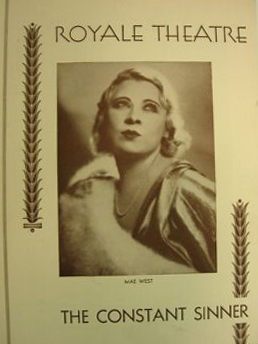
• • George Maillard Kesslere welcomed Mae into his Manhattan studio again in 1944 — — for the promotional pieces for "Catherine Was Great." In addition to the number of gelatin silver prints he shot, Kesslere also finished a stunning oil painting of Mae in her Russian empress regalia. This painting was reproduced in black and white on the souvenir programs. Mike Todd's lavish production was onstage from 2 August 1944 — 13 January 1945 on Broadway.
• • This three-quarter length Kesslere portrait of a diamond-draped Mae in fashionable attire was produced during these sessions in the summer of 1944.
• • In 1952, the lifelong bachelor (who had resided on East 62nd Street for many decades) donated the G. Maillard Kesslere Collection of 6,000 photographs and 500 paintings to the New York Public Library for its permanent theatre collection. That is a well-kept secret. Kesslere's sister Hazel was his sole survivor when he died at age 84 in January — — on 1 January 1979 — — in a nursing home in Cresskill, NJ.
• • AUCTION INFO: RR Auction, 5 Route 101A, Suite 5, Amherst, New Hampshire. This mid-January auction offers an array of autographed memorabilia.
• • Adolph Zukor [7 January 1873 — 10 June 1976] • •
• • For Adolph Zukor's autobiography, Mae West wrote this: Very few people know my secret ambition to be a lion-tamer. It began when as a child my father took me to my first circus at Coney Island. Through the years I mentioned it very rarely and only to intimates. The response to my enthusiasm was mainly negative and uninspiring. People were incapable of understanding unless they themselves felt the same driving fiery compulsion I had toward lion-taming. Throughout my career whenever I was on the road with a show or making personal appearances I had myself driven around to admire the points of interest of each new city. I would always inquire whether there was a zoo, and if there was, it was the first place I would go. To this day I visit every zoo I can. My animal instincts, perhaps?
• • Mae West continued: At any rate, each new sight of the lions started a chain reaction in me which pulled my old lion-taming ambitions into top priority. I would stand before the lions cage and see myself inside, in full command. And the secret drive increased in power. There was no moment at the height of my success that I would not have gladly exchanged positions with any lady lion-tamer for a limited time at least.
• • Mae West explained: Finally I saw a way to realize my ambition. After my first starring picture for Paramount, "She Done Him Wrong," the studio was eager to follow immediately with another. ...
• • Source: Mae West telling a story in "The Public Is Never Wrong: The Autobiography of Adolph Zukor" [NY: G. P. Putnam's Sons, 1953].
• • On Saturday, 7 January 2006 in Australia • •
• • An article "Survival of the sassiest" was written by Simon Louvish and it began with this sentence: "Mae West's wicked ways still tug at the moral straitjacket." This feature was printed in The Sydney Morning Herald on Saturday, 7 January 2006.
• • On Friday, 7 January 2000 in Newsday • •
• • An article on Cary Grant written by Blake Green began with Mae West's name in the first sentence. Blake Green wrote: Few quips have achieved the immortality of Mae West's sultry invitation, "Come up and see me sometime." Newsday, a Long Island based newspaper, published this feature on Friday, 7 January 2000.
• • In Her Own Words • •
• • Mae West said: "Out of the idea grew my second starring picture, "I'm No Angel" — — the story of a glamorous lady lion-tamer. Day by day my excitement grew as I approached closer to the supreme moment of my life. I had no fear whatever. If lions are killers at heart, I do not recall ever thinking about the fact in relation to myself. Anyhow, my obsession with getting into the cage with lions had become so great that I could recognize no stop signal. I had a talk with the trainer. He said that the lions he would use in the scene were well-trained and fairly tame. There was always some element of danger, he said, but he thought that I would be safe in the cage long enough to make the scene. ..."
• • Quote, Unquote • •
• • An article on the Lyric Theatre, which opened on 14 January 1914 in Birmingham, Alabama, mentioned Mae West.
• • “Welcome to 1914,” Brant Beene says. “That’s Sylacauga marble you’re standing on.”
• • Glenny Brock writes: It’s a late winter afternoon, and Brant Beene, the new executive director of the Alabama Theatre, is standing in the lobby of the Lyric, a vaudeville venue built more than a decade before the so-called “Showplace of the South.” He and I are giving a tour of the Lyric, explaining to a crowd of about 15 Birminghamians that this unassuming structure across the street from the Alabama is actually sacred ground in showbiz history. “Buster Keaton played here,” Brant says. “Mae West, Will Rogers, Sophie Tucker, Eddie Cantor, even Roy Rogers and Trigger.”
• • Glenny Brock explains: A few of them murmur in amazement — — or at least feigned amazement. Some members of this crowd (myself included) are too young to know or care about these old-school performers, but their names nonetheless have a gravitas, particularly when uttered in the lobby of the Lyric. ...
• • Source: Article: "On with the Show" written by Glenny Brock for Metro B; posted on 29 December 2010
• • By the Numbers • •
• • The Mae West Blog was started seven years ago in July 2004. You are reading the 2169th blog post. Unlike many blogs, which draw upon reprinted content from a newspaper or a magazine and/ or summaries, links, or photos, the mainstay of this blog is its fresh material focused on the life and career of Mae West, herself an American original.
• • Come up and see Mae every day online: http://MaeWest.blogspot.com/
________
Source:http://maewest.blogspot.com/atom.xml

Mae West
• • Photo: • • Mae West • • by Kesslere in 1944 • •
• • Feed — — http://feeds2.feedburner.com/MaeWest
NYC
Mae West.