Monday, November 06, 2006

Mae West: Miriam Goldina

In 1949 telegrams went out to East Coast reporters heralding the return of "Diamond Lil" herself to The Big Apple. When MAE WEST alighted at Grand Central Station, the press was waiting to welcome her back home.

• • Who would play the role of Rita? Stately Italian actress Rafaela Ottiano, who portrayed Russian Rita in the original 1928 Broadway production, had died during World War II [18 August 1942 in East Boston, Massachusetts] of intestinal cancer at age 54.
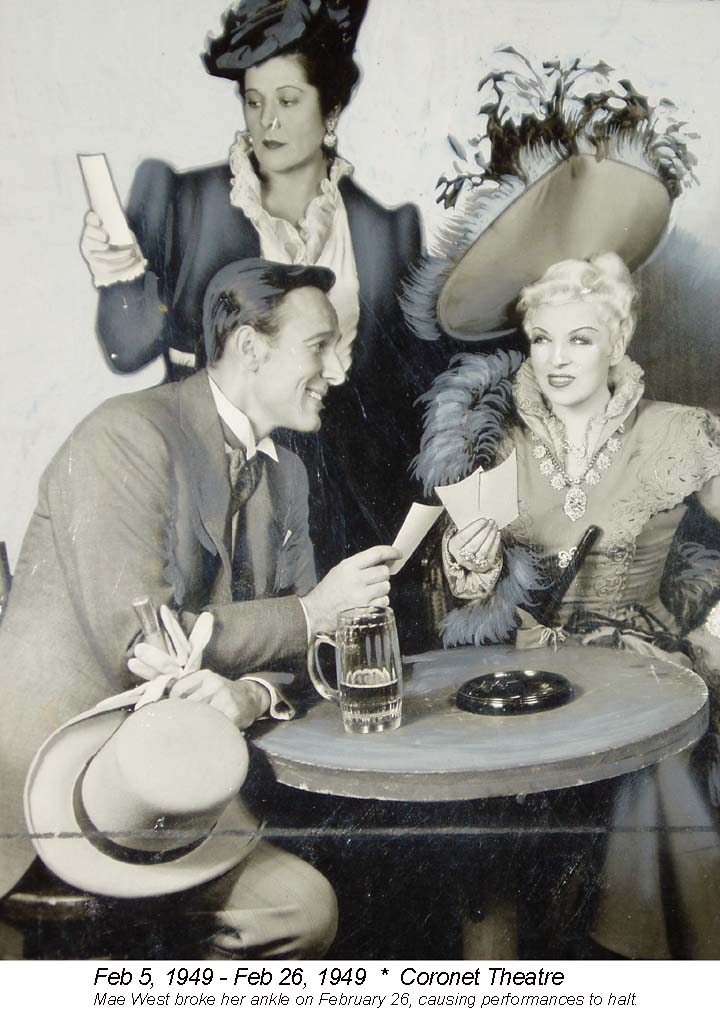
• • This part went to Miriam Goldina (born in Russia on 27 March 1898).
• • In 1934, Goldina had made her Broadway debut.
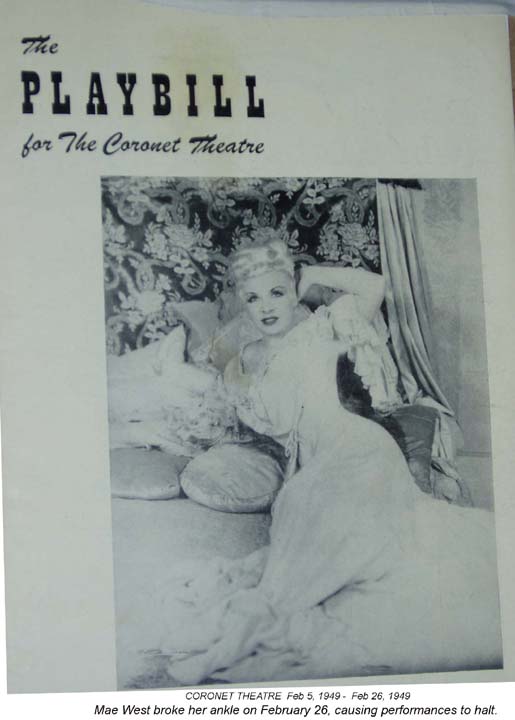
• • The revival of "Diamond Lil" opened on Broadway at the Coronet Theatre [5 February 1949 - 26 February 1949].
• • Mae West broke her ankle on February 26, causing performances to halt.
• • When she was not onstage herself, Goldina was busy lecturing on the dramatic arts. According to her students, Miriam Goldina, who studied with Stanislavsky at the Moscow Art Theatre, was probably the most accurate teacher of his method. If you went to her studio in New York, you would see many photos of her standing next to Stanislavsky, or acting in some of his plays. One photo in a silver frame had an inscription in Russian, "To one who understands my life in art."
• • A drama coach, Goldina understood that the action that happens offstage is just as important as the action that happens onstage. "All must be conveyed in the voice," she would tell her class.
• • In November 1959, Goldina took her final Broadway bows for "The Highest Tree," in which she created the role of Isabel [4 November 1959 - 21 November 1959].
• • Her TV appearances included "The Untouchables," "Perry Mason," "Mannix," "The Man from U.N.C.L.E."
• • In November, it's time to remember Miriam Goldina. She died on November 14th, 1979 in New York, NY at age 81.
________
Source:http://maewest.blogspot.com/atom.xml

Add to Google

• • Photo: Mae West • • Coronet Theatre • • February 1949 • •
• • "Diamond Lil" also featured Miriam Goldina (as Russian Rita) and Charles Martin • •

Mae West.

Sunday, November 05, 2006

Mae West Aroma

The sweet smell of success surrounded MAE WEST, especially after her first two back-to-back blockbusters for Paramount Pictures in the early 1930s.
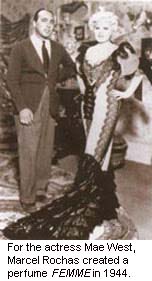
Designers pursued the actress, hoping to tag along in any way that would impact on their bank accounts. An article in The Washington Times tracked the trend of a celebrity-inspired fragrance to her: "The romance between celebrities and perfumes can be traced to the 1930s, when a bottle of Shocking perfume was modeled after actress Mae West." Read a bit more below.
• • • Sweet smell of success sparks star scents • • •
By Jen Haberkorn
THE WASHINGTON TIMES
November 2, 2006
= = = excerpt = = =
• • The scent of celebrities will be all over shopping malls this holiday season.
• • Sarah Jessica Parker, Derek Jeter, and Hilary Duff are just some of the celebrities following the smell of money and releasing fragrances for the holidays, a season when about one-third of perfume sales are made.
• • Celebrity-endorsed fragrances have stormed the perfume industry, driving the industry's first major sales increase since 2001 and making up a growing portion of the top-selling fragrances.
• • Perfume sales at department stores rose 3 percent to $2.94 billion last year, after years of hovering between $2.8 billion and $2.9 billion, according to NPD Group Inc., a market research company in Port Washington, NY. Sales from celebrity fragrances have grown 80 percent to $148.5 million from 2003 to 2005, according to NPD.
• • "They've been terrific. They've brought a whole new customer to an industry that for the last five years has been flat and slow," said Rochelle R. Bloom, president of the Fragrance Foundation, a New York trade group.
• • Britney Spears' wildly successful fragrances - - Curious,which became a top seller in department stores during the 2004 Christmas season, Fantasy, and Curious In Control - - are credited with introducing perfumes to tweens and teens. Elizabeth Arden Inc. is hoping to re-create that success with former Disney Channel star Miss Duff's new scent, With Love.
• • The romance between celebrities and perfumes can be traced to the 1930s, when a bottle of Shocking perfume was modeled after actress Mae West. Elizabeth Taylor made endorsing perfumes glamorous with the success of White Diamonds in 1991.
• • But celebrities started following the scent after Jennifer Lopez's Glow was released (late 2002) and raked in a reported $40 million during its first six months on shelves.
• • Last year, celebrity fragrances made up a quarter of the top 100 selling brands, up from 10 percent in 2003, according to NPD Group.
• • "[Celebrity fragrances] have been very important to the growth we've seen in women's fragrances and we're seeing it to a degree in men's," said Leigh Anne Rowinski, a beauty trend analyst at Information Resources Inc. in Chicago. . . .
= = = excerpt = = =
• • Source: THE WASHINGTON TIMES
• • Printed: November 2, 2006
________
Source:http://maewest.blogspot.com/atom.xml
Add to Google

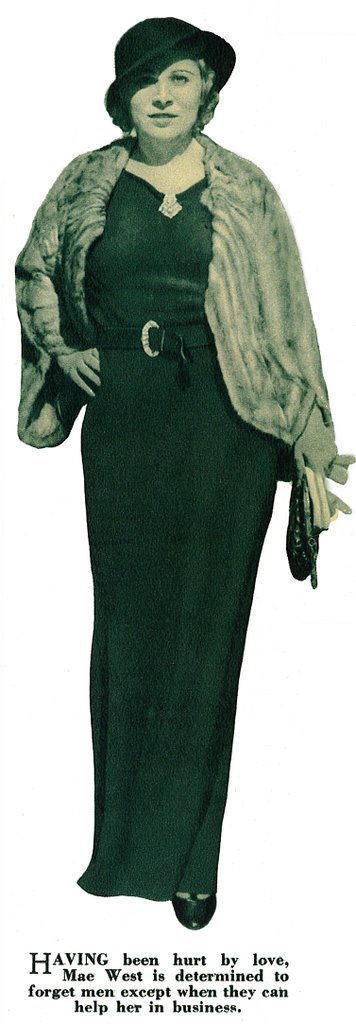
• • Photo: Mae West • • Marcel Rochas • • in the 1930s • •

Mae West.

Saturday, November 04, 2006

Mae West's Pianist

"MAE WEST, author, loses her pianist," noted Variety on 8 September 1922.
• • Harry Richman - - an unknown talent in 1922 when Mae West gave him a break and hired the tall piano man with a pronounced lisp - - was performing on the big-time B.F. Keith vaudeville circuit with the Brooklyn bombshell. They were a good team. Wherever their act was booked, the pair got excellent reviews.
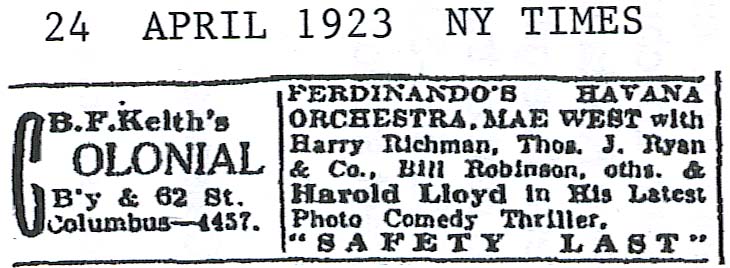
• • Ungrateful for the mega media exposure Mae had afforded him, Harry split with her and joined Texas Guinan's friend, singer Nora Bayes, in her act. However, as this clipping shows, Mae and Harry reunited and appeared together in April 1923 at the Colonial Theatre [Broadway and West 62nd Street].
• • Entertainer Harry Richman [10 August 1895 – 3 November 1972] was an actor, a singer, dancer, comedian, pianist, songwriter, bandleader, and cabaret performer. He was born Harold Reichman in Cincinnati, Ohio.

• • A flamboyant personality, Richman joined the George White's Scandals in the 1920s and appeared in the 1931 Ziegfeld Follies. In 1930, he made a splash in Hollywood with this crowd-pleaser: Puttin' on the Ritz. This film featured the Irving Berlin song of the same title, which gave Richman a phonograph record hit that year. His film career was hampered by his limited acting skills. [Writing about Puttin' on the Ritz, Leonard Maltin remarked: "A songwriter drinks and goes blind - - after seeing this you'll want to do the same".]
• • Maybe the silver screen was not his best medium. Richman remained a popular nightclub host and stage performer.
• • In 1966, his autobiography A Hell of a Life was published. In it he recounts his private and public relationship with Mae West.
• • Harry Richman married three times. All three marriages ended in divorce.
• • In November, it's time to remember Harry Richman. He died on November 3rd, 1972 in Hollywood, California at age 77.
________
Source:http://maewest.blogspot.com/atom.xml
Add to Google

• • Photo: Mae West's pianist • • Harry Richman • • 1926 • •

Mae West.

Friday, November 03, 2006

Mae West: Curtains

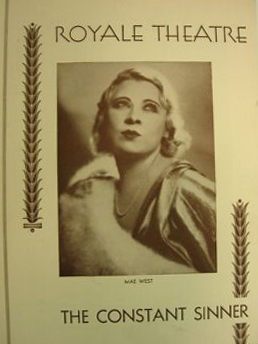
On 4 November 1931 the final curtain came down at the Royale Theatre on "The Constant Sinner"
starring and written by MAE WEST.
• • Set in Harlem, the play opened on 14 September 1931 and ran for 64 performances on Broadway.
• • The Great Depression increased the number of jobless adults and, by 1931, the unemployment rate had reached nearly 16 percent. Obviously, the bleak economic downturn took a bite out of the box office, lowering everyone's ticket sales - - not only Mae West's productions. But the storyline of "The Constant Sinner" - - Babe Carson's love for Money Johnson, a dark-skinned Harlem hoodlum with a bootlegging empire, kept many theatre-goers away. Miscegenation was a touchy subject in 1931, as Mae West knew. The Harlem Breakfast Club scenes also featured inter-racial couples. Racial attitudes being what they were during the 1930s, several critics who reviewed the play said that these scenes "turn the stomach."
• • Mae West had a large pool of African-American talent to pick from. She cast fourteen black actors and actresses, many with serious stage credentials. However, Mae was not allowed to cast the dashing, debonair actor she really wanted - - LORENZO TUCKER, billed as "The Black Valentino" - - for the role of "Money Johnson."
• • The Shuberts and Jim Timony refused to let Mae West cast a black man as her lover, afraid this would trigger police raids and worse. Forced to give in, Mae agreed to hire vaudevillian George Givot to play the Harlem hotshot during the play's Broadway run. George Givot [shown here in 1936] played the role in blackface. The Shuberts wrote it into his contract that, at the end of each performance, Givot would have to remove his wig to assure the audience that it was a Caucasian who was embracing the curvy blonde "Babe Carson" [Mae West] onstage.
• • When a detective warns Babe Carson she is in a tight spot, she shoots back, "I can always handle tight spots."
• • Another suggestive line was this one from Babe Carson: "COME UP SOMETIME, BOYS," she purrs to a group of guys. "I'LL TELL YOUR FORTUNE."
________
Source:http://maewest.blogspot.com/atom.xml
Add to Google

• • Photo: Mae West as Babe Carson • • September - November 1931 • •

Mae West.

Thursday, November 02, 2006

Mae West - - "Ear-Say"


There is so much hearsay going around about MAE WEST that it is no surprise to see the Yale University librarian Fred Shapiro double-checking what his EARS say.
This frivolity was spotted in an Arizona newspaper:
• • • • If you say it, you'll be misquoted • • • •
• • . . . delving into musty, old paper archives to get quotes from long-dead famous people sounds hopelessly anachronistic - - like a movie star who keeps her clothes on.
• • But the words of just such a star - - Mae West - - are in a new book that used just such antiquated techniques. The premise of the book is that some long-attributed quotes are fiction or folklore.
• • Yale librarian Fred Shapiro spent six years with advanced Internet searches to come up The Yale Book of Quotations. But he also combed dusty, old paper records, according to Reuters News Service.
• • And Fred Shapiro watched all of Mae West's pre-1967 movies searching for the line: "Is that a gun in your pocket or are you just happy to see me."
• • It wasn't there, wrote Fred Shapiro. Mae West never said it on screen. She said it to a police guard sent to be her escort. Mae West also said: "I used to be Snow White, but I drifted." . . . .
• • Source: The Arizona Republic Newspaper (no Reuters byline given)
• • printed on 30 October 2006
________
Source:http://maewest.blogspot.com/atom.xml
Add to Google

• • Illustration: Mae West • • from MovieNews 1933 • •

Mae West.

Wednesday, November 01, 2006

Mae West: Champ Segal

Mae West knew some shady characters — — and Champ Segal had a special place in his heart for Mae.
• • Sunset Boulevard during the 1940s was where all the guys and dolls nightclubbed, gambled, brawled, and minted gossip. Harry "Champ" Segal, a former boxer and bookie, ran a little joint on the Strip that was disguised as a barbershop (not unlike the bookmaking and loan-sharking operation he ran in a midtown Manhattan barbershop). Nearby in Los Angeles, Champ's bosom buddy Benjamin Siegel had an office at the corner of Sunset and Vine, although Bugsy did not take walk-ins.
• • Although Champ Segal never won a title in the ring, the dapper hoodlum managed many prizefighters — — Charley "Phil" Rosenberg, Ace Hudson, Phil Kaplan, Freddy Beshore, Sal Belloise — — and had 118 fights himself, 78 of which he won by knock-outs.
• • Mae West enjoyed going to boxing matches and she got a kick out of the nattily dressed wheel-dealer. Champ Segal admired Mae and included anecdotes about their friendship in his book.
• • Born in Harlem in 1899, by 1917 Harry had an arrest record for possessing narcotics.
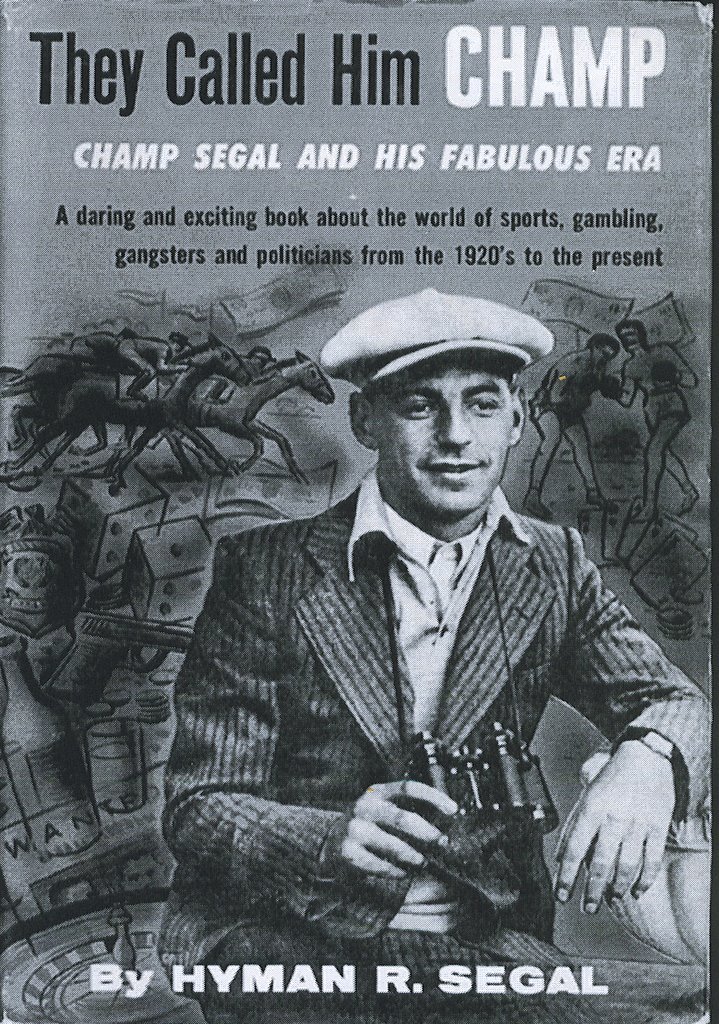
• • In 1927 he was locked up in connection with a homicide at his restaurant on St. Nicholas Avenue and West 112th Street. Throughout his hair-raising past he must have been taking notes for this biography that his brother published in November 1959, which was called "a daring and exciting book about the world of sports, gambling, gangsters, and politicians from the 1920s to the present day." Though Champ was as solitary a figure as Charlie Chaplin, astonishingly he did have a brother; Hyman's name appeared on the dustjacket: They Called Him Champ: the Story of Champ Segal and His Fabulous Era by Hyman R. Segal [NY: Citadel Press, 1959; 480 pages with b/w photographs].
• •
Mae West, Texas Guinan, Al Capone, Legs Diamond, Bugsy Siegel, Primo Carnera, Mayor Jimmy Walker — — they're all inside.
• • November 1959 there was a book launch at Lindy's Restaurant with his buddies from Stillman's Gym.
• • That was a better November than nine years earlier for Champ Segal. On 1 November 1950 the 51-year-old bookie was arrested outside of the Park-Sheraton Hotel, where he'd been living. This was part of a Times Square round-up of gangsters by the police. Champ Segal slipped through the grasp of the city's legal eagles, however. The colorful con man was still being indicted in 1974 when he was age 77.
• • Come up and see Mae every day online: http://MaeWest.blogspot.com/
________
Source:http://maewest.blogspot.com/atom.xml

• • Photo:
• • Mae West's pal • •
1967 • •

Mae West.

Tuesday, October 31, 2006

Mae West: Louis Calhern

MAE WEST often met Julia Hoyt and Louis Calhern at Texas Guinan's clubs.
• • Hoping to advance her stage career, Julia Hoyt [15 September 1897 - 31 October 1955] hooked up with debonair leading man LOUIS CALHERN [1895 — 1956], whom she met when both were cast in a 1927 drama
The Dark, which had a brief run at the Lyceum Theatre. Julia Hoyt and Louis Calhern were seen together often at Texas Guinan's during their short-lived marriage [1927 — 1932].
• • Known for starring roles on Broadway, Louis Calhern took bit parts on screen until he hit his stride during the 1950s with a string of big-budget hits ("
Asphalt Jungle," etc.) that gave him a higher profile.
• • One of his earliest minor movie roles was an appearance in a Mae West vehicle. Louis Calhern played "Dick Bolton" in "
Night After Night." Calhern had one scene in this picture. Starring MAE WEST and GEORGE RAFT, the film opened at the Paramount Theatre on 31 October 1932.
________
Source:http://maewest.blogspot.com/atom.xml

Add to Google

• • Photo: Louis Calhern • • 1943 • •


Mae West.

Monday, October 30, 2006

Mae West Confessions

MAE WEST posed for the magazine True Confessions for a two-part interview that was serialized in their December 1933 and January 1934 issues.

• • Meant to promote Mae's latest photoplay "I'm No Angel," the eye-catching feature was titled "Mae West - - Queen of Sex" and its contrarian appeal ran so far afield of all the other woman-as-clinging-vine "confessions" in this edition that the distaff-readership must have been astonished, to say the least.
• • A man in Mae's life, her friend Jack LaRue, offered charming encomiums that were used as large captions.
• • No stay-at-home-wife-life would do for the versatile performer from Brooklyn, New York, explained the editors. Mae West "learned how to do black-face imitations at an age when other children were doing long division."
• • Announcing that the actress is "more than forty today," the text continued: "There is practically no line of stage work that one can mention that Mae West has not tackled. By twelve years of age, she was a fully developed woman. Her curves were as solid and firm and alluring then as they are today. Imitations and child-parts, to which she had graduated, were discarded and Mae became a burlesque Queen at $500 a week when she was thirteen." [N.B.: Mae West was 13 years old in 1906. Did child labor laws in America permit a minor to strip in a burlesque revue in 1906??]
• • The writer added: "Vaudeville, musical comedies, even engagements at Coney Island. She became a strong woman in an acrobatic act. Dancing lessons with Ned Weyburn [sic] led the way to musical comedies. Big money in burlesque, pin money in small roles in comedies. Any job that came along - - Mae West could do it." . . .
• • In 1933 True Confessions was owned by Fawcett Publications with editorial offices in Minneapolis. Photographs printed with this lengthy piece were very interesting and show Mae in male drag, posing with animal trainers, etc.
________
Source:http://maewest.blogspot.com/atom.xml
Add to Google

• • Photo: Mae West • • October 1933 • •

Mae West.

Sunday, October 29, 2006

Mae West: Dorothy Peterson

Unlike MAE WEST, Dorothy Peterson did not acquire stardust.

• • Born in Minnesota on 25 December 1897, the pretty brunette became a stage actress. In 1930, she made her screen debut in "Mothers Cry," a weepy domestic melodrama that required the 29-year-old actress to age nearly three decades in the course of the film. Unfortunately, "Mothers Cry" instantly typecast Peterson in careworn maternal roles.
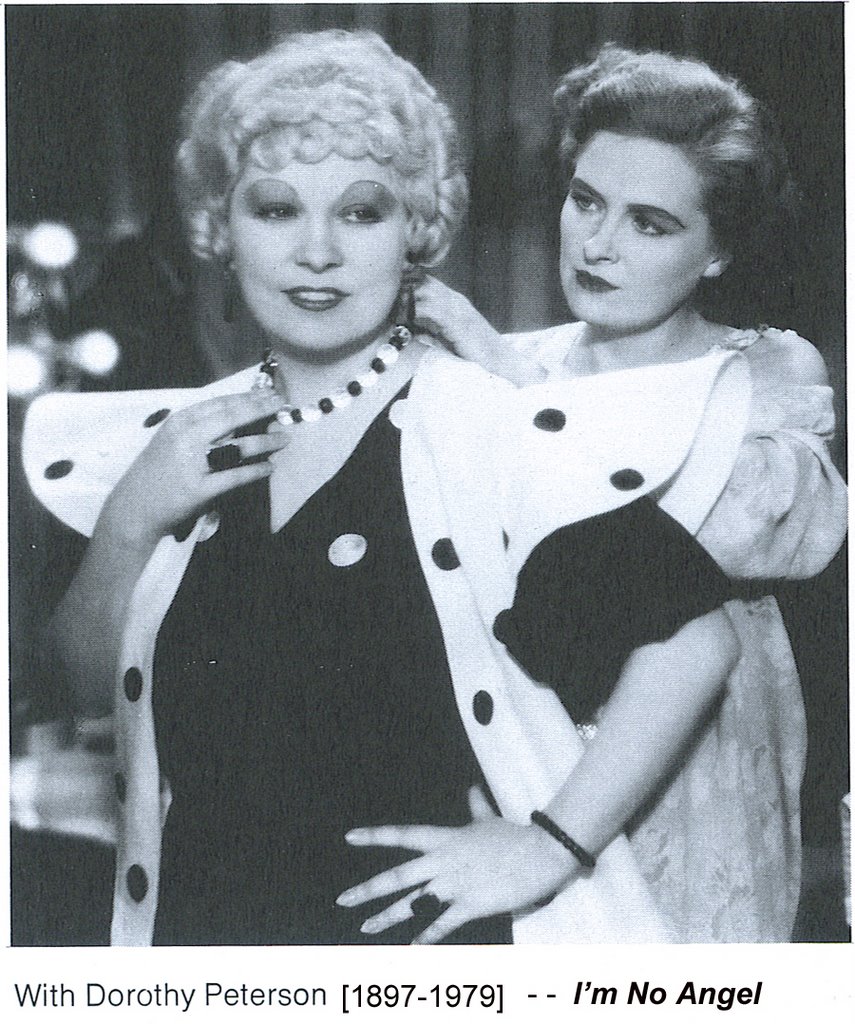
• • Dorothy Peterson played Thelma in the MAE WEST hit "I'm No Angel." This promotional photo was taken during October 1933 and the movie opened the following month.
• • Her last screen appearance was as Shirley Temple's mother in That Hagen Girl [1947], however, Dorothy Peterson remained active on the New York theatrical scene and on TV until the early 1960s.
• • She died in New York City in the month of October: 3 October 1979.
________
Source:http://maewest.blogspot.com/atom.xml
Add to Google

• • Photo: Mae West with Dorothy Peterson (as Thelma) • • October 1933 • •

Mae West.

Saturday, October 28, 2006

Mae West: October 1932

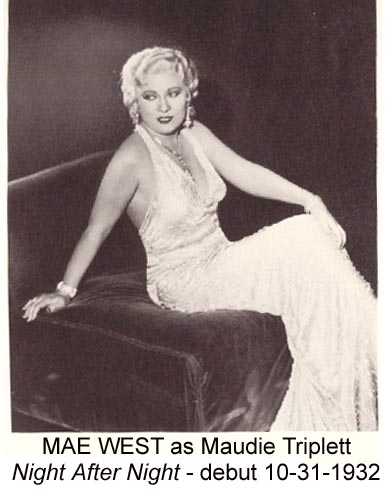
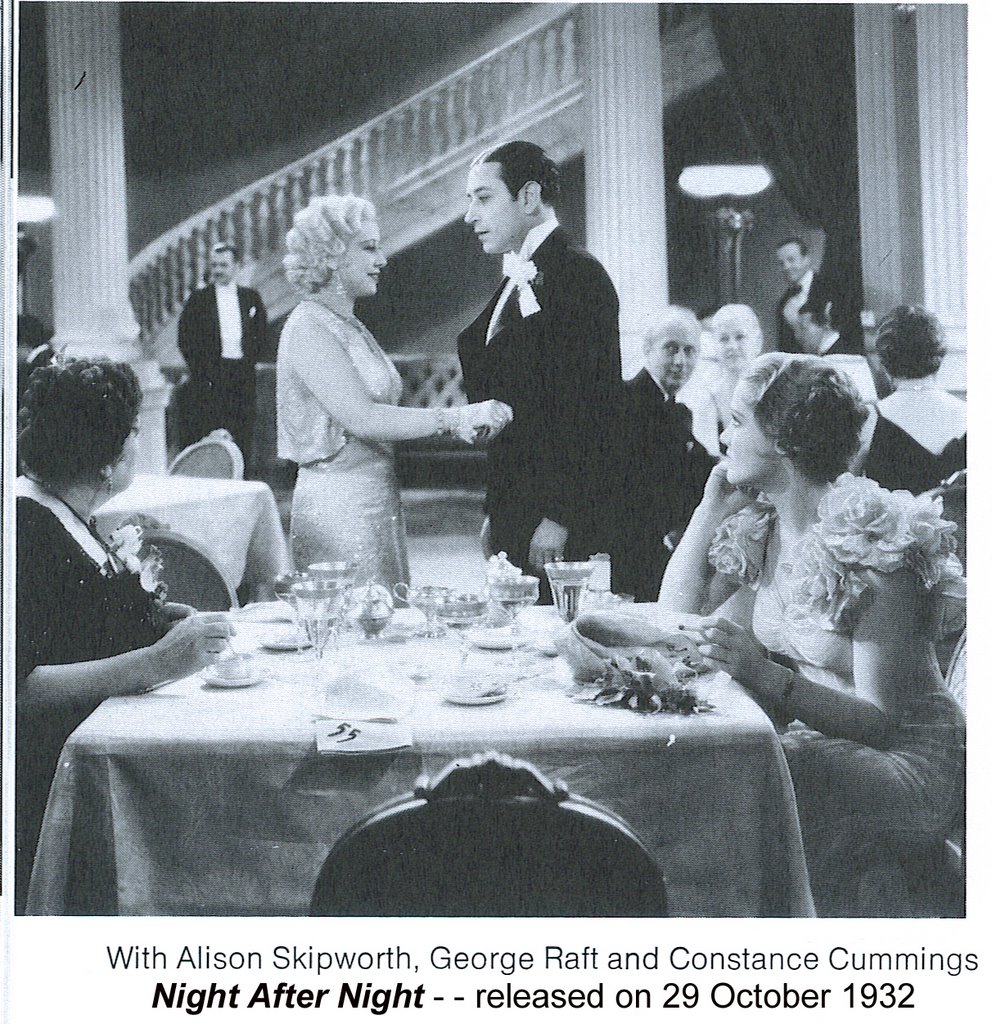
Screened for critics on October 28th, Night After Night premiered to the public on Friday night October 31st, 1932 at the Times Square Paramount and the Brooklyn Paramount Theatre. MAE WEST got the lion's share of attention. "She stole everything but the cameras," admitted co-star George Raft.
• • A stage show accompanied this screen gem: Lew Leslie's "
Dixie to Broadway" with Ethel Waters, the Mills Brothers, and Adelaide Hall.
Night after Night [1932] was directed by Archie Mayo.
Writing credits Louis Bromfield (novel) and Vincent Lawrence.
• •
Night after Night cast: • •
George Raft as .... Joe Anton
Constance Cummings as .... Jerry Healy
Wynne Gibson as .... Iris Dawn
MAE WEST as .... Maudie Triplett

Alison Skipworth as .... Mabel Jellyman
Roscoe Karns as .... Leo
Louis Calhern as .... Dick Bolton
Bradley Page as .... Frankie Guard
Al Hill as .... Blainey
Harry Wallace as .... Jerky
George Templeton as .... Patsy (as Dink Templeton)
Marty Martyn as .... Malloy
Tom Kennedy as .... Tom (bartender)

________
Source:http://maewest.blogspot.com/atom.xml
Add to Google

• • Photo: Mae West shows her star power in Night After Night • • released 1932 • •

Mae West.

Friday, October 27, 2006

Mae West: October 1959

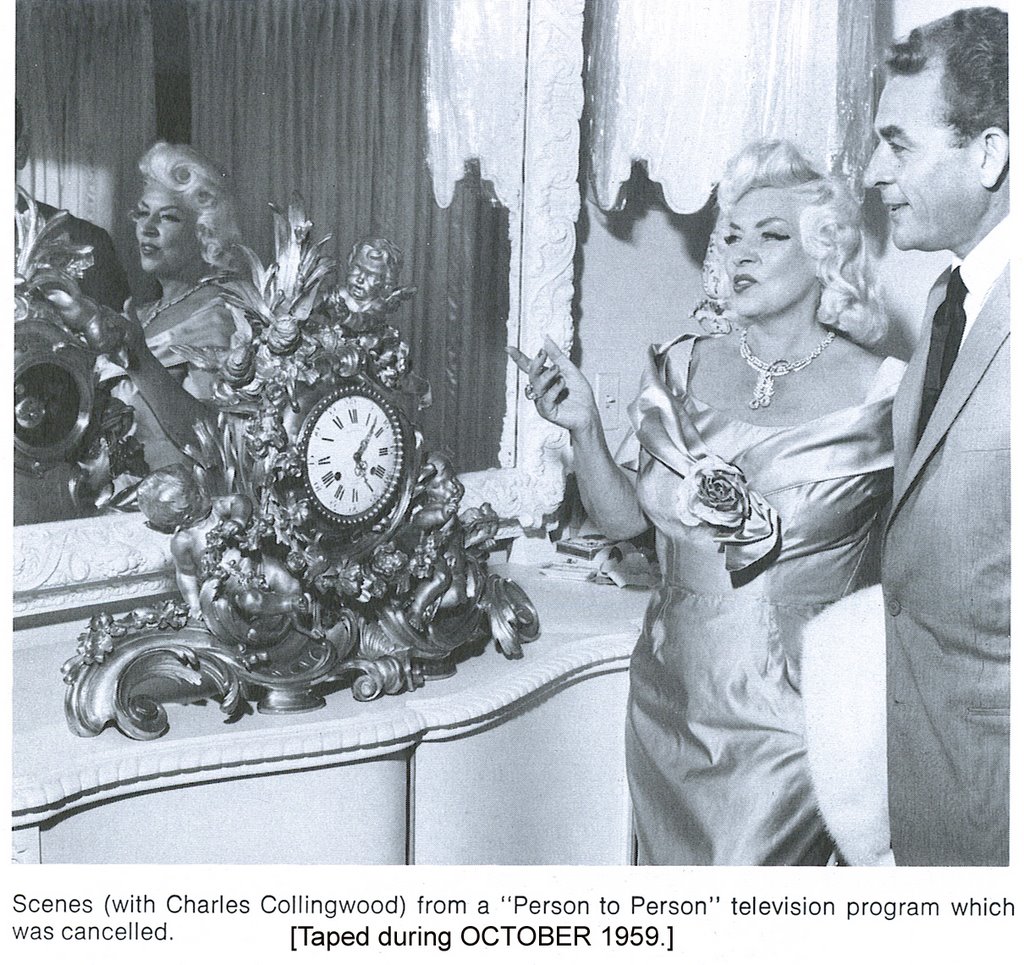
No doubt you've saved acres of back issues of Time Magazine, especially the copies that offered newsworthy morsels on MAE WEST. To save you a trip to the attic, however, here's what Time [edition: Monday 26 October 1959] noted about CBS news correspondent Charles Collingwood, who came up to see Mae:

• • CBS-TV brass sat down and privately took in a video-taped Person to Person interview with the aging Sex Goddess Mae West - - and promptly canceled the earthy program because parts of it "might be misconstrued." Had Author West (Goodness Had Nothing to Do with It) said or done anything naughty before the cameras? "Certain minds always misconstrue everything," said the past mistress of double-meaning ribaldry. "I have a very big public that understands what I say." Exactly what happened when CBS Interviewer Charles Collingwood came up and saw Mae in her Hollywood apartment?
• • One of the droller exchanges came when the newsman commented on all the mirrors in Mae's plushy bedroom. "They're for personal observation," said Mae, deadpan. "I always like to know how I'm doing."
• • Sensing that the going was getting a bit hot, Collingwood suggested that they switch the subject to foreign affairs. Said Mae: "I've always had a weakness for foreign affairs."
• • Born in Michigan, Charles Collingwood [4 June 1917 - 3 October 1985] was a pioneering CBS television newscaster. Collingwood was a protege of Edward R. Murrow during the Second World War and became known as an eloquent on-air journalist. He was part of a group of distinguished early television journalists that included Walter Cronkite, Eric Sevareid, and Murrow himself.
• • Despite a constant battle with the bottle and a feverish addiction to gambling, Collingwood went on to become chief correspondent of CBS and host of its "Eyewitness to History" series. He led in CBS's expansion to include international coverage. He reported from the Normandy invasion (at Omaha Beach), Vietnam, the White House, and other sites known for causing death and destruction.
• • Collingwood retired in 1982. The chronic alcoholic died on October 3rd, 1985 at age 68.
________
Source:http://maewest.blogspot.com/atom.xml
Add to Google

• • Photo: Mae West shows her apartment to Charles Collingwood • • 1959 • •

Mae West.

Thursday, October 26, 2006

Mae West: Hello, Dalí

An industrial strength dosage of surrealism starring MAE WEST will spike the arts scene in London next spring. The show, Other Surreal Things, is slated for the Victoria & Albert Museum.
• • The exhibition will run from March 29 to July 22, 2007 in Great Britain.
• • Salvador Dalí's
Mae West creations, a lobster telephone, a table with bird's legs, and a hat made from bouillabaisse will be among the highlights. Dalí is well represented among an array of 300 objects that explore the influence of surrealism on the worlds of design, interiors, clothes, film, and theatre. Dresses by Elsa Schiaparelli, the Paris fashion designer who collaborated with Jean Cocteau and Dalí, notably on a "Tear" and a "Skeleton" dress, will also be on view.
• • Ghislaine Woods, the curator, said: "Although there have been many exhibitions on surrealism, this is the first to explore the impact of the movement on design and the decorative arts."
• • More than 20 objects are being lent by the West Dean Foundation, the estate in Sussex owned by the late Edward James. James was the first English patron of the surrealists and filled his house, painted purple on the outside, with his collection of their works.
• • Genesis of the
Mae West Lips Sofa (1937): Dalí had first painted The Face of Mae West (Usable as a Surrealist Apartment) in 1934. Later on, Edward James, a rich British patron of the Surrealists in the 1930s, commissioned this companion piece from Dalí. The Mae West sofa is the same color as the "shocking pink" lipstick shade inspired by the actress, and developed by the fashion designer Elsa Schiaparelli.
• • The most highly paid Paramount Pictures' star during the 1930s, Mae West's image (and drawings based on her face and shape) rapidly became part of popular culture. As the Brooklyn bombshell became a commodity, artists such as Salvador Dalí, perfumers such as Rochas, designers such as Schiaparelli, etc., naturally responded to her influential position in the media.
• • Around 1938, the Mae West Lips Sofa was designed by Salvador Dalí with Edward James, and made by Green & Abbott. This 20th century icon has a wooden carcase, upholstered in felted, woven wool fabric. The Mae West Lips Sofa was purchased by the Brighton Museum & Art Gallery from the Edward James Foundation in 1983.
• • Dali's fascination with Mae West was a long one.
• • Salvador Dalí [11 May 1904 – 23 January 1989] was a Catalan-Spanish artist who became one of the most important painters of the 20th century.
A gouache now in Chicago illustrates his original plan executed during the early 1930s for a "paranoiac-critical room" based on the features of her face. When the Dalí Museum in Figueras was being constructed during the early 1970s, his Mae West Room was finally built to his specifications.
• • MAE WEST used to say, "I like two kinds of men: domestic and foreign." Therefore, it's assumed that Mae appreciated Dalí's dalliance with her image.

• • Come up and see Mae every day online: http://MaeWest.blogspot.com/
________
Source:http://maewest.blogspot.com/atom.xml
Add to Google
• • Illustration: The Face of Mae West (Usable as a Surrealist Apartment) • • 1934 • •
Mae West.

Wednesday, October 25, 2006

Mae West & Valentino

Since October is "Italian Culture Month" in New York and other cities, it is the season to highlight an Italian actor who impressed MAE WEST. When she was 33 years old, Mae West adopted Rudolph Valentino [6 May 1895 - 23 August 1926] as her spiritual adviser.

• • On Sunday 25 July 1926, Mae met Valentino at Tommy Guinan's speakeasy. Larger than the average ginmill, The Playground was on West 52nd Street (east of Broadway). Its generous square footage made it ideal for events and James R. Quirk, editor-publisher of Photoplay, hosted a Reception in honor of Valentino's new silent movie "Son of the Sheik" there.
• • Mae West and Texas Guinan were there to greet the Apulian heartthrob. No doubt Texas fancied Jadaan, a superb Arabian stallion Valentino had ridden in this melodrama. An expert equestrienne herself, the following year Texas would ride an Arabian stallion into the Shubert Theatre at the start of "Padlocks of 1927."

• • Maybe Mae West was charmed more by the Italian stallion himself - - and piqued by the abrupt end to his life that occurred one month later when the actor was only 31. Something about Rudy impressed Mae, encouraging her to think that he could link her to the unquiet dead up and down Times Square.
• • According to Whitney Bolton, a columnist for the Philadelphia Inquirer, a week after the Italian-born actor Rudolph Valentino died [1895-1926], Mae West and her friend Texas Guinan arranged for a séance in a Manhattan loft. Suspicious that the 31-year-old heartthrob was secretly poisoned by a rival, Mae summoned an Italian Medium to officiate. At the table sitting opposite Mae were Texas, her brother Tommy Guinan, and the gangster Owney Madden who owned The Cotton Club, a man remembered more for violence than his spiritual side.
• • And the rendezvous with Rudolph in 1926 must have been memorable because two years later Mae was holding séances in the smoking room of the Royale Theatre to communicate again with him. Visiting New York to see “Diamond Lil” on Broadway, the actor Jean Hersholt was invited backstage and yanked into a darkened room where a Medium was channeling Caruso and Valentino. Hersholt recalled that Rudy called upon Mae and said: “Mae, you have a lot of enemies and don’t trust any of them.”
• • During the 1920s, Sri Deva Ram Sukul supplanted Valentino as Mae West's spiritual guide when he healed the actress's agonizing stomach pains.
________
Source:http://maewest.blogspot.com/atom.xml
Add to Google

• • Illustration: Valentino and "Son of the Sheik" • • 1926 • •

Mae West.

Tuesday, October 24, 2006

Mae West as Tintype

Their book was published in October 1930. Soon everybody was talking about it.

• • On 12 October 1930, here's what The New York Times wrote about Times Square Tintypes by Sidney Skolsky, illustrated by Alex Gard:
• • "Sidney Skolsky's Times Square Tintypes is a unique biographical compendium. In it he recounts the things one does not usually hear of the famous and near famous figures of Broadway. . . . As a press agent and more recently as a columnist, he has lived closely enveloped in the maze of our stage gossip. In a field of activity where exhibitionism is a virtue, he has been quick to see or hear about each new gesture of vanity or temperamental pique . . . ."
• • MAE WEST was one of their famous Times Square Tintypes.
• • Mae West and Sidney Skolsky [1905-1983] stayed on good terms. He was an extra in her film "I'm No Angel," he wrote about her often in his column, he cheered when the Masquers honored her in April 1973, and he attended some of the seances Mae held at her California beach house.
• • Artist Alex Gard [1900-1948] was Sardi's caricaturist. He painted Mae colorfully for Vincent Sardi's restaurant - - and his neat black and white sketch was printed next to Skolsky's typewriter portrait.
• • If you chance upon this book, it's a worthwhile and amusing close-up.
________
Source:http://maewest.blogspot.com/atom.xml
Add to Google

• • Illustration: Mae West by Alex Gard • • early 1930s • •

Mae West.

Monday, October 23, 2006

Mae West & Schiaparelli

Since October is "Italian Culture Month" in New York and other cities, it is the season to highlight an Italian designer who worked with MAE WEST.

• • Elsa Schiaparelli [10 September 1890 – 13 November 1973] was the leading Parisian fashion designer of the 1920s and 30s after Coco Chanel.
• • She was born in Rome, Italy of Italian and Egyptian heritage. She was a great-niece of Giovanni Schiaparelli, who discovered the canals of Mars.
• • Schiaparelli opened her first salon, "stupidir le Sport," in 1927; the focus was on sportswear and athletic attire. In 1935 Schiaparelli moved to a salon overlooking the Place Vendôme in Paris.
• • In addition to apparel, Schiaparelli designed a number of perfumes. The first and best known - - Shocking - - was created in 1936. Shocking is famous less for the fragrance itself than for its packaging: inside a shocking pink box, the bottle was shaped like a woman's torso - - and based on the curvaceous body of one of Schiaparelli's clients, film star Mae West. For Mae West, Schiaparelli designed costumes for the film Every Day's a Holiday.

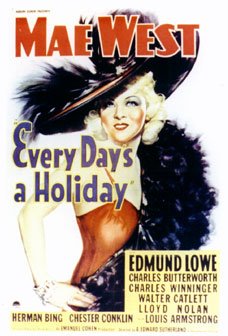
• • Released in 1938, Every Day’s a Holiday was MAE WEST's most expensive film to date. Its lavish recreation of 1890s New York was the setting for Mae's character - - charming blonde con artist Peaches O’Day - - who sells the Brooklyn Bridge to the gullible. After an enforced departure, Peaches O'Day returns disguised as a chic brunette Mademoiselle Fifi, draped in Schiaparelli gowns.
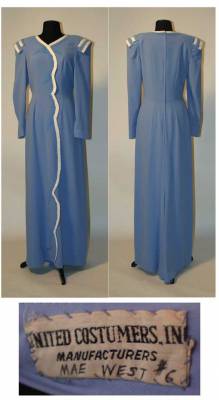
• • Enjoy this example: a powder-blue wool crepe gown with soutache trim at the shoulders and hemline worn by Mae West. Created by Schiaparelli, the gown features a sewn-in wardrobe label on the inside lining that reads: "United Costumers Inc., Mae West #6." [Actress Debbie Reynolds acquired this costume.]
• • By World War II, Elsa Schiaparelli's output had decreased. Trendsetters began pursuing younger designers such as Christian Dior. In 1954, her couture house declared bankruptcy and she moved to the USA.
• • Elsa Schiaparelli was briefly married to Count William de Wendt de Kerlor [born 1883], a Franco-Swiss psychic medium, and moved with him to New York's Greenwich Village, where she sold clothing designed by the French couturier Paul Poiret. The couple had one child, Maria Luisa Yvonne Radha, known as Gogo, born in New York City. Schiaparelli's grandchildren are the actress Marisa Berenson and the late photographer Berry Berenson (Mrs. Anthony Perkins).
• • She died at age 80 on 13 November 1973.
________
Source:http://maewest.blogspot.com/atom.xml
Add to Google

• • Illustration: Mae West costumed by designer Elsa Schiaparelli • • 1938 • •

Mae West.