Thursday, December 14, 2006

Mae West: Iconic

The iconic and ironic side of MAE WEST was explored in Peter Conrad's book: Views and Versions of New York [NY: Oxford University Press, 1984].

• • According to one reviewer, "At the heart of New York City is the world of imagination, where people attempt to depict themselves and their place as special and to leave proof of this across time. One beauty of The Big Apple is that most people fail at this, but their attempts are poignant, day after day. A rarer beauty is that a few seem to succeed. These people leave fragments of art that can ease the daily failures of New Yorkers and of those beyond who imagine something more than mortality, who can stare at the city's river through the eyes of Walt Whitman on the Brooklyn ferry [or Mae West] and know that others will come after to view the life they see and appreciate its joy and pain. ..."
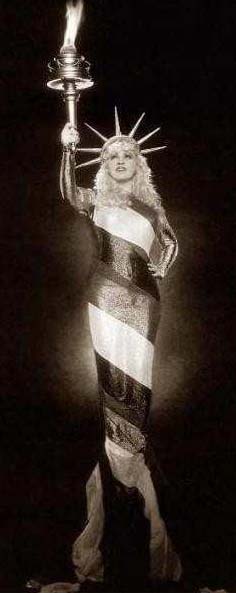
• • Author Peter Conrad has the good sense to linger over King Kong atop the Empire State Building and to recall that Mae West once portrayed the Statue of Liberty. ''King Kong is the city's nightmare of itself, Mae West its lubricious day-dreaming,'' wrote Conrad.
• • In the film Belle of the Nineties [1934] costume designer Travis Banton went to town on Mae. The film opens with a vaudevillian styled production full of scantily-clad dancers. Set in the 1890s, the famous opening features Ruby Carter [Mae West] appearing in front of various backgrounds such as a rose, a butterfly, a spider, and finally as the Statue of Liberty.
• • Come up and see Mae every day online: http://MaeWest.blogspot.com/
________
Source:http://maewest.blogspot.com/atom.xml

Add to Google

• • Photograph: Mae West • • 1934 • •

Mae West.

Wednesday, December 13, 2006

Mae West & the Swan

An article written in 1930 mentioned the preferences of MAE WEST on home decor.
• • "She likes everything massive," noted the journalist. "Her furniture, bed, even her car is larger than the average. The swan bed used onstage in Diamond Lil was taken from her home. Formerly it belonged to Diamond Jim Brady. ..."
• • When it was time to recreate the Bowery on the stage of the Royale Theatre in 1928, Mae West opted for a stylish version of her mother's era. Broadway's set designer August Vimnera equipped the saloon with an old-fashioned piano and situated Lil's upstairs dressing room in a way that guaranteed opportunities for grand sweeping entrances.
• • Onstage, Diamond Lil reclines in a gilded swan-shaped bed. Formerly, it belonged to the turn-of-the-century actress Amelia Bingham [1869 — 1927]. Mae said she purchased it from the estate of Diamond Jim Brady [1856 — 1917].
• • The swan bed made its way into the Paramount Pictures production of "
She Done Him Wrong" as well.
• • During the week when carollers are singing about the "
Twelve Days of Christmas" and the partridge in a pear tree, Mae West's languid pose with the swan seems so festive.
• • Question: what became of this famous swan bed? Who owns it now?
• • Come up and see Mae every day online: http://MaeWest.blogspot.com/
________
Source:http://maewest.blogspot.com/atom.xml
Add to Google

• • Photograph: Mae West • • 1932 • •


Mae West.

Tuesday, December 12, 2006

Mae West: Sparkle


Borrowing the title of MAE WEST's 1938 movie "Every Day's a Holiday," during the 12 days of Christmas - - when every day is a holiday - - we might be reminded of the kindness that Mae extended to all of her friends and loved ones.
• • Cancelled checks floating through the E-Bay network indicate that Mae often wrote checks to tip people generously.
• • Mae often donated her used cars to a local convent, explaining that she didn't like to see a nun waiting for a bus.
• • Why not extend a little a-MAE-zing kindness to your own community this month?
• • Be good to yourself, too. Buy or rent "Every Day's a Holiday" - - which opens on 31 December 1899 as con artist Peaches O'Day [Mae West] is selling the Brooklyn Bridge to some tourists. S/he who laughs lasts.
• • Come up and see Mae every day online: http://MaeWest.blogspot.com/
________
Source:http://maewest.blogspot.com/atom.xml
Add to Google

• • Artwork: Mae West • • 1930s • •

Mae West.

Monday, December 11, 2006

Mae West: X-Rated

An "X" marks the spot during the green-and-red season. Whether you write Xmas or Christmas, the thought is the same.
• • In 1934, greeting card manufacturer Buzz-Craft came up with these charmers. It is Mae's winter wish for you that Santa Claus will bring you everything your happy heart desires.
• • MAE WEST suggests you don your gay apparel and plant kisses under the mistletoe.
• • Old North Pole Nick works only one day a year - - but people think he's a saint, eh? Well, let's see if he fits into your chimney on December 24th. :-D
• • Come up and see Mae every day online: http://MaeWest.blogspot.com/

________
Source:http://maewest.blogspot.com/atom.xml
Add to Google

• • Artwork: Mae West • • 1934 • •

Mae West.

Sunday, December 10, 2006

Mae West: Radio Waves

In May of 1937, Chase and Sanborn Coffee began sponsoring The Chase and Sanborn Hour, starring ventriloquist Edgar Bergen and his alter-ego in wood, Charlie McCarthy. Perhaps no other broadcast of The Chase and Sanborn Hour has sparked more commentary than the December 12th, 1937 broadcast starring Mae West.
• • Mae West rarely appeared on radio. When she did, the sole purpose was to promote one of her films. West had guest-starred on
The Shell Chateau with Al Jolson in 1936 and also Louella Parsons’ blackmailing program Hollywood Hotel on 26 April 1935, with featured guest Paul Cavanagh in an adaptation of her screen gem: Goin’ to Town.
• • Additionally, on 21 February 1934, the famed Mae West Jewel Robbery was dramatized on
Calling All Cars over CBS Radio [without her personal participation in this traumatic drama].
• • When the producers of
The Chase and Sanborn Hour offered the sex goddess the opportunity to appear on the weekly show – then currently the highest-rated program of the year – she accepted the invitation to help promote her latest film, Every Day's a Holiday.
• • Mae West often wrote her own scripts and even produced her own movies, so she offered NBC the option of a sneak peek at some of the scenes from her movie.
• • Interesting, but rarely commented on, is the fact that Mae wore a spectacular black gown framed by expensive furs and jewerly when she showed up at NBC's Hollywood headquarters on Sunday December 12, 1937 - - an eyeful that could only be appreciated by the live studio audience.
• • As if to be extra-cautious, Mae donned eyeglasses and also wore a fancy lornette on a chain around her neck, not unlike the extra-careful gentleman who wears suspenders and a belt. Then she stepped up to the microphone and threw caution to the wind.
• • Come up and see Mae every day online: http://MaeWest.blogspot.com/

________
Source:http://maewest.blogspot.com/atom.xml
Add to Google

• • Photo: Mae West • • 1937 • •

Mae West.

Saturday, December 09, 2006

Mae West: Life of Bath

An uninhibited bathroom encounter with MAE WEST in 1929 stayed in the mind of Russell Gursky, a former telegram boy from Chicago, Illinois who is now in his nineties.

• • The Tucson Citizen recently saluted this 93-year-old retiree. For the past 20 years, Russell Gursky has gone to work at the Tucson Police Department. A dedicated volunteer, Gursky uses the latest technology and provides recorded copies of archived 911 calls for court cases; he also inputs data about cases of sexual assault and DUIs into the computer system and, when subpoenaed, appears in court to testify about his work.
• • Before moving to Arizona, Gursky had been employed as an industrial engineer.
• • Born in Chicago in 1913, he took a job with Western Union delivering telegrams, a job he was too young for at 15, but he secured because "I passed for 17," he said.
• • During his time with Western Union he delivered telegrams to MAE WEST and other notables such as Al Capone.
• • Gursky recalled that the Windy City's gum mogul William Wrigley Jr. rewarded him by giving him $5 to buy himself a pair of gloves.
He explained that Mae West was sitting in a bath when he hand-delivered her telegram.
"And I had to wait for her to respond," Gursky said. . . .
• • Source: The Tucson Citizen
• • Come up and see Mae every day online: http://MaeWest.blogspot.com/
________
Source:http://maewest.blogspot.com/atom.xml
Add to Google

• • Photo: Mae West • • in the early 1930s • •

Mae West.

Friday, December 08, 2006

Mae West: Libby "Belle"

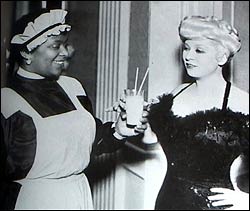
Libby Taylor was discovered by Mae West while preparing barbecue at a Harlem eatery, Black and Gold. Mae sensed that the Chicago native would make an excellent straight woman, and soon the newcomer became a cast member.

• • Libby Taylor, who was seen in films from 1931-1953, appeared with Mae West in two vehicles. In Belle of the Nineties [1934] she played Jasmine (Ruby Carter's maid) and in I'm No Angel [1933] she was Libby (Tira's hairdressing maid).
• • Despite stereotypical casting, film historians have noted that the various black maid figures function importantly in West's Gay '90s boudoir. These women set up punchlines and function as go-betweens, confidantes, and cheerleaders. Despite the uniforms, maids in West pictures come closer to being equals than white rivals; also they function as spiritual touchstones.
• • Many of Belle of the Nineties's extras are New York pals of West's boxer father or down-on-their-luck vaudevillians she had worked with once.
• • Belle of the Nineties trivia: Supposedly, the male lead was offered to George Raft, a former New York buddy of West's who had headlined her first appearance onscreen, Night After Night.
• • "Let's face it. Belle of the Nineties will be ninety-nine precent Mae West and one-half percent George Raft," said Raft to Paramount management the second time around, who surprised the actor by agreeing.
• • West's leading men were fleshed out by Universal's Roger Pryor, and Paramount's Johnny Mack Brown and John Miljan - - all rising actors at the time.
• • Come up and see Mae every day online: http://MaeWest.blogspot.com/
________
Source:http://maewest.blogspot.com/atom.xml
Add to Google

• • Photo: Mae West • • Libby Taylor • • in 1934 • •

Mae West.

Thursday, December 07, 2006

Mae West: 8 December 1898

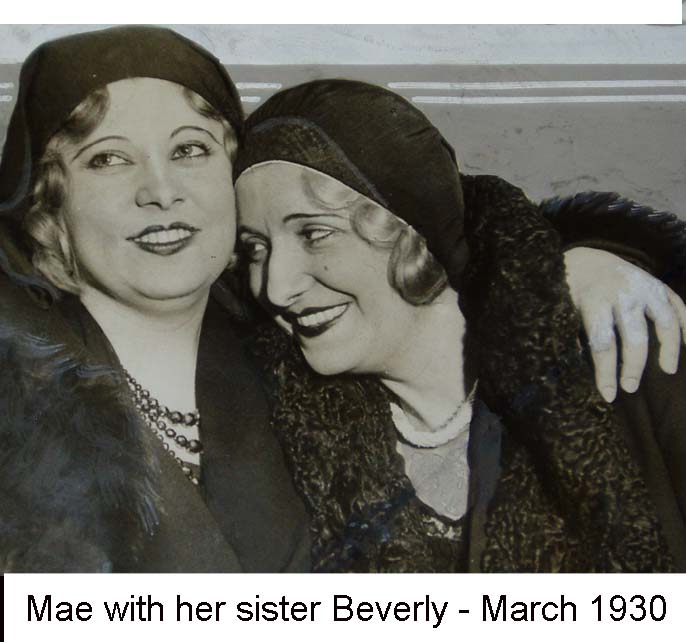
On 8 December 1898 MAE WEST and her parents welcomed a new addition to the household — — sister Mildreth Katharina, who later changed her name to Beverly.
• • Also an aspiring actress, kid sister Beverly performed at the Fifth Avenue Theatre in 1916 in an act billed as "Mae West and Sister."
• • Mae West posed in her three costumes for this booking for photographer James Abbe.
• • One number featured Mae clad in male drag opposite a very feminine Beverly. Unfortunately, no photo of the sisters together onstage in 1916 have survived.
• • Come up and see Mae every day online: http://MaeWest.blogspot.com/
________
Source:http://maewest.blogspot.com/atom.xml
Add to Google

• • Photo: Mae West • • sister Beverly in 1930 • •

Mae West.

Tuesday, December 05, 2006

Mae West: Tallulah-ed

MAE WEST posed with actress Tallulah Bankhead at an event during the 1950s.

• • Tallulah Bankhead [31 January 1902 – 12 December 1968] was an American actress, talk-show host and bonne vivante.
• • At 15, Bankhead won a movie-magazine beauty contest and moved to New York. She quickly won bit parts. During these early New York years, she became a peripheral member of the Algonquin Round Table, and was reputed to be a hard-partying girl-about-town.
• • In 1931 her name was tossed out as Paramount Pictures' "next Marlene Dietrich", but Hollywood success eluded her in her first four films of the 30s. Critics agreed that her acting was flat, that she was unable to dominate the camera, and that she was generally outclassed by Dietrich, Carole Lombard, and others.
• • In Hollywood, Tallulah rented a home [1712 Stanley Street], and began hosting frisky parties. On 9 September 1932, she was on the cover of
Film Weekly.
• • She was outspoken and uninhibited.
• • In 1932 she briefly expressed interest in spirituality and met with an Indian mystic.
• • In 1933 Tallulah Bankhead nearly died following a 5-hour emergency hysterectomy for an advanced case of gonorrhea, contracted
– – she said – – from either actor George Raft or Gary Cooper. Only 70 pounds when she was able to leave the hospital, she stoically said to her doctor, "Don't think this has taught me a lesson!"
• • In 1963 she gave her last theatrical performances in a Tennessee Williams play,
The Milk Train Doesn't Stop Here Any More.
• • Tallulah Bankhead died in New York City in December of double pneumonia arising from influenza, complicated by emphysema, at the age of 66 [12 December 1968] and is buried in Saint Paul's Churchyard, Maryland.
• • Come up and see Mae every day online: http://MaeWest.blogspot.com/

________
Source:http://maewest.blogspot.com/atom.xml
Add to Google

• • Photo: Mae West • • Tallulah Bankhead • •

Mae West.

Sunday, December 03, 2006

Mae West: No Angel


Reviewing Simon Louvish's recent tome on MAE WEST for The New York Times, critic Richard Schickel seems friendlier the second time around. Though Schickel's peppery review of Louvish's biography of W.C. Fields [in 1997] branded him as "a writer of astonishing ineptitude," on this occasion he finds more fault with the star than the men who scribble books about her. The New York Times published this critique on 3 December 2006.
• • No Angel • •
• • By RICHARD SCHICKEL • •
• • A surprising number of essentially affectless people — George Raft, Richard Dix, Nelson Eddy, to name but a few old-timers — have been movie stars. Or at any rate, so proclaimed by Hollywood, at least for a moment. These are triumphs of good looks over good sense, for generally speaking, handsome blankness leads, sooner rather than later, to B pictures, television guest shots and an inevitable drift out of all but the most cultish of consciousnesses.
• • Adding Mae West to that all-male list may seem rather dubious. But as early as 1934 a writer named George Davis called her the greatest female impersonator of all time — an identification that, in all the better critical circles, has forever clung to her — so it is probably O.K. to lump her in with the boys. In all other respects, her ability to push you out of a movie, rather than to welcome you into it, remains virtually unparalleled.
• • Mae West had a very short movie career. She made her first picture, with — yes! — George Raft, in 1932, and emerged as major box office phenomenon the following year, with “She Done Him Wrong” and “I’m No Angel.” But her appeal waned quickly after that, and by 1938 one columnist labeled her “poison at the box office.” Even though West made her best film, “My Little Chickadee,” opposite W. C. Fields, in 1940, she was finished as a movie star — if not as a curiosity. For the next 40 years, she tended her legend, touring in plays, writing some books, and, in the ’70s, appearing in two increasingly ludicrous movies, while endlessly granting interviews that recycled her old double-entendres and stressed charms that she alone was certain remained ageless — a grotesque icon, with a leftover life to kill.
• • But there had always been something decidedly weird about her, beginning with her appearance. “She is a large, soft, flabby and billowing super blonde who talks through her nostrils and whose laborious ambulations suggest that she has sore feet,” a critic wrote in 1931. More kindly, at the outset of her fame, one might say she was an anachronism, a Gay Nineties gal plunked down in the Flapper Age. But that was not the essence of her problem. As Simon Louvish writes in “Mae West: It Ain’t No Sin,” his demonically researched biography, “the main, supreme object of the adoration and love of Mae West was herself” and as West herself admitted, “I never loved another person the way I loved myself.” In short, it was her narcissism — her inability to relate to anyone in any intimately persuasive way — that so quickly destroyed her screen career.
• • The character she created was completely of her own devising. Even the industrious Louvish cannot find anyone else who significantly aided her in its creation. Somehow, in the course of two decades of largely inconsequential vaudeville trouping, the Brooklyn-born and sketchily educated West made herself into a playwright, devoutly scribbling (and occasionally filching) her one-liners and crafting the primitive narratives in which they were embedded. However lumbering the results — it is hard to find in these pages many kindly notices for her efforts — she did create a unique (and, to me) unconsciously monstrous figure only she could play. There was something mannish in her pro forma pursuit of mechanistic and, if possible, nonstop sex, but the suggestiveness of her one-liners was also a dour commentary on the female’s (at that time) unspoken sexual needs. They were never an invitation to make their satisfaction a mutually playful pleasure; there was always, I thought, something grim about going up to see her sometime. This scarcely makes West the heroine some feminists have tried to make her. Nor were her jokes quite the blatant challenge to morality the censors thought they were. Never “dirty,” they were merely suggestive.
• • Still, once New York’s puritans busted “Sex,” her first dramatic effort, on a morals charge in 1927 (she served 10 days [sic] on Welfare Island for writing it) she was forever trapped in her self-creation, forever sui generis. “Diamond Lil,” one year later, was another hit, and soon she was in Hollywood. At first, she was lucky in her timing. The immobile cameras and microphones of the early sound era locked everyone down and West’s stasis did not seem exceptional. More significantly, the censors of the Motion Picture Production Code fought West’s scripts for her first two films almost line by line, but innuendo is ever a slippery target and so are line readings. Enough got through to make Mae seem more transgressive than she actually was.
• • Some historians have suggested that her movie career declined so quickly because the film production code’s censors started to more rigorously enforce its many inane provisions in 1934 (why in the world was the word “bedbug” banned from the screen?). But by that time the movies were starting to move again, an art West never mastered. When she sang her racy songs, she tended to stand stock still and almost expressionless. When she danced, she wiggled her hips a bit, but was scarcely a female Astaire. Worst of all for her, the new movie age created a new feminine ideal: the crisp, brisk, slender women of the 1930s’ most seductive genre, romantic comedy. Claudette Colbert, Irene Dunne, Barbara Stanwyck, Myrna Loy — these women, in their sharply tailored suits were capable of trading sharply tailored quips on an equal basis with men. In West’s movies — most charitably understood as one-woman shows supported by a few dispensable stooges — the men stood around feeding her lines and awaiting her zingers. Even Cary Grant, not yet the sublime actor he would soon become, was reduced to polite puzzlement in her presence. Only Fields, a much greater self-creation, drew her into a little banter, but “Chickadee” was too little, too late.
• • Louvish does his best to explore the enigma of West’s true sexual nature, but he never quite gets at the reality behind the drawling invitations. There were, to twist one of her more famous aperçus, men in West’s life, but not much life in her men. She evinced no grand or even discernible passion for any of them, nor they for her, and Louvish often seems to wonder if they ever actually made it into the bedroom.
• • It’s interesting to observe that the same 1932 column that called West box office poison also included three other androgynes: Marlene Dietrich, Greta Garbo and Katharine Hepburn. Their legends, and to a greater or lesser degree, their immediate careers, recovered from the blow. West’s did not. That may be because the other women all had authentic, if not necessarily commonplace, sexual energy, whereas, on Louvish’s evidence, West was pretty much a peeled grape. Which is also — despite the author’s enthusiastic efforts on her behalf — her status in film (and social) history.
_____________________________________
• • Richard Schickel’s “Elia Kazan: A Biography” was just reprinted in paperback.
• • Published: December 3, 2006
• • Source: The New York Times
• • Come up and see Mae every day online: http://MaeWest.blogspot.com/
________
Source:http://maewest.blogspot.com/atom.xml
Add to Google

• • Photo: Mae West • • 1938 • •

Mae West.

Thursday, November 30, 2006

Mae West: Yogini

MAE WEST was involved with yoga in 1940, observes this recent article in Columbia Journalism Review. Here is a brief excerpt.

• • The thirties saw the rise of the influence of gossip columnists, many of whom had started their careers just a few years earlier with the tabloids. Walter Winchell and Hedda Hopper were two of the best known of the pack. Gossips wrote six days a week in many cases, so they relied to an inordinate degree on movie stars’ predilections, which began to involve yoga.
• • In 1938, Cole Porter was back in the hospital, a year after his legs were crushed in a riding accident. He was studying yoga, reported Leonard Lyons in The Washington Post, “to attain complete control of his system.” Lyons had previously outed Greta Garbo as a lonely yogini; Maureen O’Sullivan was mentioned by the beauty columnist Ida Jean Kain in one of her “Your Figure, Madame,” columns titled "Yoga Exercises Finding Favor With Women in America."
• • And guess what? Mae West was one of those women, according to Sheilah Graham in her “Hollywood Today” column of January 30, 1940.
• • During the war years, Southern California became the undisputed locus of alternative culture, and Hollywood its epicenter. Yoga was by this time, if not totally American, then a harmless pastime for the citizens of California. During World War II, it was reported that “nerves are unpatriotic,” according to the author and actress Cornelia Otis Skinner, who told a health columnist that she had tried yoga and calisthenics to cure her wartime nervousness. ...
Source: "Fear of Yoga" By Robert Love [C.J.R., November - December 2006]
Source: © 2006 Columbia Journalism Review - - http://www.cjr.org
• • Come up and see Mae every day online: http://MaeWest.blogspot.com/
________
Source:http://maewest.blogspot.com/atom.xml
Add to Google

• • Photo: Mae West • • 1938 • •

Mae West.

Wednesday, November 29, 2006

Mae West: 15 Minutes

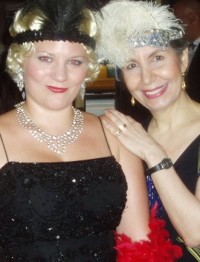
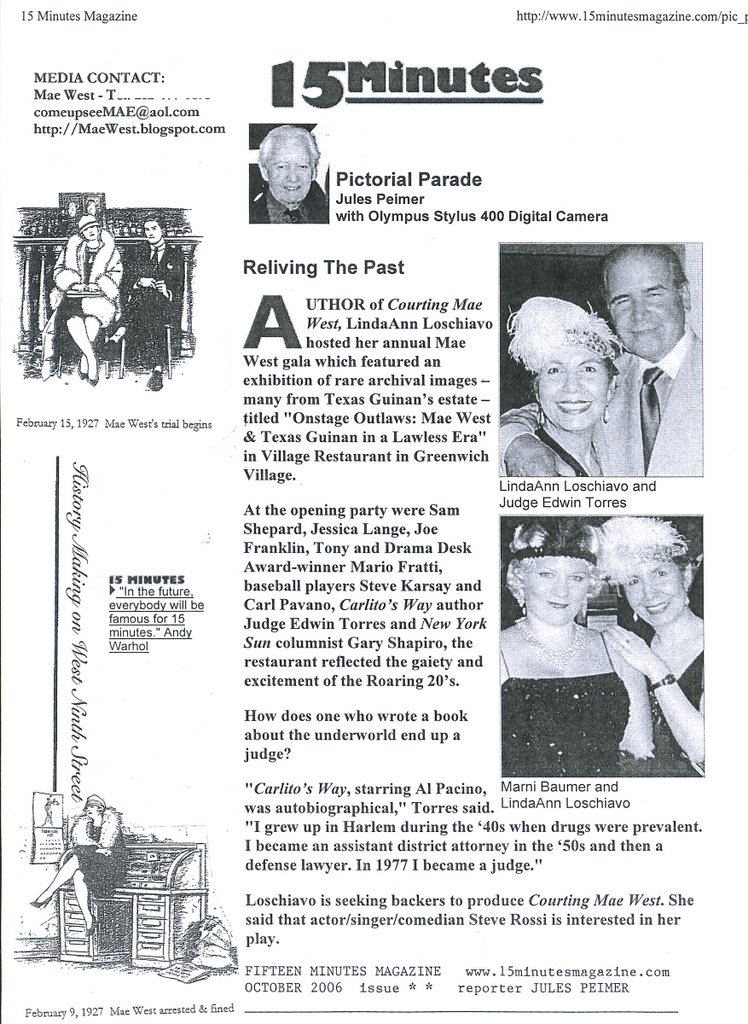
FIFTEEN MINUTES Magazine came up to see Mae! New York City's Fire Patrol was on stand-by the evening of August 17th, 2006.

Reason: they heard that vixenish vocalist MARNIE BAUMER was in Greenwich Village, doing her "Mae West Medley" at the ANNUAL MAE WEST GALA. Well, things got really hot when the boa-toting beauty took the floor to treat the crowd to "My Old Flame," "A Guy What Takes His Time," and "Frankie and Johnny."
• • George, the muscle-bound bodyguard who accompanies Texas Guinan everywhere, swore that the blonde Baumer's performance was not unlike a three-alarm-blaze. (Hey, sucker! Where were YOU on August 17th, huh?)

• • Party guests at Village Restaurant, happily feasting on a Roaring 20s menu specially prepared by chef Stephen Lyle, also were enjoying the exhibition "ONSTAGE OUTLAWS: Mae West and Texas Guinan in a Lawless Era."
• • Veteran reporter Jules Peimer covered the ANNUAL MAE WEST GALA for 15 Minutes Magazine. This is his coverage.
• • Come up and see Mae every day online: http://MaeWest.blogspot.com/
________
Source:http://maewest.blogspot.com/atom.xml
Add to Google

• • Photo: Annual Mae West Gala media coverage • • August 2006 • •

Mae West.

Monday, November 27, 2006

Mae West: Confidential

Born on February 10, 1912 in either Mexico or Arizona, Albert "Chalky" Wright turned pro in the ring two weeks after his 16th birthday, scoring a four-round win over Nilo Balles. He spent the early part of his boxing career in Southern California. Standing 5' 6 1/2", Wright fought best at 126 pounds.
• • As the 1930s drew to a close, Chalky's best-known bouts were losses to the likes of Henry Armstrong and Lew Feldman. Any championship aspirations amounted to nothing more than lip service. However, Lady Luck appeared in the form of a new employer — none other than Hollywood movie queen Mae West, for whom Chalky became a chauffeur, turning his back on the topsy-turvy world of boxing in favor of a steady paycheck.
• • Boxing historian Hank Kaplan explained: "Mae West liked having characters around, especially those in the prizefight game, and Chalky was an interesting fellow."
• • Chalky Wright had another quality that Mae West prized: loyalty. When the screen siren was robbed of a large sum of cash and jewelry, Wright became part of a decoy operation, driving around police officers Jack South (who hid on the floor) and Harry Dean (who dressed in drag to appear like the movie star) in an effort to nab the robbers and retrieve West's merchandise.
• • Such devotion did not go unreciprocated. Mae West helped to revive his career. In order for his family to meet their financial obligations, West hired Chalky's brother to take over the chauffeur's position. She then engaged promoter Morrie Cohen to line up a series of bouts that helped take Wright into contention.
• • It wasn't until he began fighting on the East Coast in 1938 that the boxing world took notice of Wright. He packed considerable power for a 126-pounder. By 1941, Wright was ranked among the top featherweights in the world and secured a title fight by decisioning future champion Sal Bartolo. On September 11, 1941, nearly 14 years after he turned pro, Wright knocked out Joey Archibald in the 11th round to win the world featherweight title. Less than a month after winning the title, Wright engaged in two tough non-title fights, losing to top contender Jose Peralta and decisioning former champ Leo Rodak.
• • In 1948, Chalky Wright finally retired, a veteran of 201 bouts in a career that spanned 20 years.
• • Amid speculation that Mae West and Wright were lovers, Hollywood Research (an information-gathering service for Hollywood Confidential publishers) was preparing an expose for their November 1955 edition. Hollywood Confidential Magazine sought a pay-off from Mae West. When Mae refused to give in to their blackmail, the magazine ran a tell-all, trumpeting on their sleazy front cover that Mae West had an "Open Door Policy" when it came to dark-skinned males.
• • In November 1955, readers who purchased this notorious scandal-sheet learned that Mae West had showered the fighter with pricey gifts, bought a house for his mother, and bankrolled his divorce.
• • In 1957, the State of California got into a courtroom tussle with Hollywood Confidential over these attempts at extortion. The trial began in early August 1957 and involved many high-profile names in addition to Mae West - - like Desi Arnaz [married to Lucille Ball] and Clark Gable.
• • Mae West avoided testifying by supplying sworn depositions that denied she had a romance with Chalky Wright. On 12 August 1957, just before he was to testify, Chalky Wright [age 45] died suddenly in Los Angeles in the bathtub of his mother's house. Mae West insisted that her friend had been murdered.
• • Come up and see Mae every day online: http://MaeWest.blogspot.com/
________
Source:http://maewest.blogspot.com/atom.xml
Add to Google

• • Photo: Mae West's chauffeur • • Chalky Wright in 1941 • •

Mae West.

Saturday, November 25, 2006

Mae West: The Other Walker

"The Night Mayor" of Gotham - - Jimmy Walker - - was a Mae West fan who attended all of her premieres. Another Walker, newsman Stanley Walker, also came up to see Mae West on many occasions. He saw her productions onstage, and he sat at her elbow several times backstage and at the night spots she frequented.
• • As a writer for the old New York Herald Tribune in the 1920s and 1930s, Stanley Walker chronicled the city in words the way Weegee did with a Graflex. Published in November 1935 to great acclaim, The Night Club Era is Walker's portrait of the wicked city during Prohibition and how the banning of liquor gave rise to a new social setting in which, legal or not, booze flowed uninhibited and gangsters rubbed shoulders with socialites and legitimate businessmen, all unified with the single intent of having a high time with a highball.
• • Written in the aftermath of Prohibition, Stanley Walker's bestseller The Night Club Era is a lively and idiosyncratic account of the people and places that defined New York's night life during the era of "the great American madness."
• • Walker includes coverage of the leading headline-makers and shakers such as the darling of Broadway MAE WEST, queen of bubbly Texas Guinan, along with the most infamous murderers and millionaires, gangsters, bartenders, celebrities of the stage, screen, and society, and a host of other colorful characters who populated the city's diverse night clubs, from El Fey to the Cotton Club.
• • Mae West was a repeater attender at the Cotton Club (owned by her lover Owney Madden) and at the El Fey, the temporary headquarters of her pal, the hostess Texas Guinan (a business partner of Larry Fay).
• • Come up and see Mae every day online: http://MaeWest.blogspot.com/
________
Source:http://maewest.blogspot.com/atom.xml
Add to Google

• • Photo: Mae West • • 1925 • •

Mae West.

Thursday, November 23, 2006

Mae West: Cary Grant

Though he made a few films before hooking up with MAE WEST, Cary Grant was still an unknown in 1932. Seeking a debonair male lead, the actress spotted him at Paramount Pictures, and told her producers, "If he can talk, I'll take him."

• • Archibald Alexander Leach [18 January 1904 – 29 November 1986] - - better known by his screen name, Cary Grant - - was an English film actor. With his distinctive Mid-Atlantic accent, he was perhaps the foremost exemplar of the debonair leading man: tall, dark, handsome, witty, and charming. He was named the second Greatest Male Star of All Time by the American Film Institute.
• • After the huge popularity their first films achieved - - "She Done Him Wrong" and "I'm No Angel" - - the pair was promoted on this Players Cigarettes tobacco card in 1934.
• • Cary Grant died in November 1986 at age 82.
• • Come up and see Mae every day online: http://MaeWest.blogspot.com/
________
Source:http://maewest.blogspot.com/atom.xml
Add to Google

• • Tobacco Card: Mae West with Cary Grant • • 1934 • •

Mae West.

Wednesday, November 22, 2006

Mae West: Love-Line

To know her was to love her, close associates have said.

• • Exploring her life has provided endless fodder for biographers.
• • To watch her films - - containing material penned for Mae West by Mae West - - is to appreciate her comic timing, her understanding of visual artistry, and also her perfectionism.
• • To hear other actresses whine about personal problems, abortions, drug dependency, suicide attempts, and their medical history is to understand how Mae West kept her audience care-free, unwilling to burden them with updates on her diabetes, the deterioration of her vision, or the ups and downs of her financial stability. Thank you Mae for making us laugh - - not sigh.
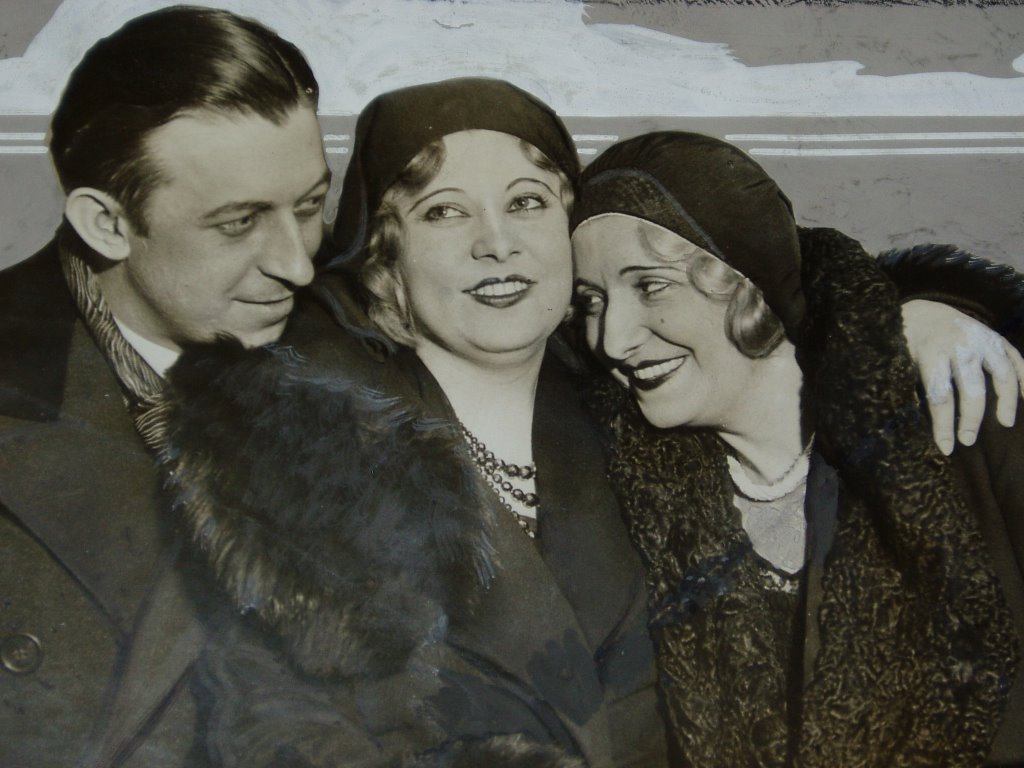
• • MAE WEST: 17 August 1893 - - 22 November 1980.
• • Come up and see Mae every day online: http://MaeWest.blogspot.com/
________
Source:http://maewest.blogspot.com/atom.xml
Add to Google

• • Photo: Mae West with her brother and sister • • 1930 • •

Mae West.

Tuesday, November 21, 2006

Mae West, Endlessly


She started life in Brooklyn, New York on 17 August 1893. "I was born on a cool night in a hot month," said Mae West, "so I knew I could expect anything."
• • On 22 November 1980, she departed from this life - - but never from our hearts.
• • She is often quoted and frequently impersonated.
• • She has always been misunderstood by most people.
• • MAE WEST often wrote her own work; she popularized African-American music; she clowned about sex; she never apologized for her size.
• • Endlessly, she is our one-of-a-kind MAE WEST.
________
Source:http://maewest.blogspot.com/atom.xml
Add to Google

• • Photo: Mae West • • early 1930s • •

Mae West.