Monday, October 16, 2006

Mae West: West Coast

Viator [the Latin word for "traveler"] is arranging spirited tours for Hallowe'en fans and MAE WEST devotees out in California.

• • In October, The West Coast Ghost will drop in on MAE WEST. This company features a ‘Director of Undertakings’ whose job it is to "host the Dearly Departed Tour in Los Angeles, and tell tales of tinseltown tragedies, all in the comfort of the Dearly Departed Tomb Buggy." Ghoulish stops include "last gasp locations of MAE WEST, Frank Sinatra, River Phoenix, Bela Lugosi, among other local haunts." For fees and info:
• • Contact: Kate Sullivan, 1-973-568-7589
• • Headquartered in San Francisco, Viator claims to be "the world’s leading online resource for travel experiences."
• • Mention MaeWest.blogspot.com if you call these folks.
________
Source:http://maewest.blogspot.com/atom.xml
Add to Google

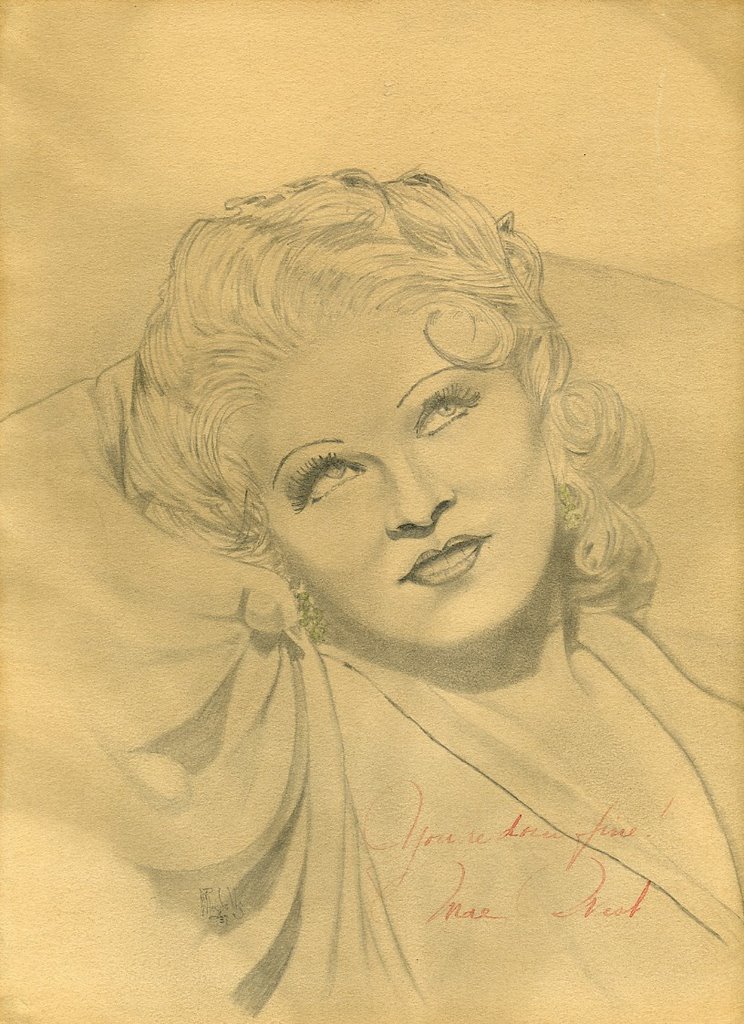
• • Illustration by Wm Reynolds: Mae West • • 1933 • •

Mae West.

Sunday, October 15, 2006

Mae West: Mrs. Miguel

MAE WEST met many people at the night clubs run by her friend Texas Guinan. One intriguing connection Mae West made was Broadway dancer-choreographer ROSE ROLANDO, a vivacious beauty whose performances onstage would send theatre critics into fits of ecstatic adjectives.

• • Born in Los Angeles as Rosemond Cowan, Rose's dancing feet led her into Lorenz Hart and Richard Rodgers popular musical "Garrick's Gaieties" - - which ran for 212 performances. Rose Rolando opened Act II with a number called "Rancho Mexicana." Perhaps that was Rose's way of flirting with the Mexican set designer, artist Miguel Covarrubias [1904-1957].
• • Drawn into the theatre circle by his relationship with this dark-eyed dancer, Covarrubias pursued celebrity caricature.

His portraits of vaudeville and Broadway stars graced the covers of Vanity Fair, Collier's, and other publications. The New Yorker asked him to sketch MAE WEST. His drawing of "Diamond Lil" (now in the Smithsonian) appeared in their 5 May 1928 issue.
• • Rose Rolando was photographed by Edward Weston, Max Eastman, and Man Ray. Diego Rivera, Miguel Covarrubias, and other artists painted her.
• • After years of living together in Greenwich Village, the pair married in 1930.
• • The couple collaborated on several books, documenting their travels to Bali and elsewhere.
________
Source:http://maewest.blogspot.com/atom.xml
Add to Google

• • Illustration: Mae West • • Miguel Covarrubias • • May 1928 • •

Mae West.

Saturday, October 14, 2006

Mae West: Amedeo Bertini

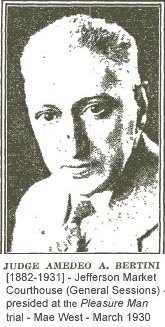
Since October is "Italian Culture Month" in New York and other cities, it is the season to highlight an Italian-American jurist who presided over an infamous obscenity trial at Jefferson Market Court (General Sessions) - - involving the actress-playwright MAE WEST.

• • • • Here's what The Herald Tribune reported on 4 April 1930:
• • • MAE WEST ACQUITTED! • • •
• • NEW YORK: The Jury drawn from a special panel to pass on Mae West's guilt for presenting "Pleasure Man," a play described by the state as "indecent, improper, immoral, and obscene," was dismissed by Judge Amedeo Bertini in General Sessions court today [4 April 1930]. The jury failed to agree on a verdict after 10 hours of deliberation. "Pleasure Man" was raided and closed on 1 October 1928, after one performance at the Biltmore Theatre on Broadway, and the case - - involving Mae West and eleven co-defendants of the cast - - has been pending since then. . . .

• • Who was Amedeo A. Bertini? And why did such a raucous raid in OCTOBER 1928 not go to trial until MARCH 1930?

• • Nathan Burkan, the high-profile lawyer hired to defend MAE WEST - - and keep the repeat offender out of Jefferson Market Jail - - did his best legal foot-dragging to stall the case from coming to trial. Meanwhile, the witnesses' memories were not as sharp after a year-long hiatus, and much of the cast had joined the Navy to avoid going to court.
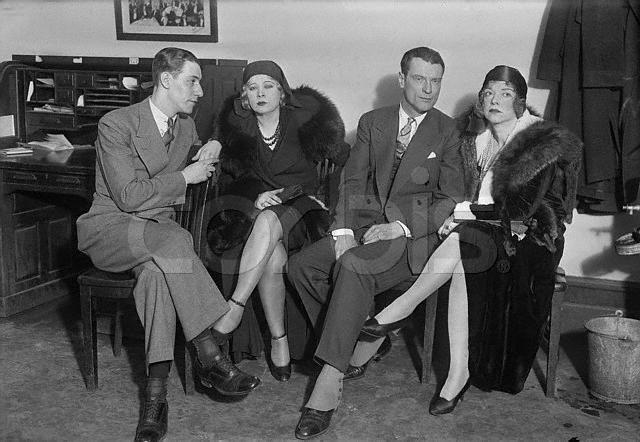
• • Mae West, in mourning for her mother (who had died in January 1930) was often accompanied by Jim Timony, her brother Jack, and her sister Beverly.
• • Another supporter, the speakeasy queen Texas Guinan [1884-1933] was in court to cover the proceedings for the newspaper New York American. Texas was disappointed that Mae West did not take the stand. Nathan Burkan kept Mae out of the hot seat, arguing that she only penned the play - - but did not perform in it, obviously, since Mae was starring in her other play "Diamond Lil."
• • Meanwhile, Amedeo A. Bertini [1882-1931] was having his own headaches, dogged by accusations that he bought his way into the Supreme Court.
• • After a 1928 financial scandal had bumped Judge Francis X. Mancuso off the bench, in October 1929 a friend of Jimmy Walker (and also a pal of F.X. Mancuso) was nominated to take his place: Governor Roosevelt appointed Tammany-team-player Amedeo Bertini to the post.
• • Born in 1882 in Greenwich Village, Amedeo A. Bertini was the American son of two Italian immigrants who had left Northern Italy in 1873 and settled on the south side of Washington Square. His affable father Bartolomeo Bertini, the proprietor of the Campidiglio Hotel [135 Bleecker Street, near Thompson St.], became well-known in Italian-American circles; Mayor Hugh J. Grant appointed Bart Bertini to serve on the committee when New York City celebrated the 400th anniversary of Columbus in 1892.
• • His son Amedeo, a boyhood buddy of Jimmy Walker, attended P.S. 35 on 13th Street, DeWitt Clinton High School, and Cornell University. He transferred to Columbia University, where he received his bachelor's and his law degree. The lawfirm of Bertini and Hirshon was headquartered downtown in the Woolworth Building [233 Broadway, near City Hall]. Politically well-tooled, Bertini was a member of the Iroquois Club, Tiro a Segno, and the National Democratic Club. He had raised $75,000 for the Italian Hospital in N.Y.
• • In 1929, the position of a Supreme Court Justice paid $22,500. Before accepting the judgeship, however, Bertini had become wealthy. He and his family resided in a two-story penthouse on the roof of an apartment building he owned at 37 Washington Square West. Bertini's tenants included Charles L. Kohler, Tammany leader of the Tenth Assembly District.
• • Mae West's trial began 16 March 1930. It had its share of entertainment value. Cast member Chuck Connors II sang the controversial "She's the Queen of the Beaches" for Judge Bertini and the jury. Though somber and bereaved, Mae West had to stuff a black handkerchief in her mouth to keep from laughing at this performance.
• • Actor Alan Brooks [1888-1936] - - who played the title role in "Pleasure Man" - - swore on the witness stand that he was astonished to discover that his character had died from being castrated. The debonair 42-year-old leading man testified in smart-looking spats and a gorgeous suit.
• • Judge Amedeo Bertini dismissed the Wales Padlock Law as ineffective, saying that it was impossible to accurately stage a play with ambiguous meanings in front of the jurors. [No kidding. . . .] He warned Broadway producers to police themselves better, however.
• • Variety exulted with a banner headline: Mae West Beats It!
_______________________________
Source:http://maewest.blogspot.com/atom.xml
Add to Google

• • Photo: attorney J. Rosenthal • • Mae West • • Alan Brooks [wearing spats] • • Texas Guinan • • 1 April 1930 • •
• • Photo: Judge Amedeo A. Bertini [1882-1931]

Mae West.

Friday, October 13, 2006

Mae West: a.k.a. "Steve Rossi"

Since October is "Italian Culture Month" in New York and other cities, it is the season to highlight an Italian-American actor who worked with MAE WEST.
• • Joseph Charles Tafarella was born on 25 May 1932 in New York, NY.
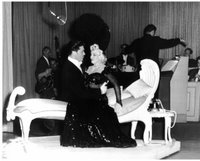
• • He's been on center stage since he was nine. Born on Third Avenue and East 111th Street in Manhattan's East Harlem section, he was most influenced by his father's success in the entertainment business. "We owned a book printed in 1929 that listed Santi Tafarella as the world's greatest cornet player," he proudly recalls. "Papa was also an experienced musical arranger and notator." During the Depression, NBC Radio in California hired Santi Tafarella, who immediately moved his family to North Hollywood and got his son enrolled in the prestigious Robert Mitchell Boy Choir School. Touring with them, the youngster learned to serenade God in seven languages including Latin, Greek, and Hebrew.
• • While his father toiled away, making beautiful music with NBC, Catherine Bianco Tafarella was busy driving her son to auditions. At 12 years old, he harmonized with Hollywood's version of a priest - Bing Crosby - in Going My Way (1944); at 14, he sang in The Jolson Story (1946). This was an auspicious beginning: both pictures scored at the Academy Awards and more roles in movie musicals followed.
• • Much as he loved being onscreen, he had a yearning for higher learning. In 1949, Santi Tafarella's son entered Loyola University on a scholarship, majoring in communication arts and theater. Couple of years later, he was playing the lead in The Vagabond King for the Civic Light Opera Company in Los Angeles when he caught the eye of a Hollywood icon.
• • Mae West, clad in furs and jewels, came up to see him backstage with her manager Jerry Franks. "I told her I was a student at a Catholic university. Mae West said, 'I don't give a damn. You're a terrific singer and you've got a great body and a great face. I want you to be the leading man in my show, and I'll sign you up with my agency, William Morris.'" The 60-year-old actress ushered him into her new Las Vegas extravaganza that would feature modern gladiators: Mr. Universe, Mr. America, Mr. World, and other musclemen. "Though several of these bodybuilders were gay," he chuckles, "Mae West slept with them all!"
• • He wrote the opening numbers for this - "The Opposite Sex Now and Then," "In Dreams I Kiss Your Hand, Madame" - songs that were performed by a 15-piece orchestra as he fox-trotted with Mae West. In 1953, since nothing like this had ever been done before, they were unprepared for the audience's reaction. "Women stormed the stage. They went absolutely wild for the men. We'd have to stop the show until these ladies were led back to their seats." He adds, "Wherever we played, The Mae West Revue sold out."
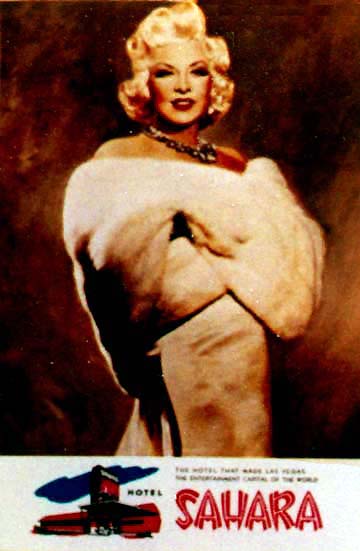
• • According to Mae West's leading man, however, "Mae didn't put my name on the marquee at Ciro's because there was no room for it. Then we went to the Sahara. The night before we opened she called me up and said, 'I want to see you downstairs at the marquee.' My entire name was across the whole marquee. Her name was only seven letters. She says, 'What name do you notice up there?' I said, 'To tell you the truth, I notice my name more than yours.' 'Why is that?' asked Mae West. I said, 'Because I have 22 letters, and you only have seven.' Mae made a decision: 'From now on, your name is Steve Rossi.'" He got used to seeing his new name spelt out in lights, his wagon hitched to a star.
• • In 1953-1954 Steve co-starred with Mae West in her sold-out concerts all over America.
• • In 1957, Steve Rossi teamed up with Marty Allen and they became a top comedy team. They appeared on 700 television shows including 44 appearances on "The Ed Sullivan Show," three of which were with the Beatles in 1964.
• • Allen and Rossi were regular guests stars on “What’s My Line,” “Hollywood Squares,” “Password,” and other game shows. They also starred in Paramount films notably The Last of the Secret Agents with Nancy Sinatra and Ed Sullivan as guest stars.
• • Steve Rossi has guest-starred with Perry Como, Dean Martin, Dinah Shore, Merv Griffin, Mike Douglas, and with Johnny Carson on The Tonight Show.
• • Now 74 years old, he still sings and performs onstage.
_______________________________
Source:http://maewest.blogspot.com/atom.xml

Add to Google

• • Photo: Mae West • • Steve Rossi • • 1954 • •

Mae West.

Thursday, October 12, 2006

Mae West & Walter: Oct. 1943

It was October 1943 when Columbia began production on a new film starring MAE WEST: "The Heat's On." [This movie was released on 9 February 1944.]

• • Production on Mae West's wardrobe began that October with a very special designer - - the dean of period costumes: Walter Plunkett.
• • Born in Oakland, California, Walter Plunkett [2 June 1902 - 8 March 1982] studied law at the University of California, but showed greater interest in the campus theatrical group. In 1923, Plunkett moved to New York and launched himself as a stage actor, as well as a costume and set designer. After an interval in Greenwich Village, he moved back to the West Coast - - this time to Hollywood - - and found work as a movie extra. His thespian flame burned out; he soon made a fortuitous career change to costume designer.

• • In 1927, Walter Plunkett's first screen credit as a costume designer appeared. During the late 1920s and early 1930s, while working at RKO, he transformed a huge costume and wardrobe department into an efficient, creative studio asset. Enjoying free reign at RKO, Walter Plunkett spun creations that rivaled the work of his contemporaries (Travis Banton and Adrian).
• • By 1936 Walter Plunkett was known as the foremost authority on period costumes. His best-known work was seen in "Gone with the Wind" and "Singin' in the Rain," in which he lampooned his initial style of the Roaring 20s. Unfortunately, the Academy had not yet devised a category for "Best Costumes" - - or Plunkett surely would have won. Author Margaret Mitchell loved the way he dressed Vivien Leigh (as Scarlett O'Hara).
• • By 1943, when he outfitted Mae West, he was quite in demand.
• • In 1951, Plunkett shared an Academy Award with Orry-Kelly and Irene for "An American in Paris." Plunkett retired in 1966, leaving behind a distinguished body of work in films, on Broadway, and for the Metropolitan Opera.
_______________________________
Source:http://maewest.blogspot.com/atom.xml
Add to Google

• • Photo: Mae West costume • • Walter Plunkett 1943 • •

Mae West.

Wednesday, October 11, 2006

Mae & Aimee Semple McPherson

Of course, it's time to commemorate a woman admired by MAE WEST on her birthday in October.

• • Aimee Semple McPherson [9 October 1890 –– 27 September 1944], also known as "Sister Aimee" or simply "Sister," was an evangelist and media sensation in the 1920s and 1930s; she was also the founder of the Foursquare Church.
• • McPherson had started out as a Salvation Army worker. [Mae West featured a Salvation Army worker Captain Cummings in her 1928 Broadway play "Diamond Lil." Diamond Lil learns that he is really "the Hawk" and doing detective work undercover. In the film "She Done Him Wrong," Captain Cummings is played by Cary Grant.]
• • Aimee McPherson spent four years [1918-1922] as an itinerant Pentecostal preacher, finally settling with her mother in Los Angeles, California, and founding the Foursquare Gospel church. She supervised construction of a large, domed church building in the Echo Park area of Los Angeles, and it was completed in June 1923. Named Angelus Temple, it had a seating capacity of over 5,000.
• • When Aimee Semple McPherson, the famous Evangelist (with marcel-waved hair) from Los Angeles visited New York on February 19th, 1927, she insisted on visiting Texas Guinan's club. Mae West was there to meet Aimee, too.
• • Texas Guinan welcomed McPherson and this was quite a promotional dream - - two gals of Irish descent in different types of show business. Aimee invited Texas to her Glad Tidings Tabernacle (West 33rd Street) the next day. Texas and her chorus girls showed up (before going to work), to the astonishment of everyone.
• • At the time, women in the pulpit ministry were rare — — those who wore makeup and jewelry in the pulpit, nonexistent. McPherson's uniqueness in this respect, her flamboyance and her unashamed use of low-key sex appeal to attract converts, endeared her to her followers in Los Angeles. She would invariably appear before parishioners in a white gown, carrying a bouquet of flowers. When it was time to take up a collection, McPherson used to say, "No coins, please!"
• • Mae was paying attention to all the stagecraft and image-building at work here.
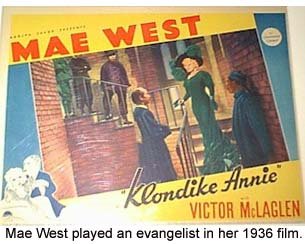
• • Mae West played an evangelist in Nome, Alaska in her film "Klondike Annie" - - released in February 1936 after a lengthy hold-up by the censors who refused to let Mae West appear as a preacher or religious worker onscreen.
• • On 27 September 1944 Aimee Semple McPherson was found dead of an overdose of prescription barbiturates.
• • Photo of Mae West as Klondike Annie from a vintage lobby card.
_______________________________
Source:http://maewest.blogspot.com/atom.xml
Add to Google

• • Photo: Mae West • • 1936 • •

Mae West.

Tuesday, October 10, 2006

Mae's husband Guido Deiro

Since October is "Italian Culture Month" in New York and other cities, it is the season to highlight an Italian musician who married MAE WEST.

• • Guido Deiro was born 1886 in northern Italy.
• • Guido Deiro [1886-1950] was to the piano-accordion as Barrios was to the guitar, John Philip Sousa to the marching band, Scott Joplin to ragtime, and Zez Confrey to novelty piano. All but forgotten today (outside of accordion circles), Guido Deiro gained renown in the early 20th century for his virtuoso live performances. In 1910, he came to the USA from Italy and began performing on the vaudeville circuit.
• • In 1913, the handsome, successful 27-year-old accordionist (who was married to Julia Tatro at the time) met a 20-year-old vaudevillian Mae West, while both were performing in a vaudeville show in Detroit. The couple quickly fell in love and secretly married. Mae signed her marriage license as Catherine Mae Belle West; at the time she was still married to dancer Frank Wallace.
• • Mae filed for divorce from Guido Deiro on the grounds of adultery on 14 July 1920. The divorce was granted by the Supreme Court of the State of New York on 9 November 1920. Guido almost immediately re-married for the third time. Mae later said, "Marriage is a great institution. I'm not ready for an institution."
• • The two did not see each other again until 1943, when Guido looked for Mae in Hollywood after she had become a movie star. By then, Mae had also legally shed her ex-husband Frank Wallace, after a lengthy court proceeding and Guido had split from his fourth wife, who was about 30+ years his junior. Though once a high-earner and very generous to everyone, unfortunately, Guido was destitute by then. He showed her an article he had written, Mae West and Me, which he planned to sell to Look Magazine. She was very displeased about this. Guido was a true gentleman, for despite the financial losses he had suffered during the Depression (and his real need of the money Look would have paid him), he handed the article over to Mae instead, and so they kept their former relationship private.
• • They became friends again. Occasionally, Guido would visit her at the Ravenswood Apartments in Hollywood.
• • Guido Deiro died [26 July 1950 in California] of congestive heart failure at age 63.
• • Photograph source: www.guidodeiro.com - - Guido is on the extreme left and Mae (wearing a hat) is next to him.
_______________________________
Source:http://maewest.blogspot.com/atom.xml
Add to Google

• • Photo: Mae West • • Guido Deiro • • 1915 • •

Mae West.

Monday, October 09, 2006

Mae West: Ghost on Rossmore

Kevin Roderick, publisher of L.A. OBSERVED, made this (er. . .) observation:

• • Author and former Los Angeles cop Joseph Wambaugh, writing on the Los Angeles Times op-ed page, calls Rossmore Avenue his favorite L.A. street and only partly because James Ellroy lives on it.
• • "It's retro and romantic for anyone with powerful remembrances of things past," Joseph Wambaugh says. "One sees ghosts on Rossmore, Mae West for one, sashaying out of the Ravenswood to a waiting limo and two hunky escorts for a night at the Cocoanut Grove. I used to patrol that street when I was a young cop assigned to Wilshire Division. And nobody ever punched me in the mouth on Rossmore Avenue. . . ."
• • Source: "Wambaugh on today's LAPD" by editor-publisher Kevin Roderick
Publication: L.A. OBSERVED - - 9 October 2006 - - www.laobserved.com
Email Kevin Roderick: editor@laobserved.com
• • L.A. OBSERVED is a network of weblogs devoted to independent reporting, selective linkage and informed commentary on Los Angeles and Southern California.
_______________________________
Source:http://maewest.blogspot.com/atom.xml
Add to Google

• • Photo: Mae West • • 1937 • •

Mae West.

Sunday, October 08, 2006

Mae West & Don Ameche

Since October is "Italian Culture Month" in New York and other cities, it is the season to highlight an Italian-American actor who worked with MAE WEST.
• • Dominic Felix Amici was born on 31 May 1908 in Kenosha, Wisconsin.
• • In an interview,
Don Ameche recalled: "The Mae West episode? I almost got thrown off the air for life because of that skit."
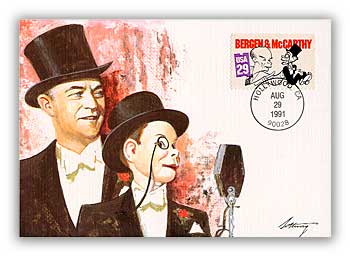
• • Close to Christmas — — on 12 December 1937 — — Mae West appeared in two separate sketches on ventriloquist Edgar Bergen's radio show,
The Chase & Sanborn Hour, that shocked both the listening audience and NBC executives. Since Mae was promoting her latest film, the studio felt that this popular weekly program would give her free exposure - - and Edgar Bergen [1903-1978] had attracted his own substantial fan base. Gowned and bejeweled, Mae appeared as herself, flirting very heavily with Charlie McCarthy, Bergen's dummy, utilizing her usual brand of sexy wit and risqué sexual references.

Even more outrageous was a sketch earlier in the show, written by Arch Oboler, that starred Mae West and Don Ameche as Adam and Eve in the Garden Of Eden. The conversation between the two was considered so bawdy, bordering on blasphemous, that she was banned from being featured, or even mentioned, on the NBC network. She did not appear on radio for many years.
• • Script writer Arch Obler suffered no consequences, however.
• • Tall (5' 11"), dashing Don Ameche was a versatile and popular film actor in the 1930s and 1940s, usually cast as a debonair, mustached leading man. He was also popular as a radio master-of-ceremonies during this time. As his film popularity waned in the 1950s, he continued working in theater and some TV.
• • During the 1980s, his career enjoyed a comeback when he played an aging millionaire who mentors Eddie Murphy in
Trading Places [1983] and a rejuvenated oldster in Cocoon [1985] who can break-dance.
• • Don Ameche died [6 December 1993 in Scottsdale, Arizona] of prostate cancer at age 85.
_______________________________
Source:http://maewest.blogspot.com/atom.xml

Add to Google

• • Photo: Mae West co-stars • • Don Ameche • • Edgar Bergen • • 1937 • •

Mae West.

Saturday, October 07, 2006

Mae West: a.k.a "Jack LaRue"

Since October is "Italian Culture Month" in New York and other cities, it is the season to highlight an Italian-American actor who worked with MAE WEST.

• • How many knew that Gaspere Biondolillo took the stage-name of "Jack LaRue"? Jack LaRue [born 3 May 1902 in New York City] was part of the original Broadway cast when MAE WEST brought her hit "Diamond Lil" to the Royale Theatre in April 1928. Onstage Jack LaRue played Lil's Latin lover Juarez. [Gilbert Roland played that role, under a Russian moniker, in the film version: She Done Him Wrong.]

• • After graduating from DeWitt Clinton High School in the Bronx, Gaspere Biondolillo became a piano tuner. Dropping into a casting office off Broadway one morning, as he made his rounds of keyboard adjustments, he found himself hired to work as a bellhop in a film that featured actor Edmond O'Brien. For three days work, he earned $45, which sparked his interest in more acting assignments. For the next two years, he tried to get film work - - and failed. However, Otis Skinner brought him to the stage in a production of "Blood and Sand"; this was at the Empire Theatre [September - November 1921]. After his Broadway debut, many more plays came his way.
• • In 1933, George Raft was suspended by Paramount Pictures for refusing to take the unsympathetic role of Trigger in a film based on William Faulkner's novel Sanctuary - - renamed "The Story of Temple Drake" with Miriam Hopkins in the film's title role. Paramount cast Jack LaRue instead of George Raft. One job LaRue lost out on, though, was a meaty bit in "Scarface"; Howard Hawks cast LaRue as Guino Rinaldo, the killer protege of Paul Muni (height: 5' 10") - - but then Hawks decided that LaRue (height: 5' 11½") was too tall for this part. Go figure.
• • LaRue went on to make over 100 movies and many TV appearances.
• • On 13 September 1936, Carlo Roncoroni, head of the new Cines studio in Rome, flew to Hollywood to invite Jack LaRue to appear in the title role - - of a film about Christopher Columbus. "According to tentative plans," noted The N.Y. Times, "the picture would be made by an Italian company and Roncoroni believes that, because of its subject, it would be an ideal entering wedge to the American film market."
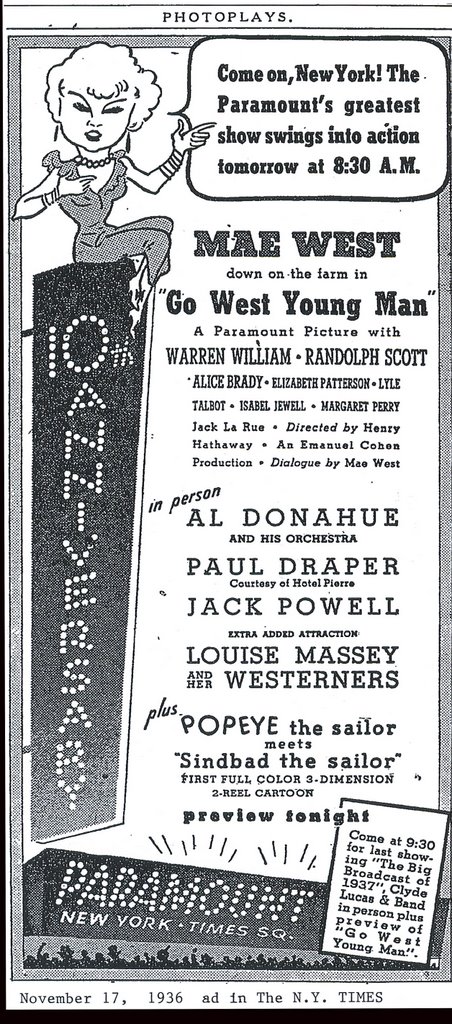
• • Mae West liked LaRue and fished him into "Go West, Young Man" [released in November 1936]. They also worked together on other theatre projects, for instance, on Mae's theatrical production: Sextette. This comedy - - about a woman with many ex-husbands - - opened on 7 July 1961 at Edgewater Beach Playhouse in Chicago. Jack LaRue played one of her former spouses, an American gangster.
• • In 1973, when the Masquers Club honored Mae West with a "Mae Day" tribute, the ceremony was attended by Jack LaRue, George Raft, Jack Noland, and others.
• • Jack LaRue died [11 January 1984 in Santa Monica, California] of a heart attack at age 82.
_______________________________
Source:http://maewest.blogspot.com/atom.xml
Add to Google

• • Photo: Mae West ad • • Jack LaRue • • 1930s • •

Mae West.

Friday, October 06, 2006

Mae West & Rafaela Ottiano

Since October is "Italian Culture Month" in New York and other cities, it is the season to highlight an Italian actress who worked with MAE WEST.

• • Rafaela Ottiano [born 4 March 1888 in Venice, Italy] was part of the original Broadway cast when MAE WEST brought her hit "Diamond Lil" to the Royale Theatre in April 1928.
Onstage Rafaela Ottiano played Rita; her co-conspirator Juarez was played by Jack La Rue. The willowy brunette [height: 5' 5½"] reprised her role in the film version: She Done Him Wrong opposite Gilbert Roland, who was born in Mexico though cast as a manipulative Muskovite.
For the movie, the Hays Office changed the ethnicity of the villains from Spanish to Russian.
• • After establishing herself on the Italian stage, actress Rafaela Ottiano came to American films in 1924. During the talkie era, Ottiano specialized in sinister, spiteful characterizations. As the aging trollop Russian Rita in She Done Him Wrong (1933), she meets a well-deserved end at the hands of Mae West.
• • In The Devil Doll (1935), Ottiano makes clear her plans to exploit her scientist husband's "miniaturization" process by hissing malevolently, "We'll make the whole world small!" A somewhat more benign Rafaela Ottiano can be seen in Grand Hotel (1932), in which she plays the overprotective maidservant of ballerina Greta Garbo, and Curly Top (1935), in which her sour severity melts when exposed to the relentless sunshine exuded by Shirley Temple.
• • Rafaela Ottiano lived in the Times Square area during the Prohibition Era. She never married.
• • Ottiano died [18 August 1942 in East Boston, Massachusetts] of intestinal cancer at age 54.
_______________________________
Source:http://maewest.blogspot.com/atom.xml
Add to Google

• • Photo: Mae West • • Rafaela Ottiano • • 1933 • •

Mae West.

Thursday, October 05, 2006

Mae West & Dom DeLuise

Since October is "Italian Culture Month" in New York and other cities, it is the season to focus on some Italian-American actors who worked with MAE WEST.

• • Brooklyn native Dominick "Dom" DeLuise was born 1 August 1933 to Italian American parents Vicenza and John DeLuise.
• • Dom DeLuise, who has many movie credits to his name, was also seen in Sextette [1978]. Released by Crown International, this musical comedy starred Mae West. Others in the cast included Timothy Dalton, Tony Curtis, Ringo Starr, George Hamilton, Alice Cooper, and Walter Pidgeon.
• • Dom DeLuise also played host in the documentary film "Mae West . . . and the Men Who Knew Her."
_______________________________
Source:http://maewest.blogspot.com/atom.xml
Add to Google

• • Photo: Mae West • • Dom DeLuise • • 1978 • •

Mae West.

Wednesday, October 04, 2006

Mae West: October 1928

October 1928: MAE WEST, still starring on Broadway as "Diamond Lil," making the most of her success even though her play "Pleasure Man" at the Biltmore Theatre had been shut down by the police on 2 October 1928, was often interviewed.
Learn how Samuel Marx, a frequent backstage visitor, described actress MAE WEST.
• • • • • • • • Prominent among those who have written their names in fire on Broadway is that of Mae West. ... She is both an actress of peculiar merit, and an authoress of ability, although her talent has been directed into unpleasant fields. ...
• • Although her weight now is well around 200 lbs., she can still do a passable tap-dance. A blonde, short woman, she possessed a slow, fascinating drawl. Her reputation as an entertainer has grown rapidly in the past decade. ...
• • Her favorite expression is "Doncha know?" which she appends to almost every sentence she speaks. ...
• • She is a frank woman about her love affairs. Each night after the performance her dressing room would be swamped by society folk from Fifth Avenue's swanky 400, eager to meet this "creature." Miss West entertained backstage impartially, for blue-bloods and lesser admirers. It was not at all unusual for her to make her guests comfortable in her dressing room, and then proceed to remove her outer garments in their astonished presence. A stout woman, she found the tight-laced corsets of the period she acted [1890s] almost unbearable, and after stripping herself down to black underwear would sit down to chat. It was nothing if not unconventional. . . . [to be continued]
• • Source: Wild Women of Broadway by Samuel Marx [1929]
_______________________________
Source:http://maewest.blogspot.com/atom.xml
Add to Google

• • Photo: Mae West • • "Diamond Lil" • • 1928 • •

Mae West.

Tuesday, October 03, 2006

Mae: Autumn of Tears

MAE WEST cherished immutability.
• • Charles Darwin may have challenged the fixity of species, however, Mae made up her mind that she would only play characters who were in their twenties - - women who were sexy, ambitious, sought after, in control, and decorated with diamonds.
• • The autumn of 1964 brought Mae face to face with her fears: mortality and mutability.
• • Though Mae had taken good care of her health, shortly after her 71st birthday she was hospitalized and her ailments were scrutinized. The diagnosis: diabetes.
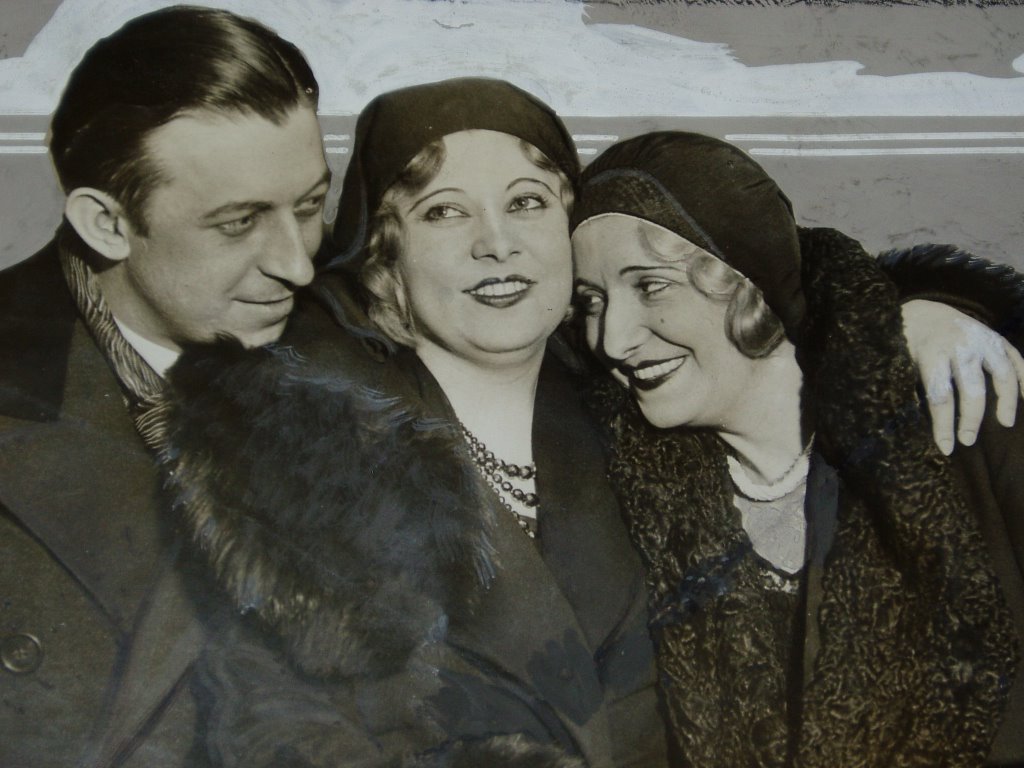
• • As Mae was quietly convalescing at home, with Paul Novak at her side, she received terrible news. Her beloved brother John Edwin West, 64, had a massive heart attack.
• • As he matured, her kid brother's career had stalled. More than once, he had turned to his movie-queen sister for assistance. But Mae also remembered how much she had counted on John's unfailing loyalty during her court trials. In 1930, for instance, when the
Pleasure Man trial at Jefferson Market Court had bankrupted her, and she was too upset to seek work, John supported his two unemployed sisters and set up a nice household for the three of them in an apartment building on West 57th Street (across the street from Carnegie Hall).
• • Born on 11 February 1900, John Edwin West died during October 1964. Mae made arrangements for his body to be sent back to Brooklyn to the family crypt.
• • Two weeks later, Mae - - who hated to think about death - - made a Will.
_______________________________
Source:http://maewest.blogspot.com/atom.xml
Add to Google

• • Photo: Mae West • • with her brother and sister (all wearing mourning for their mother) • • during the
Pleasure Man trial at Jefferson Market Court House in March 1930 • •

Mae West.

Monday, October 02, 2006

Mae West's Launchpad: LeBaron

By October 2nd, 1911 MAE WEST had a fistful of glowing reviews commenting on her Broadway debut. Imagine how it feels to be an 18-year-old vaudevillian — — crowned by that first Broadway success.
• •
The New York Sun wrote that she "danced with considerable grace and agility" doing The Philadelphia Drag (a ragtime parody). "A girl named Mae West, hitherto unknown, pleased by her grotesquerie and a snappy way of singing and dancing," observed The New York Times. The New York Tribune was also smitten, applauding Mae West for showing "a bit of a sense of nonsense, which is the very latest addition to wit." And though Variety's churlish critics usually savaged Mae West in their pages, this time a reviewer gold-stamped her act: "She danced in Turkish harem trousers in a most energetic, amusing, and carefree manner" [23 September 1911].
• • The show was
A La Broadway and Hello Paris. It opened on 22 September 1911 at the Folies Bergere, a beautiful venue that, unfortunately, did not have enough seating to make such a costly production pay off. Over budget and under-attended, the revue closed after eight performances. Fortunately, Lee and J.J. Shubert were in the house on opening night, enjoying Mae's rosy splashdown across the major New York City newspapers.
• •
A La Broadway was written by William LeBaron [16 February 1883 — 9 February 1958]. Neither the 28-year-old LeBaron nor the 18-year-old actress could suspect how important they would become to each other's careers, but they were meant to click.
Why? Because William LeBaron appreciated a laughmeister who could improve on a role. And Mae West loved to polish a line 'til it glowed.
• • At first, Mae had not been pleased with her anemic role as Maggie O'Hara, an Irish maid, nor with the fact that a comedy duo who was supposed to accompany her number couldn't deal with their props. But Mae always met her material halfway. After delivering a sassy send-up of the servant in a broad Irish brogue, and after getting applause for the novelty she sung — — "
They Are Irish" — — she was ready for her encore.
• • Secretly, during rehearsals, Mae had written extra choruses in various Irish dialects for her production numbers. When she was called back for seven encores, she stunned the producers (and ticket-holders) by having a new verse ready for each. LeBaron, who had written this satire, applauded Mae's creativity.
• • Let's back up and introduce him properly. American producer William LeBaron left New York University with the desire to be a playright. This dream came to fruition, after which LeBaron signed on as managing editor of
Collier's magazine. His instinctive sense of what constituted a good story enabled LeBaron to take charge of the East Coast branch of Famous Players/ Lasky Studios in 1924.
• • Film historians claim that William LeBaron had an overriding fascination with low comedians, especially W.C. Fields — — whom LeBaron insisted upon starring in silent films even though Fields was hardly big box office at the time. In 1928, LeBaron moved to FBO Studios, which evolved into RKO Radio, the company where LeBaron served as vice president in charge of production from 1929-1932. A disagreement with the RKO brass immediately led LeBaron back to Famous Players, which was now formally known as
Paramount Pictures. In 1932, he was an associate producer there.
• • Once more, LeBaron pushed W.C. Fields on the public, this time with more success. With a few hits under his belt, LeBaron was also in a position to nurture the screen career of Mae West.
• • In 1932, two years after
Diamond Lil played in Los Angeles, Mae West was back in Hollywood to make her first movie: Night After Night, George Raft's first starring picture. William LeBaron, the producer, gave her permission to rewrite her own role. Mae made sure her brief scenes dazzled movie-goers.
• • By December 1932, Mae was in front of the cameras again. This time she was starring in
She Done Him Wrong. Lowell Sherman was Mae's director and LeBaron was the producer. When he produced I'm No Angel, LeBaron also assigned Cary Grant to play Jack Clayton, Tira's major love interest.
• • When he was a producer at RKO, LeBaron won an Oscar for Best Picture 1930 — 1931:
Cimarron.
• • When he was at Paramount, LeBaron was nominated for an Oscar for Best Picture 1932 — 1933:
She Done Him Wrong.
• • With the departure of Ernst Lubitsch, LeBaron became Paramount's chief of production in 1936, a post he held until 1941. Five years later, he set up an independent unit at 20th Century-Fox. William LeBaron's final production, released through United Artists, was the film
Carnegie Hall [1947].
_______________________________
Source:http://maewest.blogspot.com/atom.xml

Add to Google

• • Photo: Mae West • • on the set with actor Cary Grant and producer William LeBaron • • December 1932 • •

Mae West.